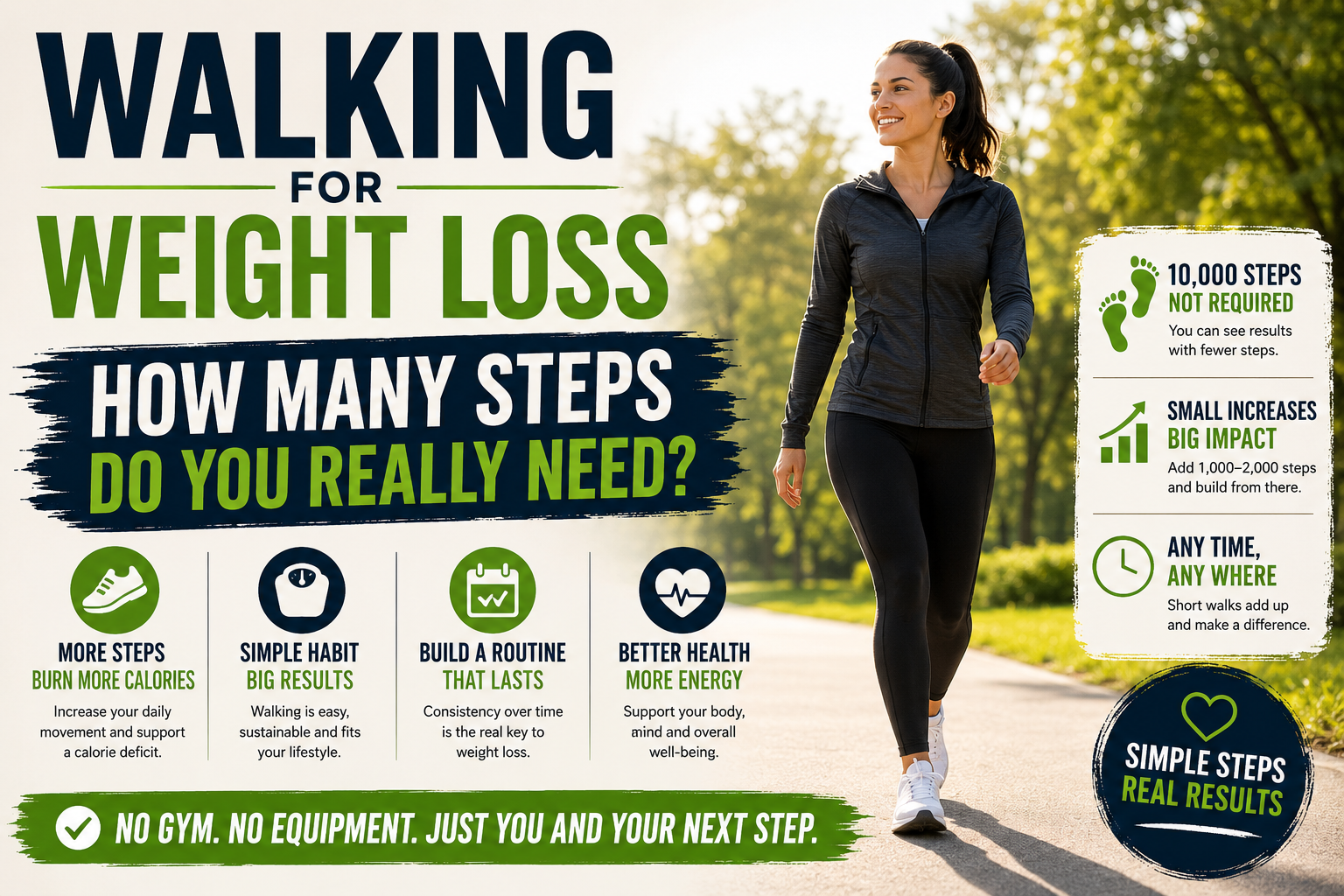
Walking for weight loss may be one of the simplest strategies you can add to your daily routine. You do not need a gym membership, complicated equipment, or an exhausting workout plan. You simply need to move more consistently.
But one question comes up again and again:
How many steps a day do you actually need to lose weight?
Is 10,000 steps really the magic number? Can 5,000 steps be enough? And does walking actually help if your goal is fat loss?
The answer is more encouraging than you might think. There is no single step count that guarantees weight loss. What matters most is how walking fits into your overall activity level, food intake, calorie balance, and — most importantly — a routine you can maintain.
Does Walking Help With Weight Loss?
Yes. Walking can support weight loss because it increases the amount of energy you use throughout the day.
Weight loss ultimately requires an energy deficit. In simple terms, over time your body needs to use more energy than you consume.
You can create that deficit by eating less, moving more, or — usually most realistically — combining both.
Walking for weight loss is particularly useful because it is relatively easy to recover from and can be repeated frequently. Instead of trying to burn hundreds of calories through occasional exhausting workouts, you can gradually increase your everyday movement.
Regular physical activity is also part of broader health recommendations. You can learn more about the benefits of physical activity from the Centers for Disease Control and Prevention.
If you want to understand the relationship between movement, food intake, and weight loss in more detail, read our guide to calorie deficit vs intermittent fasting.
How Many Steps a Day for Weight Loss?
There is no universal number of daily steps that automatically causes weight loss.
Your ideal target depends on factors such as:
- your current activity level,
- body size,
- walking speed,
- diet,
- overall calorie intake,
- other physical activity, and
- how consistently you walk.
For someone currently averaging only 3,000 or 4,000 steps per day, increasing immediately to 10,000 may not be necessary.
A more practical approach might be to increase your current average by 1,000–2,000 steps per day and maintain that level before increasing it again.
That turns walking into a habit rather than another short-lived challenge.
Do You Really Need 10,000 Steps a Day?
No. The famous 10,000-step target is not a biological threshold where weight loss suddenly begins.
You can benefit from walking well below 10,000 steps per day, especially if it represents a meaningful increase from your previous activity level.
Think of 10,000 steps as a possible target rather than a requirement.
For example, imagine someone who normally walks about 4,000 steps each day.
If that person consistently increases their average to 6,000 or 7,000 steps, that is a substantial increase in weekly movement — even though they never reach 10,000.
Progress matters more than hitting an arbitrary number.
A Simple Step Goal for Beginners
Instead of choosing your target based on what someone else is doing, start with your own baseline.
Track your normal activity for several days without deliberately trying to walk more. Most smartphones and smartwatches can estimate your daily step count automatically.
Then calculate your approximate average.
From there, try something like this:
- Current average: 3,000 steps → aim for 4,000–5,000.
- Current average: 5,000 steps → aim for 6,000–7,000.
- Current average: 7,000 steps → aim for 8,000–9,000.
- Already near 10,000 → focus on consistency, pace, duration, or other parts of your weight-loss routine.
These are practical examples rather than strict prescriptions.
The important principle is simple:
Start where you are and gradually move more.
How Many Calories Does Walking Burn?
There is no accurate universal “calories per 1,000 steps” number.
The amount of energy you use while walking depends on several variables, including your body weight, speed, distance, terrain, incline, and walking efficiency.
A brisk uphill walk is very different from slowly walking around a supermarket, even if your step counter records a similar number of steps.
This is why it is usually better to use step counts as a behavior target rather than trying to calculate exactly how many calories every walk burns.
Walking and Your Calorie Deficit
This is where walking becomes especially useful for weight management.
Imagine two approaches.
In the first, you try to create your entire calorie deficit by dramatically reducing food intake.
In the second, you make reasonable adjustments to your diet while also increasing your daily movement.
For many people, the second approach feels much more manageable.
For many people, walking for weight loss is especially useful because it increases daily activity without requiring another demanding workout.
Walking does not replace nutrition. Instead, it gives you another tool for increasing daily energy expenditure without necessarily requiring intense exercise.
Over weeks and months, those extra walks can add up.
Walking vs. Intense Exercise for Weight Loss
Running, cycling, strength training, and other forms of exercise can all be useful.
But harder is not automatically better.
The biggest advantage of walking is often its simplicity.
You can walk:
- before work,
- during a lunch break,
- after dinner,
- while talking on the phone,
- while listening to a podcast, or
- when running short errands.
You do not necessarily have to schedule a formal “workout.”
That makes walking easier to integrate into everyday life — and consistency is extremely important when your goal is long-term weight management.
Is Brisk Walking Better for Weight Loss?
Walking faster generally increases the intensity of your activity.
But that does not mean every walk needs to become a workout.
When using walking for weight loss, you do not need every walk to be fast or intense.
A useful strategy is to combine ordinary daily movement with some purposeful brisk walking.
For example, you might accumulate most of your steps naturally throughout the day and add a dedicated 20- or 30-minute walk when your schedule allows.
You can also gradually increase your pace as your fitness improves.
Try a 10-Minute Walk After Meals
One of the easiest ways to increase your daily step count is to attach walking to something you already do every day.
Meals provide an obvious trigger.
Instead of telling yourself, “I need to walk more,” create a specific rule:
After dinner, I walk for 10 minutes.
If your schedule allows, you could do the same after lunch.
Two short walks can feel much easier than trying to find time for one long exercise session.
More importantly, you are connecting the new behavior to an existing routine.
Walking Works Better When It Becomes a Habit
A perfect walking plan that you follow for five days is less useful than a reasonable plan you can follow for months.
The real advantage of walking for weight loss appears when walking becomes part of your normal daily routine.
This is why we focus so much on routines at Routine Made Simple.
Instead of depending on motivation, make walking part of something you already do.
For example:
- walk immediately after lunch,
- park slightly farther from your destination,
- take a short walk after finishing work,
- walk while making phone calls, or
- use an evening walk as the end of your workday.
If building habits is difficult for you, our guide on how to build a habit without relying on motivation explains this approach in more detail.
Walking and Intermittent Fasting
If you already practice intermittent fasting, walking can fit naturally into the same simple routine.
You do not need to treat walking as a way to “earn” food or compensate for what you ate.
Instead, think of intermittent fasting and walking as two separate behaviors that may help you structure your day.
For example, someone following a 16:8 schedule might take a morning walk, eat during their normal eating window, and take another short walk after dinner.
If you are new to fasting, start with our beginner’s guide to intermittent fasting rather than trying to change everything at once.
Don’t Try to Change Everything at Once
This is one of the most common mistakes people make when trying to lose weight.
They decide that tomorrow they will:
- eat perfectly,
- fast for 16 hours,
- walk 10,000 steps,
- start exercising,
- stop eating sugar, and
- drink more water.
That might work for a few enthusiastic days.
Then normal life returns.
A better strategy is to build one or two behaviors first.
Maybe your first goal is simply:
Walk 2,000 more steps than your current average and keep doing it consistently.
Once that feels normal, you can decide what to improve next.
A Simple Walking for Weight Loss Routine
You do not need a complicated program. Here is a simple example:
Morning: 5–10 minutes of walking if your schedule allows.
During the day: Look for opportunities to accumulate additional steps instead of sitting whenever possible.
After lunch: Take a short walk.
After dinner: Walk for 10–20 minutes.
Weekly goal: Focus on your average daily steps rather than worrying about one unusually inactive day.
This approach is not dramatic.
That is exactly the point.
What If You Miss Your Step Goal?
Nothing terrible happens.
One low-activity day does not ruin your progress any more than one long walk guarantees weight loss.
Look at the trend.
If your target is 7,000 steps and one day you only manage 4,500, simply return to your normal routine the next day.
Avoid turning one imperfect day into an abandoned plan.
Should You Walk Every Day?
Walking can usually be incorporated frequently because it is relatively low-impact compared with many forms of intense exercise.
However, your appropriate activity level depends on your fitness, health, mobility, and individual circumstances.
If you have an injury, medical condition, significant pain, or have been advised to limit physical activity, discuss changes in your exercise routine with an appropriate healthcare professional.
So, How Many Steps Do You Really Need?
Probably not a magical number.
If you are currently inactive, even a relatively modest increase in your daily steps can represent meaningful progress.
Instead of asking:
“Do I need 10,000 steps?”
Ask:
“How can I consistently move a little more than I do now?”
That question is far more useful.
Start with your current average. Add a realistic amount. Keep doing it. Then increase your target when the new level starts to feel normal.
The best walking for weight loss plan is not necessarily the one with the highest step target — it is the one you can repeat consistently.
The Bottom Line
Walking for weight loss works best as part of a larger, sustainable routine.
You do not need to obsess over reaching exactly 10,000 steps every day. Walking helps increase daily movement and energy expenditure, but nutrition and your overall calorie balance still matter.
Start with a realistic increase in your current activity instead of chasing someone else’s step target.
The goal is not to create the hardest routine possible.
The goal is to create one you can still be following months from now.
Want a Simple Routine You Can Actually Follow?
If you are trying to combine better daily habits, intermittent fasting, and weight management without making your life revolve around dieting, start with something simple.
Download our FREE 7-Day Simple Routine Guide.
It gives you a practical starting point for building a simple 16:8 routine one step at a time — without trying to change everything overnight.
Individual weight-loss results vary. This article is for general educational purposes and is not a substitute for individualized medical or nutritional advice.