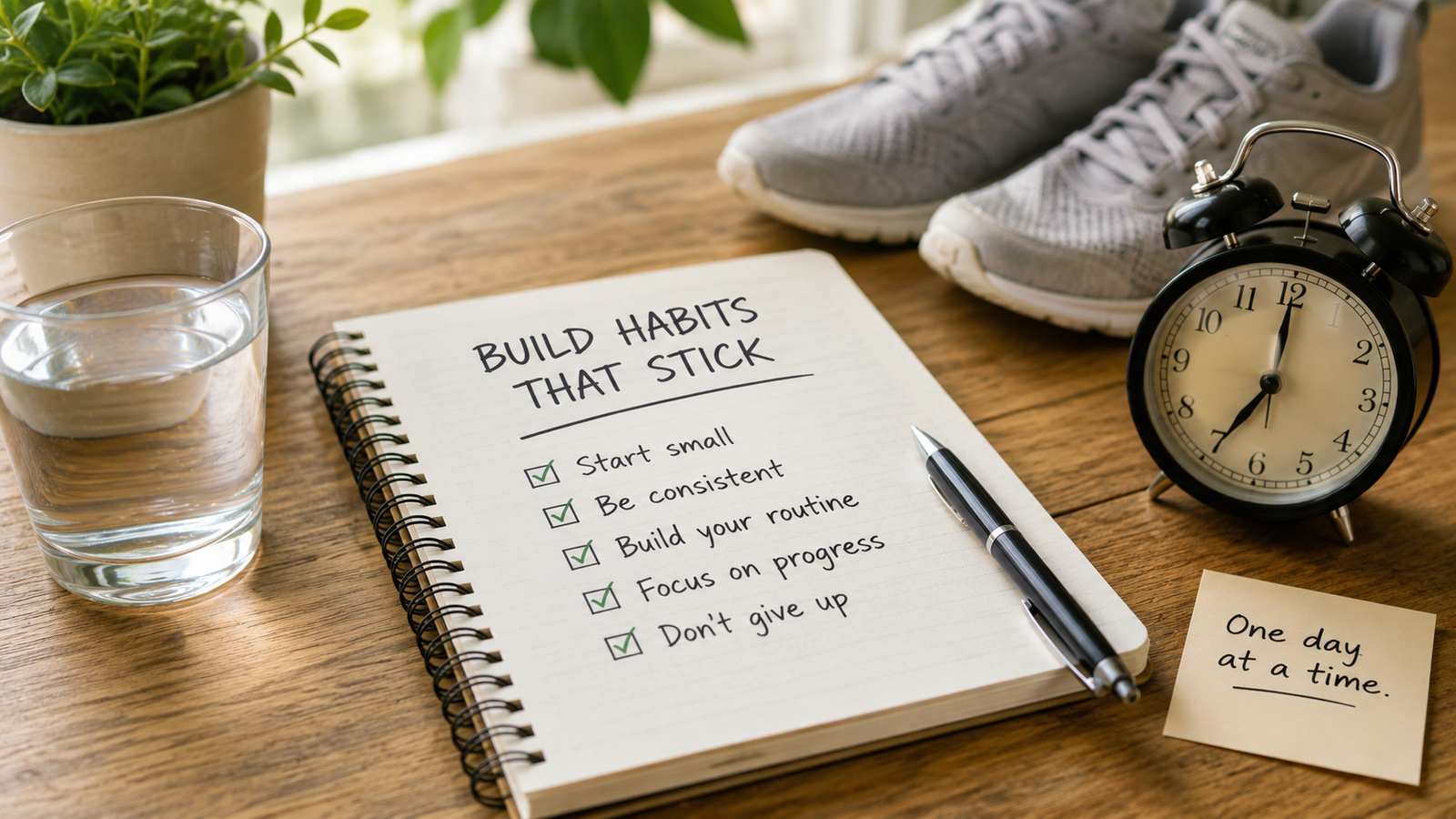
Motivation can be useful when you are starting something new. The problem is that motivation is not equally strong every day.
Some mornings you feel ready to change everything. On other days, even a simple healthy choice can feel like extra work.
If you want to learn how to build a habit that actually lasts, the goal should not be to stay motivated forever. A better approach is to create a behavior that is simple, clear and easy enough to repeat even when motivation is low.
That is when a healthy action starts becoming a normal part of your routine instead of something you constantly have to force yourself to do.
Table of Contents
- Why Motivation Is Not Enough
- How to Build a Habit: Start Smaller Than You Think
- Give Your Habit a Clear Trigger
- Make the Healthy Choice Easier
- Attach the New Habit to Something You Already Do
- Intermittent Fasting Is Also a Habit
- Use Fixed Points in Your Day
- Where Feel Great Fits Into My Routine
- Do Not Let One Bad Day Become a Bad Month
- Consistency Matters More Than Perfection
- Track the Habit Before You Optimize It
- Create a Minimum Version for Difficult Days
- Do Not Add the Next Habit Too Quickly
- What to Do When Motivation Disappears
- A Simple 7-Day Habit Experiment
- How to Build a Habit That Lasts
Why Motivation Is Not Enough
Think about habits you already perform without much thought.
You probably do not need motivation to brush your teeth, make coffee, check your phone or lock the door when you leave home.
Those behaviors are connected to familiar situations and repeated often enough that they require very little decision-making.
New habits are different.
At first, they require conscious effort. This is why people often depend on motivation during the first few days.
You may feel motivated after seeing progress, reading an inspiring story or deciding that Monday will finally be different.
But eventually normal life returns.
You get busy. You sleep badly. Your schedule changes. You have a stressful day.
A habit that depends entirely on motivation often disappears at exactly that point.
A habit built around a simple structure has a much better chance of surviving ordinary days.
Research on habit formation supports the idea that repeating a behavior in a consistent context can gradually make it feel more automatic. The National Institute of Diabetes and Digestive and Kidney Diseases also describes healthy behavior change as a process that develops over time rather than a single decision.
How to Build a Habit: Start Smaller Than You Think
One of the most common mistakes when learning how to build a habit is trying to change too much at once.
Someone decides to start eating better, exercise every day, drink more water, stop eating sugar, walk 10,000 steps and begin intermittent fasting — all at the same time.
None of those goals is necessarily bad.
The problem is that you have created a routine with too many opportunities to fail.
Instead, start with something smaller.
- Walk for 10 minutes after dinner.
- Drink one glass of water after waking up.
- Add a source of protein to your first meal.
- Stop eating 30 minutes earlier in the evening.
- Prepare one part of tomorrow’s meal in advance.
You can always expand a small habit later.
First, prove that you can repeat it.
A habit does not need to be impressive. It needs to be repeatable.
Give Your Habit a Clear Trigger
“I will drink more water” is a good intention, but it does not tell you exactly when the behavior should happen.
Compare that with:
“After I make my morning coffee, I will drink a glass of water.”
Now the new behavior has a clear trigger.
You can use the same approach with many healthy habits:
- After lunch → take a 10-minute walk.
- After brushing your teeth → prepare your clothes for tomorrow.
- When you sit down for your first meal → include a protein source.
- After dinner → begin your overnight fasting window.
The existing part of your day becomes a reminder for the new action.
This is much easier than hoping you will remember a vague intention at some point during a busy day.
Make the Healthy Choice Easier
Your environment plays an important role in whether a habit is easy or difficult to maintain.
If the healthy behavior requires several decisions and several minutes of preparation, while the easier alternative is immediately available, consistency becomes harder than it needs to be.
Try reducing the friction.
If you want to walk in the morning, prepare your shoes the night before.
If you want to drink more water, keep a bottle where you spend most of your day.
If you want to make better food choices, decide what your next meal will be before you become extremely hungry.
If you want to reduce evening snacking, avoid keeping your usual trigger foods directly in front of you.
These changes do not guarantee perfect behavior.
They simply make the behavior you want easier to perform.
Attach the New Habit to Something You Already Do
A simple way to make a habit stick is to connect it with something that already happens reliably.
Instead of creating a completely new event in your day, place the new action next to an established routine.
For example:
- Morning coffee → fill your water bottle.
- Lunch → take a short walk afterward.
- Dinner → prepare something for tomorrow.
- Brushing your teeth → put your phone away for the night.
The exact actions are less important than the principle.
Use something consistent to remind you of something new.
This is one of the simplest answers to the question of how to build a habit without constantly relying on willpower.
Intermittent Fasting Is Also a Habit
Intermittent fasting is usually discussed as an eating schedule, but it can also be viewed as a daily habit.
If you decide every evening when to stop eating and every morning when to start again, you are making the same decisions repeatedly.
A consistent schedule can remove some of those decisions.
For example, someone following a 16:8 schedule may usually finish the final meal at roughly the same time and eat the first meal at roughly the same time the following day.
After a while, the timing becomes familiar.
That does not mean everyone needs to follow 16:8. A 12:12 or 14:10 schedule may be easier and more appropriate for someone who is just getting started.
If you are new to fasting, our beginner’s guide to intermittent fasting explains how to choose a fasting window without immediately making the routine unnecessarily difficult.
Use Fixed Points in Your Day
Healthy routines often become easier when individual behaviors stop feeling like unrelated tasks.
Instead, they become parts of a sequence.
A simple morning sequence could be:
- wake up,
- drink water,
- prepare your usual morning drink,
- start your normal day.
An evening sequence might be:
- eat dinner,
- clean the kitchen,
- begin the overnight fasting period,
- prepare for the following morning.
Once one action naturally leads to the next, the routine requires fewer decisions.
And fewer decisions can make consistency easier.
Where Feel Great Fits Into My Routine
This is also how I prefer to think about the Feel Great products I use.
I do not want a complicated collection of things I have to remember at random times throughout the day.
Instead, each product has a specific place inside an existing routine.
Unimate is part of my earlier-day routine, while Balance is connected with my main meals.
The products do not create the habit for me, and they do not replace the fundamentals of sensible eating or weight management.
What I like about the structure is simply that I do not have to keep deciding when everything happens.
If you want to understand how the two products fit into the overall approach, read Unimate and Balance: Two Different Roles in a Practical Feel Great Routine.
Do Not Let One Bad Day Become a Bad Month
At some point, you are going to miss a habit.
You may skip the walk.
You may eat differently than planned.
You may stay up too late.
You may break your fasting window earlier than expected.
That does not mean the routine has failed.
The bigger mistake is allowing one unusual day to become a reason to abandon the habit completely.
Instead of thinking:
“I ruined everything.”
Ask yourself:
“What is the next normal action?”
If yesterday did not go according to plan, you do not need an extreme correction today.
You simply need to return to the normal routine.
Consistency Matters More Than Perfection
When people start a new routine, they often imagine that success means following it perfectly.
But perfection is a difficult standard to maintain in real life.
Consistency is different.
If you follow a useful habit most of the time and return to it quickly after disruptions, you are still building something valuable.
This is especially important with habits related to food, activity and weight management.
A single meal does not determine your results.
A single missed walk does not determine your fitness.
A single shortened fasting day does not determine whether the overall routine works for you.
The pattern over time matters much more than one individual day.
Track the Habit Before You Try to Optimize It
You do not need a complicated tracking system when you are starting.
A simple checkmark can be enough.
For the first few weeks, ask:
- Did I do the behavior?
- Was it easy enough to repeat?
- What made it difficult?
- Can I remove one obstacle?
You are looking for patterns.
If you repeatedly fail to perform a habit, do not immediately assume that you lack discipline.
The habit may simply be too large, badly timed or inconvenient.
Before demanding more motivation from yourself, see whether you can improve the system.
Create a Minimum Version for Difficult Days
Some days will be easier than others.
This is why it helps to create a minimum version of your habit.
If your normal plan is a 30-minute walk, your minimum version might be 10 minutes.
If your normal plan is preparing a balanced dinner, the minimum might be choosing the simplest reasonable meal available instead of abandoning the plan completely.
If you are gradually building an overnight fasting routine, the minimum might be returning to a comfortable 12-hour fasting window rather than deciding that the entire routine is over.
The minimum version keeps the habit alive without requiring perfect circumstances.
When people ask how to build a habit that survives busy or stressful days, having this smaller backup version can be especially useful.
Do Not Add the Next Habit Too Quickly
Once a new habit starts going well, it is tempting to immediately add several more improvements.
Be patient.
Give the first behavior time to become familiar.
Then add another small action.
For example:
- Establish a consistent overnight break from eating.
- Improve the structure of your first meal.
- Add a regular walk.
- Improve another part of your daily routine.
None of these changes looks dramatic on its own.
But after several months, a collection of small habits can create a very different lifestyle without requiring one huge lifestyle overhaul.
What Should You Do When Motivation Disappears?
Expect it to happen.
You do not need to fix your motivation every time you feel less enthusiastic.
Instead, examine the structure of the habit.
Ask yourself:
- Is the behavior small enough?
- Does it have a clear trigger?
- Is my environment helping me?
- Am I trying to change too many things at once?
- Do I have a minimum version for difficult days?
If those pieces are in place, you may be able to continue the routine even after the excitement of starting something new has disappeared.
A Simple 7-Day Habit Experiment
If you want to put this into practice, do not redesign your entire life today.
Choose one small behavior.
Then use this formula:
After [something I already do], I will [small behavior].
For example:
After dinner, I will walk for 10 minutes.
Try it for seven days.
At the end of the week, ask yourself whether the behavior was easy enough to repeat.
If it was, continue doing it or make it slightly bigger.
If it was not, reduce the size of the habit or change its trigger.
That is usually more useful than waiting for another burst of motivation.
How to Build a Habit That Lasts
If you remember only a few ideas from this article, remember these:
- Start smaller than you think you need to.
- Give the habit a clear trigger.
- Make the desired behavior easier.
- Connect it with something you already do.
- Create a minimum version for difficult days.
- Return to the routine quickly after a missed day.
- Add complexity only after you have consistency.
Motivation can help you start.
But if you really want to understand how to build a habit that lasts, focus less on how inspired you feel today and more on whether the behavior is simple enough to repeat tomorrow.
You do not need to build a perfect day. Build a normal day that moves you in the right direction.
Frequently Asked Questions
How long does it take to build a habit?
There is no single number that applies to everyone. The time required depends on the behavior, the person and how consistently the action is repeated. Simple behaviors may become familiar faster than more complex lifestyle changes.
Can you build a habit without motivation?
Motivation can help you begin, but it does not need to stay high forever. Clear triggers, repetition and making the behavior easy to perform can reduce how much you depend on motivation.
What is the easiest way to build a healthy habit?
Start with one small action, connect it to something you already do and repeat it in a similar situation. Once the behavior feels normal, you can gradually expand it.
What should I do if I miss a day?
Return to your normal routine at the next reasonable opportunity. One missed day is usually much less important than allowing a temporary disruption to become a reason to stop completely.
Important: This article is for general educational purposes and is not medical advice. If you have a medical condition, take medication, are pregnant or breastfeeding, or have a history of disordered eating, speak with an appropriate healthcare professional before making significant changes to your diet, fasting routine or supplement use.