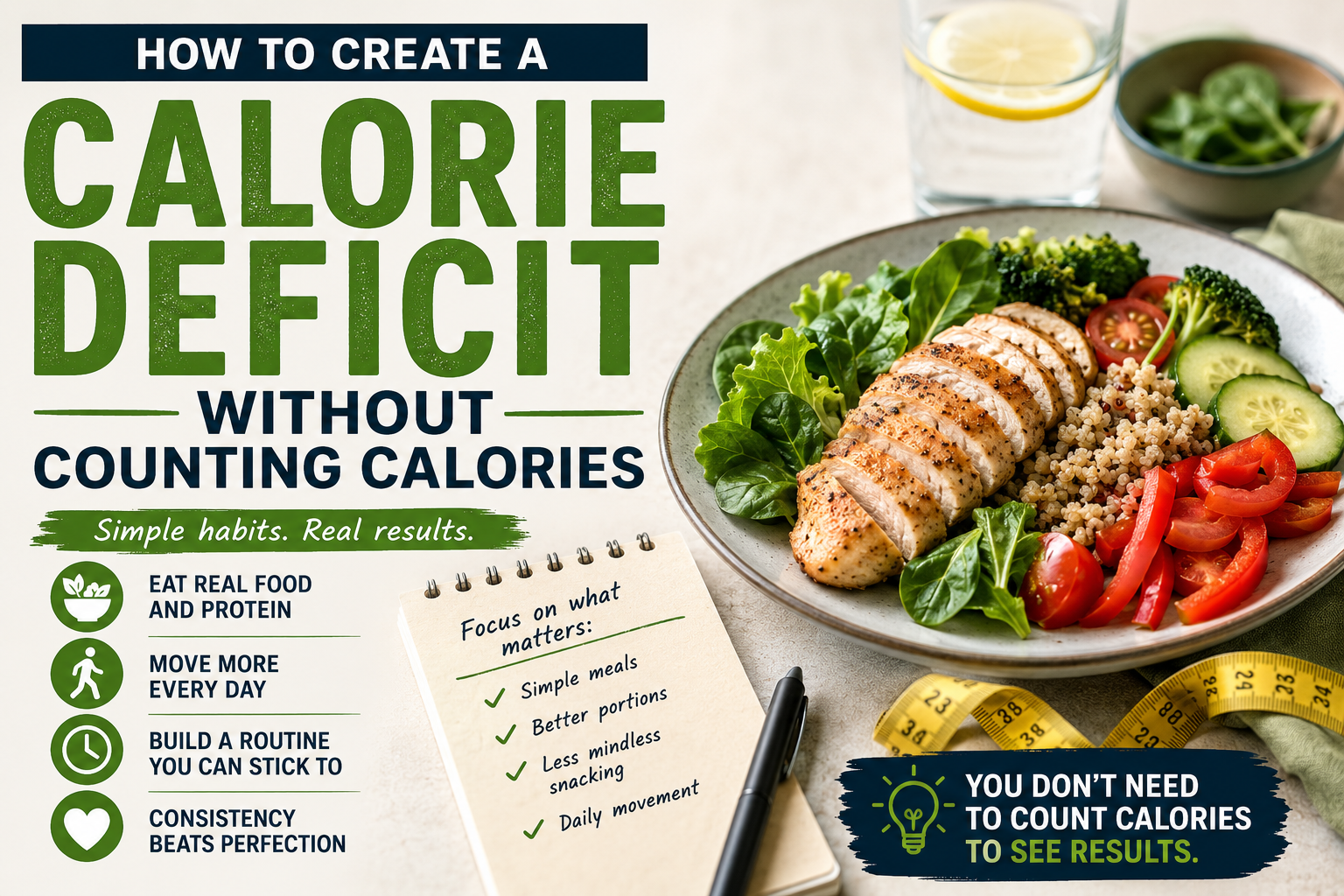
Creating a calorie deficit without counting calories is possible — and for many people, it may be easier to maintain than tracking every meal, weighing every ingredient, and constantly checking an app.
A calorie deficit still matters for weight loss. Your body needs to use more energy than you consume over time. But that does not mean you need to know the exact calorie value of everything you eat.
Instead, you can build a few simple habits that naturally make it easier to eat less, move more, and stay consistent.
In this guide, we will look at how to create a calorie deficit without counting calories, which habits matter most, where walking and intermittent fasting may fit, and how to make the entire process simpler.
What Is a Calorie Deficit?
A calorie deficit simply means that your body is using more energy than you are consuming over time.
When that happens consistently, your body needs to draw on stored energy. This is why calorie balance remains an important part of weight management regardless of which diet or eating schedule you choose.
That does not mean calories are the only thing that matters.
Food quality, protein, fiber, activity, sleep, appetite, meal timing, portion size, and your ability to maintain a routine can all influence how easy or difficult it is to maintain that deficit.
If you want a deeper explanation of how calorie balance compares with fasting, read our guide to calorie deficit vs intermittent fasting.
Do You Have to Count Calories to Lose Weight?
No.
Counting calories is one way to manage food intake, but it is not the only way.
Some people enjoy tracking because it gives them clear numbers. Others find that weighing food, scanning labels, and logging every meal makes eating unnecessarily complicated.
If tracking helps you, there is nothing wrong with using it.
But if you dislike calorie counting, you can still create a calorie deficit without counting calories by changing the structure of your meals and daily routine.
The goal is to make behaviors that support a calorie deficit happen more naturally.
1. Build Meals Around Protein
One of the simplest changes you can make is to include a meaningful source of protein in your main meals.
Examples include eggs, fish, chicken, lean meat, Greek yogurt, cottage cheese, tofu, beans, lentils, or other foods that fit your dietary preferences.
Protein can make meals more substantial and can help you build a more structured eating pattern.
Instead of starting with the question:
“How many calories can I eat?”
Try starting with:
“What is my main protein source for this meal?”
That single question can improve the structure of your plate without requiring a food scale.
2. Eat More High-Fiber Foods
Fiber-rich foods can also make a simple eating routine easier to manage.
Vegetables, fruit, legumes, whole grains, seeds, and other fiber-rich foods generally take up more space on your plate and can help create meals that feel more substantial.
A simple practical approach is to make vegetables a visible part of lunch and dinner rather than treating them as an optional side dish.
You do not have to calculate the exact grams of fiber in every meal.
Focus on repeatedly choosing foods that naturally provide it.
3. Watch Liquid Calories
Drinks are one of the easiest places for calories to enter your routine without making you feel like you have eaten much.
Sugary soft drinks, sweetened coffees, juices, large specialty coffees, and other calorie-containing drinks can add up quickly.
If your goal is a calorie deficit without counting calories, simplifying your drinks is an easy place to start.
Water, unsweetened tea, and black coffee are simple options for many people.
You do not need to make every drink perfectly calorie-free. The idea is simply to become aware of how much energy you may be drinking without really noticing it.
4. Simplify Your Portions
You do not necessarily need a kitchen scale to reduce portions.
You can start with something much simpler.
Serve your normal meal, then slightly reduce the portion of the most calorie-dense part while increasing vegetables or another lower-energy, high-volume food.
You can also pause before automatically taking a second serving.
Give yourself a little time to decide whether you are genuinely still hungry or simply continuing because the food is available.
Small changes repeated every day can matter more than dramatic restrictions that last only a week.
5. Reduce Mindless Snacking
Many calories are not consumed because of physical hunger.
They happen while watching television, working at a computer, driving, feeling bored, or simply because food is nearby.
This does not mean snacks are bad.
But it can help to make eating more intentional.
Instead of continuously grazing throughout the day, try creating clearer meals and deciding when you genuinely want a snack.
One useful question is:
“Am I hungry enough to eat a proper meal, or do I simply want something to taste?”
That moment of awareness can make a surprising difference over time.
6. Make Highly Processed Foods Less Automatic
You do not have to completely eliminate your favorite foods.
That kind of all-or-nothing rule often makes a routine harder to maintain.
Instead, look at which foods you tend to eat automatically and in large amounts.
Cookies, chips, sweets, pastries, fast food, and similar highly palatable foods can be very easy to overeat.
The solution does not have to be permanent restriction.
Sometimes simply buying them less frequently or keeping smaller amounts at home changes how often you eat them.
Your environment matters.
7. Walk More Every Day
Creating a calorie deficit is not only about eating less.
Increasing your daily movement can also contribute to your overall energy expenditure.
Walking is particularly useful because it is accessible, simple, and easy to add to everyday life.
You might walk after lunch, take a short evening walk, park farther away, or simply look for opportunities to move more throughout the day.
If you want a practical starting point, read our complete guide to walking for weight loss.
You do not need a perfect 10,000-step target. Increasing your activity from your current baseline can already be a meaningful change.
8. Use Meal Timing as a Tool — Not a Rule
Some people find it easier to control food intake when they have a clearer eating schedule.
This is one reason intermittent fasting can be useful for certain people.
A 16:8 schedule, for example, gives you a defined eating window instead of eating from early morning until late at night.
That does not automatically create a calorie deficit.
You can still eat more energy than you need during an eight-hour eating window.
But a structured schedule may reduce opportunities for unnecessary snacking and make your routine easier to manage.
If fasting is new to you, read our beginner’s guide to intermittent fasting.
Where Feel Great Can Fit Into a Simple Routine
Some people prefer to make their routine even more structured by combining meal timing with the Feel Great system.
Feel Great is built around two products — Unimate and Balance — that can be incorporated into a repeatable daily routine rather than a complicated diet plan.
A simple example might look like this:
- Morning: Unimate as part of your morning routine.
- Eating window: Follow the meal schedule that works for you.
- Before your main meals: Use Balance according to the product directions.
- Daily movement: Add walking or another form of activity you can maintain.
The important distinction is that Feel Great should not be viewed as a substitute for the fundamentals of weight management.
A product does not magically cancel excess food intake, and no supplement can guarantee weight loss.
Instead, one practical advantage of a structured system is routine: having a repeatable framework that may be easier to follow day after day.
Want to Explore Feel Great?
If you would like to see the Feel Great products, pricing, and available options, you can visit the Feel Great shop below.
Disclosure: This page contains an affiliate link. If you purchase through this link, Routine Made Simple may earn a commission at no additional cost to you.
9. Stop Trying to Be Perfect
A sustainable calorie deficit without counting calories does not require perfect eating.
You can eat dessert sometimes.
You can have a restaurant meal.
You can have days when your routine does not go exactly as planned.
The problem usually begins when one imperfect meal turns into:
“I ruined everything, so I might as well start again Monday.”
You did not ruin anything.
Return to your normal routine at the next meal.
Consistency across weeks matters much more than perfection during one afternoon.
10. Make the Better Choice the Easy Choice
Willpower is unreliable.
Your environment is much more predictable.
If healthy food requires preparation while highly processed snacks are sitting directly in front of you, the easier option often wins.
So change the environment.
Keep foods you want to eat regularly easy to access. Prepare simple meals in advance. Keep water nearby. Decide when you are going to walk before the day gets busy.
Good routines reduce the number of decisions you need to make.
This is the same principle we discuss in our guide on how to build a habit without relying on motivation.
How Do You Know If You’re in a Calorie Deficit Without Tracking?
If you are not counting calories, you need another way to evaluate whether your routine is working.
The simplest approach is to look at trends over time.
Your body weight naturally moves up and down from day to day because of hydration, food volume, sodium intake, digestion, and other factors.
That is why a single weigh-in tells you very little.
Instead, look at your average trend across several weeks.
If your goal is weight loss and your average weight is gradually decreasing, your overall routine is likely creating an energy deficit.
If your weight remains essentially unchanged for several weeks, your current food intake and activity may be close to maintenance.
If that happens, you do not necessarily need to start counting every calorie.
You can first make one small adjustment.
Reduce a portion slightly. Remove one regular snack. Replace a calorie-heavy drink. Add another walk.
Then observe what happens.
How Fast Should You Lose Weight?
Faster is not automatically better.
Extreme restriction may produce rapid short-term changes, but it can also make a plan much more difficult to maintain.
For general information about healthy weight management and physical activity, you can review guidance from the Centers for Disease Control and Prevention.
Your appropriate rate of weight loss can depend on your starting weight, health, medications, activity level, and other individual factors.
If you have a medical condition, take medication that affects weight or appetite, or have specific nutritional needs, speak with an appropriate healthcare professional before making major changes.
A Simple Day Without Counting Calories
What might all of this look like in real life?
You could start your morning with your normal routine, keep drinks simple, and use a defined eating schedule if that works for you.
At your first meal, build the plate around protein, vegetables, and foods that make the meal satisfying.
After eating, take a short walk.
At dinner, use the same basic structure rather than trying to calculate the exact number of calories on your plate.
Keep unnecessary evening snacking from becoming automatic.
Then repeat.
There is nothing dramatic about this approach.
That is exactly why it can work as a routine.
What If Your Weight Stops Changing?
A plateau does not automatically mean that something is wrong.
As your body weight and activity change, the amount of energy you use can also change.
If your weight trend has remained unchanged for several weeks and you still want to lose weight, review your routine before making dramatic changes.
Look at portion sizes, snacks, drinks, restaurant meals, weekend eating, and daily movement.
Choose one area to improve.
Do not immediately cut everything at once.
The best adjustment is usually the smallest change that moves you in the right direction while still allowing you to maintain the routine.
Calorie Deficit Without Counting Calories: The Bottom Line
You absolutely can create a calorie deficit without counting calories.
The key is understanding that you are not avoiding calorie balance — you are simply managing it indirectly through your habits.
Build meals around satisfying foods. Include protein and fiber. Watch liquid calories. Reduce mindless snacking. Walk more. Use meal timing if it helps you. Make portions reasonable and create an environment that supports the choices you want to make.
Then watch the trend and adjust when necessary.
You do not need to turn every meal into a mathematics problem.
You need a routine simple enough to repeat.
Want to Make Your Routine Simpler?
If you want a practical starting point rather than another complicated diet plan, download our FREE 7-Day Simple Routine Guide.
It shows you how to structure a simple 16:8 routine one step at a time. And if you are ready to explore the Feel Great products, you can go directly to the shop.
Disclosure: The Feel Great link is an affiliate link. If you make a purchase through it, Routine Made Simple may earn a commission at no additional cost to you.
Individual results vary. This article is provided for general educational purposes and is not intended as medical or nutritional advice. Supplements are not a substitute for a balanced diet or appropriate medical care.