Most people know that eating too much can make weight loss harder.
The difficult part is knowing what “too much” actually looks like.
Restaurant portions are often large. Food packages can contain several servings. A handful of nuts can quietly become three handfuls. And even nutritious foods can make maintaining a calorie deficit difficult when portions gradually increase.
The good news is that you do not necessarily need to weigh every ingredient or track every calorie.
If you want to learn how to control portion sizes, a few simple habits can make your meals easier to manage without turning eating into a mathematics exercise.
Why Portion Size Matters for Weight Loss
Weight loss ultimately requires consuming less energy than your body uses over time.
That is the basic idea behind a calorie deficit.
But creating that deficit does not necessarily mean eating tiny meals.
A more useful approach is to build meals that provide enough food to feel satisfying while keeping calorie-dense foods in reasonable portions.
This distinction matters because the same number of calories can look very different depending on what is on your plate.
A meal containing protein, vegetables, fiber-rich carbohydrates and some healthy fat can occupy considerably more space than a similar number of calories from highly processed snack foods.
That is why learning how to control portion sizes works best when combined with smart food choices rather than simply trying to eat less of everything.
The Centers for Disease Control and Prevention recommends an eating pattern that emphasizes foods such as fruits, vegetables, whole grains and a variety of protein foods while staying within your calorie needs.
Portion Size vs Serving Size: What’s the Difference?
These two terms are often used interchangeably, but they do not mean exactly the same thing.
Serving size is a standardized amount listed on a nutrition label or used as a reference.
Portion size is the amount you actually choose to eat.
For example, a cereal package might list one serving as a specific number of grams. But if you pour a large bowl without measuring it, your actual portion could contain two or three servings.
Neither serving sizes nor portions need to dictate exactly how much you personally should eat. But understanding the difference can help explain why calories sometimes add up faster than expected.
How to Control Portion Sizes: 10 Simple Strategies
You do not need complicated rules to get started. Here are 10 practical strategies that can help you learn how to control portion sizes while still eating satisfying meals.
1. Start With Protein
When building a meal, decide on your protein source first.
That might be:
- eggs
- chicken or turkey
- fish
- lean meat
- Greek yogurt
- cottage cheese
- tofu or tempeh
- beans or lentils
Protein can help make meals more satisfying, which may make portion control easier later in the meal.
If this is something you struggle with, our guide to how to eat more protein gives several simple ways to increase protein intake without completely changing your diet.
2. Let Vegetables Take Up More Space
One of the easiest ways to create a larger-looking meal without dramatically increasing calories is to give vegetables more room on your plate.
You do not need a perfect formula.
A practical starting point is simply to make vegetables a visible part of most main meals rather than treating them as decoration.
For example, compare:
Large serving of pasta + small amount of vegetables
with:
Moderate serving of pasta + chicken + large portion of vegetables
The second plate may contain more food by volume while being easier to fit into a weight-management plan.
For another useful visual approach to building meals, see the USDA MyPlate resources.
3. Use a Normal-Sized Plate
The same amount of food can look surprisingly different depending on the plate underneath it.
You do not need to buy special “diet plates.”
Simply avoiding oversized dinner plates and bowls can provide a useful visual boundary for your meal.
Fill your plate once, sit down and eat it before deciding whether you actually need more.
This is one of the simplest ways to practice portion awareness without weighing every ingredient.
4. Don’t Eat Straight From the Package
This is particularly useful for calorie-dense foods.
Think about:
- nuts
- chips
- crackers
- cookies
- cheese
- chocolate
- granola
When you eat directly from a large package, there is no obvious stopping point.
Instead, put the amount you intend to eat into a bowl or onto a plate and put the package away.
You can always choose to have more.
The difference is that the second portion becomes a conscious decision instead of something that happens automatically.
5. Be Careful With Healthy but Calorie-Dense Foods
“Healthy” does not mean “unlimited.”
Some nutritious foods contain a lot of energy in a relatively small amount.
Examples include:
- nuts and nut butters
- olive oil
- avocado
- cheese
- granola
- dried fruit
- seeds
There is no reason to avoid these foods simply because they contain calories.
But portions matter.
A tablespoon of olive oil added while cooking is very different from pouring freely from the bottle without noticing how much you use.
This is one reason someone can genuinely feel that they are eating healthy but still not losing weight.
6. Slow the Meal Down
If a meal disappears in five minutes, you have very little time to notice how satisfied you are becoming.
You do not need to count every bite or chew each mouthful a specific number of times.
Just reduce the speed slightly.
Put your fork down occasionally.
Take a drink of water.
Have a conversation.
Give the meal enough time to actually feel like a meal.
The goal is not to eat artificially slowly. It is simply to stop eating so quickly that the next portion is already on your plate before you have considered whether you need it.
7. Reduce Distractions While Eating
Television, phones and computers can make it surprisingly easy to disconnect eating from hunger and satisfaction.
You can finish a plate of food while barely remembering eating it.
This does not mean every meal needs to happen in complete silence.
But if portion control is difficult, try eating at least one meal each day without scrolling through your phone or watching something.
Pay attention to the food instead.
It is a small change, but it can make the beginning and end of a meal much clearer.
8. Serve Food in the Kitchen
Where you place the food can influence how easy it is to have seconds.
If large serving dishes remain in front of you on the table, taking another portion requires almost no thought.
Try serving your meal in the kitchen and leaving the remaining food there.
Again, seconds are not forbidden.
You are simply adding a small pause between the first portion and the next one.
That pause gives you an opportunity to ask:
Am I still hungry, or does the food just taste good?
9. Have a Simple Routine Before Meals
Another useful part of learning how to control portion sizes is avoiding the point where you become so hungry that almost any portion feels too small.
Portion control can become easier when meals are part of a predictable routine rather than something that happens only after hunger becomes intense.
For some people that means eating meals at reasonably consistent times.
For others it means preparing food in advance or deciding what they are going to eat before hunger becomes intense.
If you follow the Unicity Feel Great routine, this is also where Balance typically fits into the structure.
Balance is a fiber-based product generally used around meals according to the current product directions. Fiber can contribute to satiety as part of the diet, but Balance should not be viewed as something that cancels calories or allows unlimited portions.
Unimate has a different role in the Feel Great routine and is generally positioned earlier in the day. That is why it is useful to understand the two products separately rather than treating them as interchangeable.
If you want a more detailed comparison, read our guide to Unimate vs Balance.
Want to See How Feel Great Fits Into a Simple Routine?
Unicity Feel Great combines Unimate and Balance with a structured daily routine. If you are curious about the products, current pricing and availability, you can review them in the official Unicity shop.
Referral disclosure: this link contains an independent distributor identifier. If you purchase through it, the distributor may receive sales credit or compensation, at no additional charge to you.
10. Pause Before Getting Seconds
You finish your plate and immediately think:
I could eat more.
Maybe you should.
But you do not have to decide immediately.
Give yourself a short pause.
Drink some water. Clear the plate. Wait a few minutes.
If you are genuinely still hungry, have some more food.
But consider adding more of the foods that make the meal satisfying — protein, vegetables or another fiber-rich food — rather than automatically repeating the entire first portion.
You Don’t Need Perfect Portions
One of the easiest ways to make weight loss unnecessarily difficult is to turn every meal into a test.
Was that too much rice?
Was the chicken portion exactly right?
Should you have eaten three fewer almonds?
That level of precision is unnecessary for most people.
Instead, look at patterns.
If your weight is gradually moving in the direction you want, your meals are satisfying and your routine feels manageable, you probably do not need to micromanage every portion.
If nothing is changing over several weeks, portion sizes are one of the variables worth reviewing.
This is especially useful if you want to create a calorie deficit without counting calories.
What If You’re Still Hungry?
Learning how to control portion sizes should not mean spending the entire day hungry.
If you regularly finish meals and remain very hungry, simply making every portion smaller may be the wrong strategy.
Instead, look at what the meal contains.
Does it have enough protein?
Does it contain fiber?
Is most of the meal made from foods that are easy to eat quickly?
Are you trying to create an unnecessarily aggressive calorie deficit?
We covered this in more detail in our guide to losing weight without feeling hungry.
Sometimes the solution is not less food.
It is a better-designed meal.
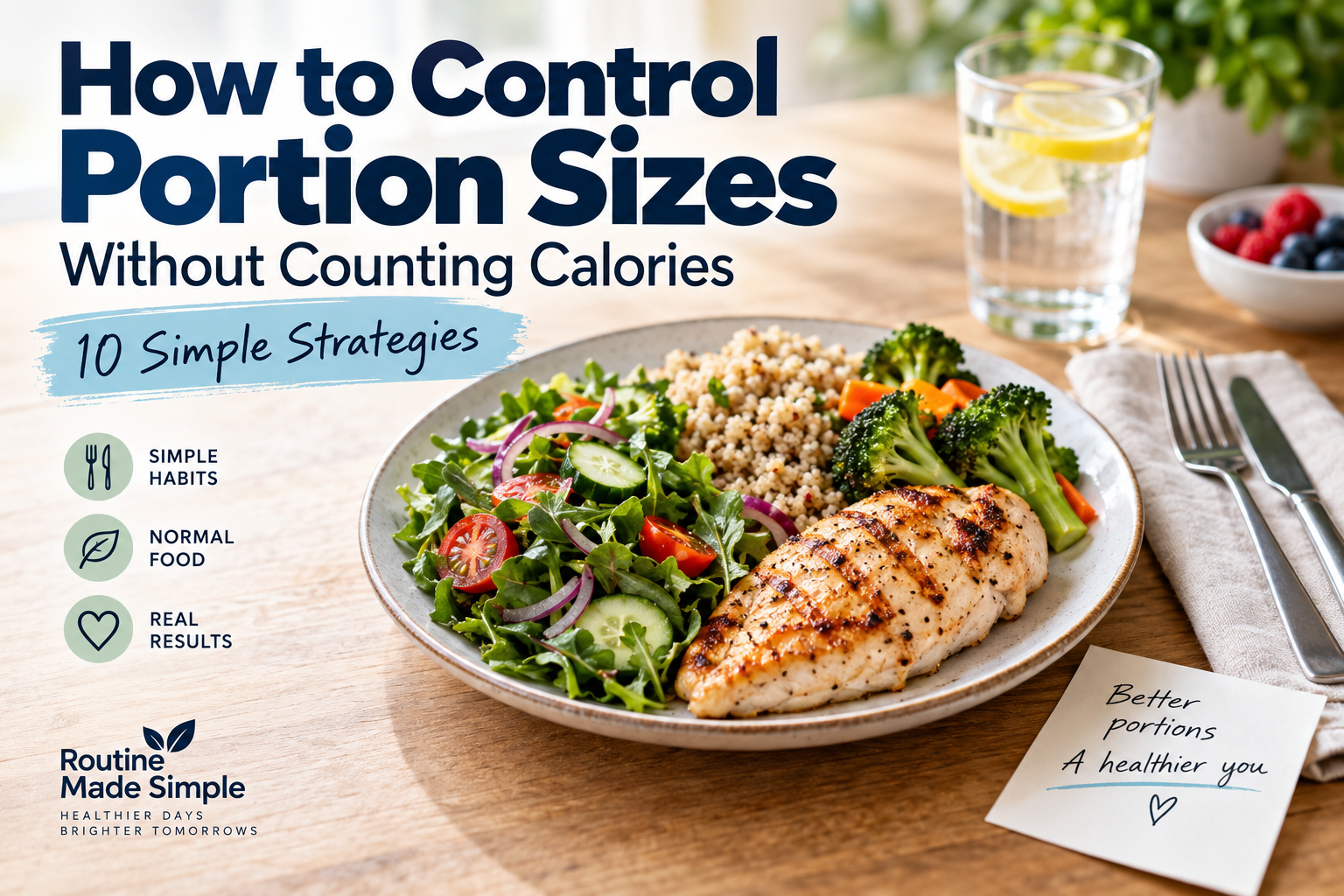
A Simple Portion-Control Plate
If you do not want to count calories or weigh food, try using your plate as a rough visual guide.
A typical meal could include:
- a substantial source of protein
- a generous portion of vegetables
- a moderate portion of potatoes, rice, pasta, bread or another carbohydrate source
- a reasonable amount of fat or sauce
This is not a rigid formula.
Your portions will vary depending on your body size, activity level, goals, food preferences and the rest of your diet.
Think of the plate as a starting framework rather than a prescription.
How to Control Portion Sizes Without Counting Every Calorie
If calorie tracking feels too complicated, focus on repeatable behaviors instead.
Use similar plates and bowls. Build meals around protein. Include vegetables or other fiber-rich foods. Pay attention to calorie-dense extras such as oils, sauces, cheese and snacks.
Then watch the overall trend rather than judging individual meals.
This gives you a practical way to manage portions while still leaving room for normal meals, restaurants and foods you enjoy.
Frequently Asked Questions
Can portion control help you lose weight?
It can. Managing portions can help reduce overall energy intake, which may make it easier to maintain the calorie deficit required for weight loss. Portion control works best alongside satisfying meals rather than simply trying to eat as little as possible.
Do I need to weigh my food?
No. Food weighing can be useful if you want more accurate information about your intake, but it is not mandatory. Many people can improve portion awareness using plates, bowls, food labels and consistent meal habits.
Should I stop eating before I feel full?
You do not need to follow an arbitrary hunger rule. The goal is to become more aware of when you are comfortably satisfied rather than automatically eating until the plate or package is empty.
Can I eat large portions and still lose weight?
Yes, depending on what those portions contain. Foods with lower energy density — particularly many vegetables, fruits and other fiber-rich foods — can provide considerable food volume for relatively few calories. Large portions of calorie-dense foods are different.
Is portion control better than calorie counting?
Neither method is universally better. Calorie tracking provides more numerical information, while portion-based strategies can be simpler and easier to maintain. The useful approach is the one that helps you manage your overall intake consistently.
The Bottom Line
Learning how to control portion sizes does not mean eating tiny meals.
It means becoming more intentional about how much food reaches your plate and how you decide whether you need more.
Start with protein.
Add plenty of vegetables and fiber-rich foods.
Be more deliberate with calorie-dense foods.
Avoid eating directly from large packages.
Slow down enough to notice when the meal has satisfied you.
And remember that no single portion determines your progress.
The goal is not perfect portion control. The goal is a way of eating that naturally makes appropriate portions easier to repeat.
Important: This article provides general educational information and is not individualized medical or nutritional advice. Energy and nutrition needs vary between individuals. If you have a medical condition, take medication, are pregnant or breastfeeding, have a history of disordered eating, or need individualized dietary guidance, speak with a qualified healthcare professional.