You are eating better. You are trying to move more. Maybe the scale even started going down.
Then suddenly — nothing.
If you are asking yourself “why am I not losing weight?”, it does not necessarily mean that your entire plan has stopped working.
Weight loss is rarely perfectly linear. Your body weight can fluctuate from day to day, and as you lose weight, the amount of energy your body needs can also change.
Sometimes the problem is simply that you need more time.
Other times, small habits have gradually changed enough to erase the calorie deficit that was previously producing weight loss.
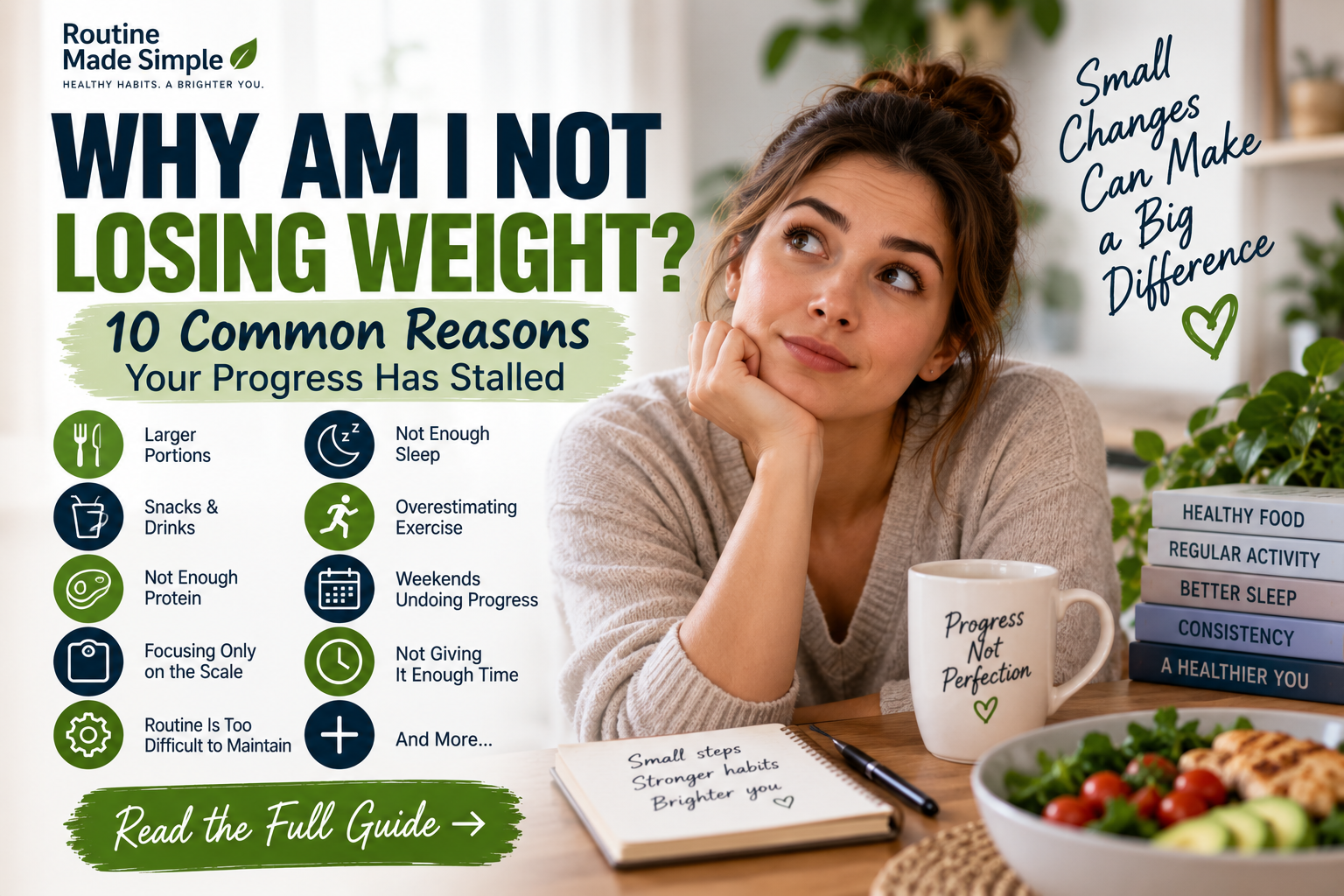
Here are 10 common reasons your progress may have stalled — and what you can do about them.
1. You May Be Eating More Than You Realize
This is probably the least exciting explanation, but it is one of the first things worth checking.
You do not need to count every calorie forever.
However, it is surprisingly easy for small amounts of extra food to accumulate throughout the day.
Think about:
- a few bites while preparing dinner,
- oil added while cooking,
- cream or sugar in coffee,
- a handful of nuts,
- finishing food from someone else’s plate,
- an extra snack in the evening.
None of these foods are automatically a problem.
But together they can significantly change your total energy intake.
If your weight has genuinely stopped changing, spend three or four days simply paying closer attention to everything you eat and drink.
You may find the answer without needing to start a complicated diet.
If calorie tracking is something you would rather avoid, see our guide to creating a calorie deficit without counting calories.
2. Your Portions Have Slowly Become Larger
Another reason you may be wondering why am I not losing weight is portion creep.
This can happen even when you are eating nutritious foods.
Peanut butter, nuts, cheese, olive oil, avocado and similar foods can absolutely fit into a healthy diet.
But they are also relatively energy-dense.
A portion that gradually becomes larger can add more energy than you realize.
You do not necessarily need to weigh every ingredient.
Instead, look at the foods you eat frequently and ask whether your portions have changed since you started losing weight.
Often, a small adjustment is enough.
3. Small Snacks and Drinks Are Adding Up
Meals are usually easy to remember.
The food between meals is easier to forget.
A snack at work.
A few crackers while watching television.
A sweet drink in the afternoon.
A little food while cooking.
Individually, these may seem insignificant.
But weight loss depends on your overall energy balance, not only what happens at breakfast, lunch and dinner.
This becomes especially important when eating is driven by boredom, stress or habit rather than physical hunger.
If that sounds familiar, read how to stop eating when you are not hungry.
Make Your Routine Easier to Follow
If intermittent fasting is part of your approach, our free 7-day guide can help you build a simple 16:8 routine without making the process unnecessarily complicated.
Affiliate disclosure: Routine Made Simple may earn a commission from qualifying purchases made through affiliate links, at no additional cost to you.
4. You May Be Overestimating What Exercise Burns
Exercise is extremely valuable for health.
But it is easy to overestimate how many calories a workout burns.
A long walk does not automatically cancel out a large restaurant meal.
And a workout should not become a reason to eat significantly more unless your actual needs justify it.
The CDC notes that physical activity increases energy expenditure, but weight loss generally requires combining activity with appropriate energy intake.
See the CDC guidance on physical activity and weight
.
This does not mean exercise is ineffective.
Quite the opposite.
Regular movement supports health and can help create the energy deficit needed for weight loss. Physical activity is also particularly important for maintaining weight after it has been lost.
The key is not treating exercise as permission to eat without limits.
If you want a simple way to increase your activity, start with our guide to walking for weight loss.
5. Your Meals May Not Be Satisfying Enough
Eating less does not automatically mean eating better.
If your meals leave you hungry again an hour later, staying consistent becomes much harder.
A practical meal usually includes some combination of:
- a clear protein source,
- vegetables or fruit,
- fiber-rich foods,
- an appropriate amount of carbohydrates,
- some dietary fat.
Protein can be particularly useful when building more satisfying meals.
You do not need to turn every meal into a high-protein fitness recipe.
Simply make sure protein is actually present.
For practical ideas, see 10 simple ways to eat more protein.
6. Your Weekends May Be Undoing Your Weekdays
This is extremely common.
Monday through Friday looks structured.
Then Friday evening arrives.
Restaurant meals, alcohol, desserts, snacks and larger portions continue through the weekend.
Then Monday becomes another fresh start.
The problem is that your body does not reset its energy balance every Monday morning.
Your overall pattern matters.
You can absolutely enjoy restaurant meals, desserts and social occasions while losing weight.
But if five structured days are followed by two days of significantly higher intake, your weekly calorie deficit can become much smaller — or disappear entirely.
The CDC specifically recommends planning ahead for weekends, vacations and other changes in routine when trying to maintain healthy eating patterns.
Read the CDC guidance on maintaining healthy eating patterns
.
The solution is not to make weekends miserable.
It is to stop treating Saturday and Sunday as days when every normal habit disappears.
7. You May Not Be Giving It Enough Time
Weight does not fall in a perfectly straight line.
You may see something like:
Down → down → unchanged → slightly up → unchanged → down.
That can still represent progress.
Body weight reflects more than body fat.
Short-term changes can also reflect water, glycogen, food in your digestive system and other normal fluctuations.
This is why a few days without a lower number on the scale does not automatically mean you have reached a true plateau.
Look at the trend over several weeks rather than reacting to every individual weigh-in.
Healthy weight loss is generally gradual. The CDC notes that people who lose weight at a steady pace are more likely to maintain their weight loss than those pursuing very rapid loss.
8. You Are Looking Only at the Scale
The scale is useful.
But it is not the only useful measurement.
You can also monitor:
- waist circumference,
- how your clothes fit,
- walking distance or pace,
- strength,
- energy levels,
- consistency with your habits.
This does not mean you should ignore your weight if weight loss is your goal.
It means one measurement should not determine whether you believe the entire process is working.
Look at the bigger picture.
9. You Are Not Sleeping Enough
If you keep asking “why am I not losing weight?”, look beyond food and exercise.
Sleep matters too.
Not because sleep magically burns body fat.
But inadequate sleep can make hunger, cravings, food decisions, physical activity and consistency harder to manage.
The CDC includes adequate sleep alongside healthy eating, physical activity and stress management as part of a lifestyle that supports healthy weight management.
If your nights are regularly too short, read our complete guide to sleep and weight loss.
10. Your Routine Is Too Difficult to Maintain
This may be the most important reason of all.
A plan can work perfectly on paper and still fail in real life.
If your weight-loss strategy requires you to:
- prepare complicated meals every day,
- never eat at restaurants,
- avoid every food you enjoy,
- exercise intensely every day,
- constantly fight hunger,
- depend on motivation for every decision,
then the problem may not be your discipline.
The problem may be the system.
A simpler routine usually has a better chance of surviving busy days, weekends, travel and periods of lower motivation.
That is why we prefer practical systems such as simple meal planning for weight loss rather than trying to make every meal perfect.
The same principle applies to habits in general.
Read how to build a habit without relying on motivation.
Why Weight Loss Can Slow Down After You Lose Weight
There is another important reason progress can become slower even when you have genuinely been successful.
Your body is now smaller.
A smaller body generally requires less energy than a larger body.
Weight loss can also include some loss of lean tissue, and your total daily energy expenditure can decline as your weight decreases.
This means the food intake that produced a calorie deficit at your starting weight may eventually produce a much smaller deficit.
At some point, your energy intake and expenditure may become similar enough that your weight stabilizes.
This is one reason weight-loss plateaus are common rather than evidence that your body has somehow become incapable of losing weight.
Read more about weight-loss plateaus
.
What to Do If Your Weight Hasn’t Changed for 2–4 Weeks
If the scale has been relatively stable for several weeks, do not immediately redesign your entire diet.
Do a simple audit first.
Step 1: Check Your Portions
Have portions gradually increased?
Pay particular attention to calorie-dense foods, sauces, oils and snacks.
Step 2: Check Your Drinks
Look at:
- soft drinks,
- juice,
- sweetened coffee,
- alcohol,
- other calorie-containing beverages.
Liquid calories can be easy to overlook.
Step 3: Check Your Snacks
Are you eating between meals because you are hungry?
Or because food is available?
Those are not always the same thing.
Step 4: Check Your Weekends
Compare your weekday routine with Saturday and Sunday.
You may immediately notice where the difference is coming from.
Step 5: Check Your Activity
Has your daily movement decreased?
You may still be doing three workouts per week while walking significantly less during the rest of the day.
Step 6: Check Your Sleep
Are you consistently sleeping enough?
If not, improving sleep may make several other parts of your routine easier.
Step 7: Change One or Two Things
Do not respond to a plateau by simultaneously cutting carbohydrates, skipping another meal, doubling your exercise and eliminating every snack.
Make the smallest useful adjustment.
For example:
- slightly reduce one regular portion,
- replace one calorie-containing drink with water,
- remove one habitual snack,
- add a 20-minute walk,
- return to your normal weekend meal structure.
Then give the change enough time to evaluate it.
Should You Start Counting Calories?
Not necessarily.
Calorie counting is a tool, not a requirement.
Some people find it useful because it shows them where their energy intake is coming from.
Others find it tedious and difficult to maintain.
If your progress has stalled and you genuinely do not know why, temporarily tracking your normal food intake for a few days can be educational.
You do not have to turn it into a permanent lifestyle.
The CDC similarly notes that counting calories all the time is not necessary, although understanding your approximate energy needs can be useful.
What About Intermittent Fasting?
Intermittent fasting can help some people create a simpler eating structure.
But fasting itself does not guarantee weight loss.
If your eating window contains enough food to meet or exceed your energy expenditure, your weight may remain stable.
That is why we view intermittent fasting as a scheduling tool rather than a loophole around energy balance.
If you are new to fasting, start with our beginner’s guide to intermittent fasting.
When It May Be Worth Talking to a Healthcare Professional
Food and activity are important, but they are not the only factors that can influence body weight.
Age, medications, medical conditions, hormones, genetics, sleep, stress and environmental factors can also play a role.
If you have been consistently following a reasonable plan and are concerned about your lack of progress — particularly if you have other symptoms or take medications that may affect weight — consider discussing it with an appropriate healthcare professional.
That is more useful than assuming every plateau is caused by a lack of willpower.
Why Am I Not Losing Weight? The Bottom Line
If you are asking “why am I not losing weight?”, do not assume you need a completely new diet.
Start by looking at the basics.
Check your portions.
Look at snacks and drinks.
Compare weekends with weekdays.
Review your daily movement.
Pay attention to sleep.
And make sure your routine is simple enough to maintain when life gets busy.
Then make one or two small adjustments and watch the trend over time.
The goal is not to create the strictest possible weight-loss plan.
It is to build a routine that creates progress and that you can actually keep doing.
Disclaimer: This article is for general informational and educational purposes only and is not medical advice. Individual weight management can be affected by medical conditions, medications and other factors. If you have concerns about your weight, nutrition, medications or health, consult an appropriate healthcare professional.