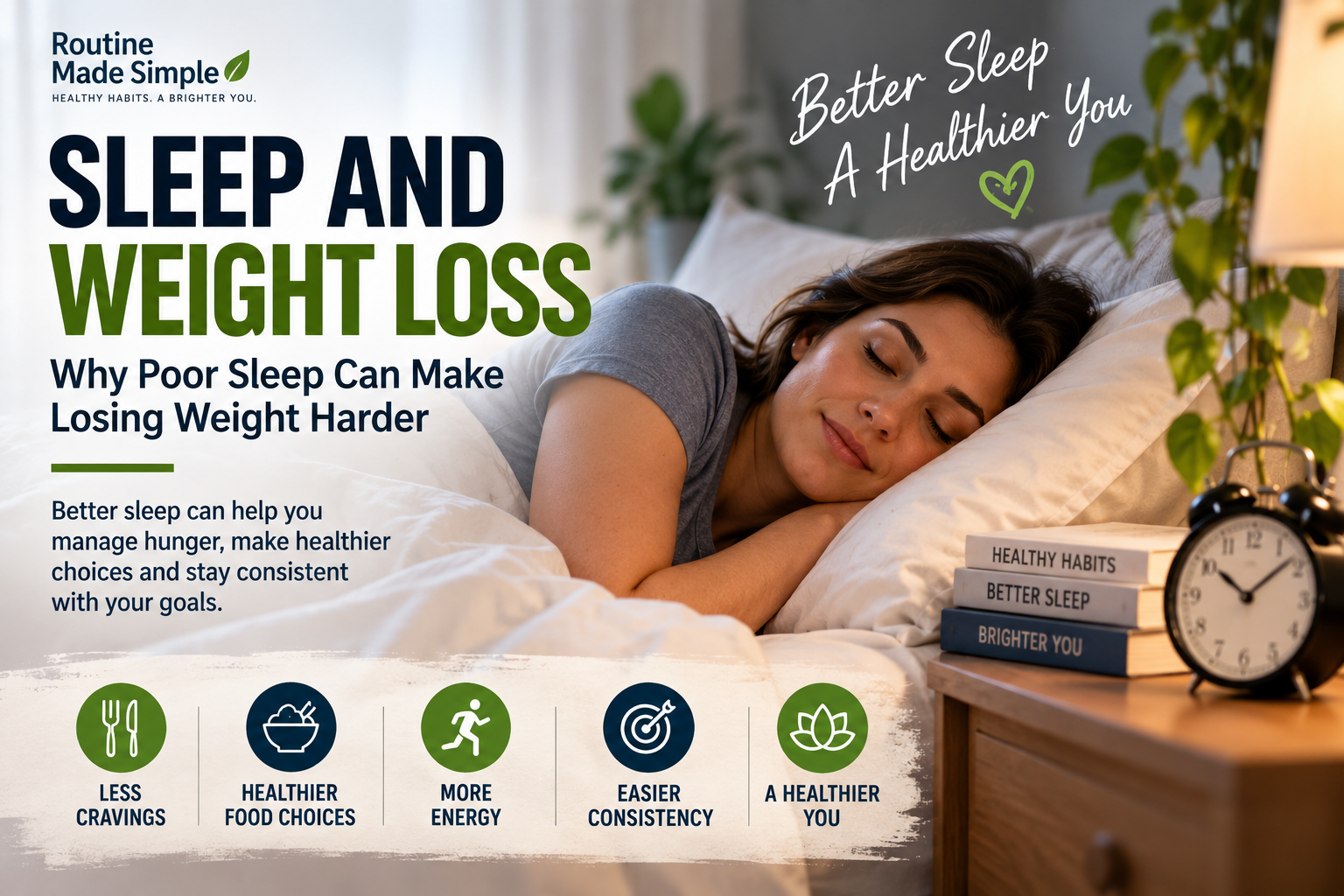
You can have a reasonable meal plan, walk regularly and try to stay consistent — but if you are constantly exhausted, weight loss may still feel much harder than it should.
That is because sleep and weight loss are more connected than many people realize.
Sleep does not magically burn fat, and getting eight hours of sleep will not cancel out consistently eating more energy than your body needs.
But poor sleep can influence hunger, appetite, food choices, activity and your ability to stick with healthy habits.
In other words, sleep may not replace nutrition and movement, but it can make both of them easier — or harder.
Here is what you should know.
Why Sleep Matters for Weight Management
Healthy weight management is not just about food.
The CDC describes healthy weight loss as a lifestyle that includes healthy eating patterns, regular physical activity, enough sleep and stress management.
See the CDC guidance on healthy weight loss
.
That does not mean sleep is a secret weight-loss trick.
It means sleep is part of the environment in which your food and activity decisions happen.
If you are rested, it may be easier to prepare a meal, go for a walk, stop eating when you are satisfied and follow the routine you planned.
If you are exhausted, those same decisions can require much more effort.
1. Poor Sleep Can Make You Feel Hungrier
One of the most important connections between sleep and weight loss is appetite.
Experimental studies have found that restricting sleep can increase hunger and the desire to eat in at least some groups.
For example, a randomized crossover study comparing three nights of very short sleep with normal sleep found increased hunger and prospective food consumption after sleep restriction.
Read the study on shortened sleep and appetite
.
This does not mean everyone who sleeps badly will automatically overeat.
But it helps explain why a difficult night can sometimes be followed by stronger cravings and more interest in food.
2. Sleep Restriction May Increase Calorie Intake
Feeling hungrier matters because it can influence how much you eat.
In one controlled randomized study, people assigned to sleep restriction increased their calorie intake significantly compared with the control group, without a corresponding increase in activity energy expenditure.
See the randomized study on sleep restriction and calorie intake
.
This is particularly relevant if you are trying to create a calorie deficit without counting calories.
You can build a very reasonable food plan, but consistently feeling tired and hungry may make that plan harder to follow.
3. More Sleep May Help Some People Eat Less
The reverse relationship has also been studied.
In a randomized clinical trial of adults with overweight who normally slept less than about 6.5 hours per night, researchers helped one group extend their sleep.
The sleep-extension group increased sleep by about 1.2 hours per night and consumed, on average, around 270 fewer calories per day than the control group during the intervention.
Read the NIH summary of the sleep-extension trial
.
That is an interesting finding, but it should not be turned into a promise that sleeping longer automatically causes weight loss.
The study was relatively short, and longer-term outcomes still require more research.
The practical takeaway is simpler:
Improving inadequate sleep may make appetite and eating behavior easier to manage for some people.
4. Tiredness Can Change Your Food Decisions
Think about the difference between choosing dinner at 6 PM after a good night of sleep and choosing dinner after five hours of sleep and a long workday.
The second situation usually requires more effort.
You may be less interested in cooking.
You may want something faster.
You may be more tempted by highly palatable foods.
You may also care less about the plan you made yesterday.
This is one reason meal planning can be particularly useful on tired days.
The fewer decisions you need to make when exhausted, the easier it is to follow your normal routine.
5. Poor Sleep Can Make Cravings Feel Harder to Manage
Cravings are influenced by many factors, including habits, food availability, emotions, hunger and routine.
Sleep can be another piece of that puzzle.
Older controlled research found that short sleep was associated with increased appetite, particularly for calorie-dense foods, although hormone and appetite responses are not identical across all studies.
This is why it is better not to reduce the entire issue to statements such as “poor sleep raises ghrelin and lowers leptin.”
The evidence is more nuanced than that.
The practical point remains that inadequate sleep can make eating behavior more difficult for some people.
If sweets are a frequent challenge, see our guide on how to stop sugar cravings.
6. Being Tired Can Reduce Your Desire to Move
Exercise is not only about what your body is physically capable of doing.
It is also about whether you actually feel like doing it.
After a poor night of sleep, going for a walk or doing a workout can feel significantly less appealing.
You may also spend more time sitting simply because you are tired.
You do not need an extreme training plan for weight management.
Simple daily activity still matters.
If you are building your movement routine from scratch, our guide to walking for weight loss is a good place to start.
7. Sleep Affects Your Ability to Stay Consistent
Healthy routines rely on repetition.
That sounds obvious, but consistency requires energy.
When you are chronically tired, even small decisions can feel harder:
- preparing breakfast,
- packing lunch,
- going for a walk,
- stopping after one snack,
- shopping for groceries,
- going to bed instead of staying on the couch with food.
This is where sleep and weight loss becomes less about metabolism and more about behavior.
A good routine should reduce the amount of willpower you need.
That is the same principle behind our guide on how to build a habit without relying on motivation.
8. Sleep Does Not Replace a Calorie Deficit
This is important.
You cannot sleep your way into weight loss if your energy intake consistently exceeds your energy needs.
Energy balance still matters.
Sleep is better viewed as something that may influence how easy or difficult it is to create and maintain the behaviors that support an appropriate calorie intake.
The same applies to protein.
Eating more protein may help make meals more satisfying, but it does not override energy balance either.
If you are working on meal structure, see how to eat more protein without making your diet unnecessarily complicated.
9. Night Eating May Sometimes Be Connected to Sleep Habits
Late-night eating does not always mean you are doing something wrong.
But short or irregular sleep can create longer waking periods, which simply gives you more opportunities to eat.
If you regularly stay awake until midnight or later, the period between dinner and bedtime may become another eating window.
Sometimes that eating is driven by hunger.
Sometimes it is boredom, television, stress or habit.
If evenings are difficult for you, read why you may feel hungry at night.
And if you often eat without physical hunger, our guide on how to stop eating when you are not hungry may help.
How Much Sleep Do Adults Need?
Sleep needs vary between individuals, but most adults should generally aim for at least seven hours of sleep per night.
That does not mean seven hours is ideal for every single person.
Some people function better with more.
Sleep quality also matters.
Spending eight hours in bed but waking repeatedly throughout the night is not necessarily equivalent to eight hours of restorative sleep.
Signs That Sleep May Be Affecting Your Weight-Loss Routine
You do not need laboratory testing to notice patterns in your own behavior.
Consider whether you regularly experience:
- stronger cravings after poor sleep,
- more snacking when tired,
- difficulty preparing meals after bad nights,
- less interest in walking or exercise,
- late-night eating because you stay awake longer,
- greater reliance on highly convenient foods,
- difficulty following routines after several nights of poor sleep.
If several of these happen repeatedly, improving sleep may be a useful part of your broader routine.
A Simple Evening Routine for Better Sleep
You do not need a complicated “perfect sleep routine.”
Start with a few basic behaviors.
Keep a Reasonably Consistent Bedtime
Your schedule does not need to be exact to the minute.
But going to bed at dramatically different times every night can make consistency harder.
Create a Wind-Down Period
Give yourself some separation between the busy part of the day and sleep.
This might be 20–30 minutes of quieter activity.
Read, shower, prepare things for tomorrow or simply reduce stimulation.
Reduce Late-Night Screen Time
If scrolling keeps you awake much longer than intended, create a practical boundary.
You might charge your phone away from the bed or set a specific time when you stop checking social media.
Watch Late Caffeine
Caffeine can affect sleep for many hours.
If you have difficulty falling asleep, consider whether afternoon or evening caffeine may be contributing.
Make Your Bedroom Support Sleep
A dark, quiet and comfortable environment generally supports sleep better than a bright, noisy room.
Again, perfection is not required.
Small environmental changes can still help.
Do Not Try to Fix Everything at Once
If your current sleep schedule is very inconsistent, do not create ten new rules tonight.
Choose one change.
For example:
- go to bed 30 minutes earlier,
- stop scrolling in bed,
- avoid caffeine late in the day,
- create a consistent wake-up time,
- prepare tomorrow’s breakfast before bed.
Then repeat it until it becomes normal.
This is usually more sustainable than trying to become a completely different person overnight.
Sleep and Weight Loss: A Simple Daily Framework
If you want to combine everything into one manageable routine, keep it simple.
During the day: Eat reasonably structured meals that include protein, vegetables, fruit and other foods you enjoy.
Move regularly: Walk, exercise or simply increase your daily activity.
In the evening: Avoid turning the hours after dinner into an endless snacking period.
Before bed: Create a short wind-down routine.
At night: Give yourself enough opportunity to sleep.
The next day: Notice whether better sleep changes your hunger, cravings and energy.
You are looking for patterns, not perfection.
What If You Use Intermittent Fasting?
Intermittent fasting does not remove the importance of sleep.
In fact, poor sleep may make fasting feel more difficult if you wake up tired and unusually hungry.
If you use an eating window, focus on building meals that are satisfying enough to support the routine rather than trying to compensate for poor sleep with stricter fasting.
If you are new to the approach, see our beginner’s guide to intermittent fasting.
Sleep and Weight Loss: The Bottom Line
Sleep and weight loss are connected, but sleep should not be treated as a magic fat-loss tool.
Its value is more practical.
Getting enough sleep may help make hunger easier to manage.
It may reduce the pressure to constantly fight cravings.
It can make exercise and food preparation feel easier.
And it can help support the consistency that healthy routines depend on.
If you already focus on food and movement but constantly feel exhausted, sleep may be the missing part of your routine that deserves more attention.
Start small.
Go to bed a little earlier.
Reduce one late-night habit that keeps you awake.
Then see how your next day feels.
Build a Routine That Is Easier to Maintain
Healthy weight management is rarely about one perfect habit. Food, movement, sleep and consistency all work together.
If intermittent fasting is part of your routine, our free 7-day guide can help you build a simple 16:8 structure without making the process unnecessarily complicated.
Affiliate disclosure: Routine Made Simple may earn a commission from qualifying purchases made through affiliate links, at no additional cost to you.
Disclaimer: This article is for general informational and educational purposes only and is not medical advice. Persistent insomnia, excessive daytime sleepiness, loud snoring, breathing interruptions during sleep or other ongoing sleep problems should be discussed with an appropriate healthcare professional.