You start your fasting window with the best intentions. Then morning arrives and so does the first question:
Can I have coffee?
Then another one. What about lemon water? A splash of milk? Tea? A zero-calorie sweetener? Supplements?
Something that was supposed to make eating simpler can suddenly become surprisingly complicated.
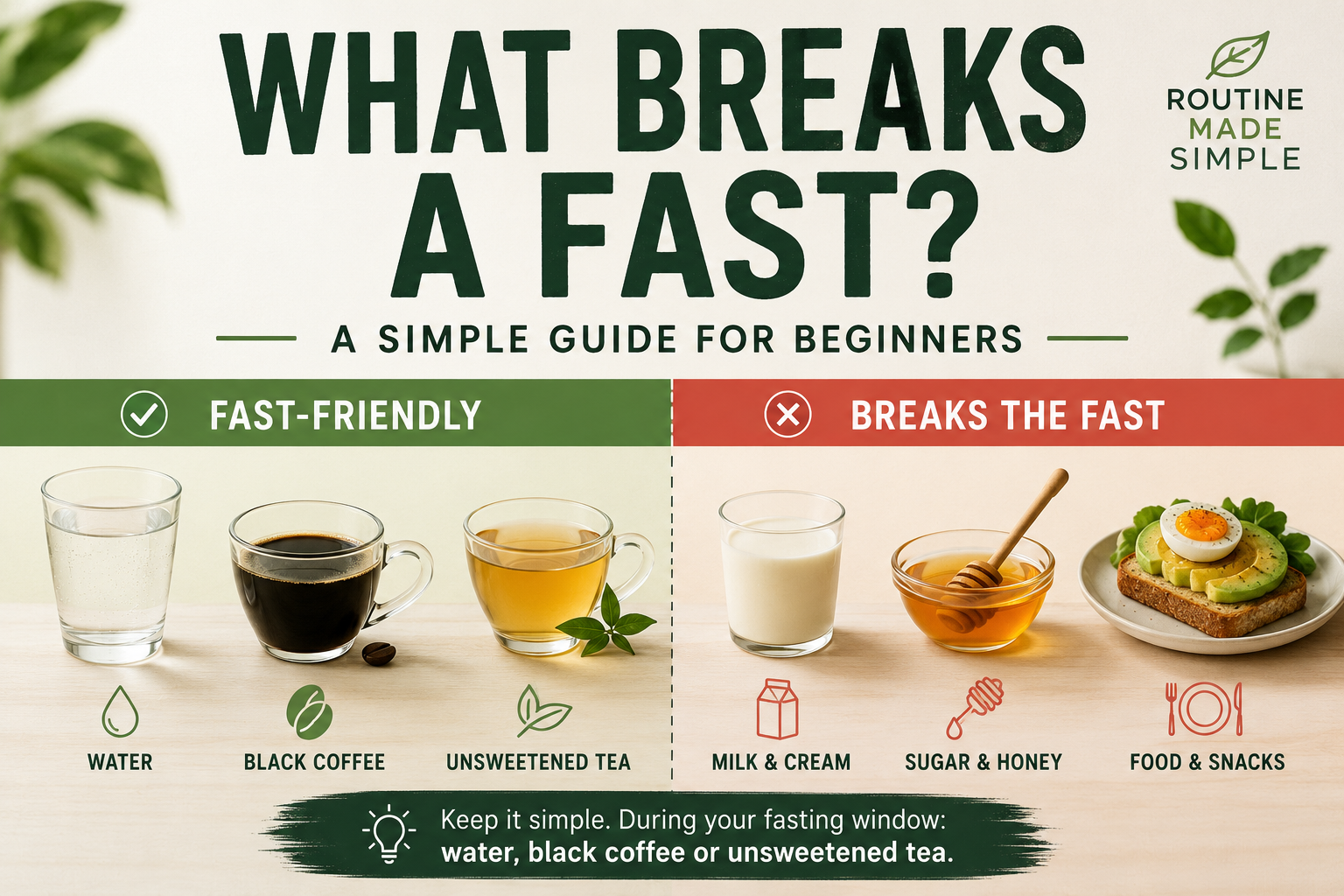
For most people using intermittent fasting as a practical eating schedule, the basic idea is much simpler: avoid food and calorie-containing drinks during your fasting window. Water and zero-calorie beverages such as plain coffee and unsweetened tea are commonly used during intermittent fasting.
If you’re completely new to fasting and haven’t chosen an eating window yet, start with our beginner’s guide to intermittent fasting, which explains common eating windows and how to ease into a routine.
There are a few gray areas, though. So if you’re wondering what breaks a fast and what you can safely leave for your eating window, here’s a practical way to think about it.
Quick Answer: What Breaks a Fast?
| Food or drink | During a fasting window? |
|---|---|
| Plain water | Yes |
| Sparkling water (no calories) | Yes |
| Black coffee | Generally, yes |
| Unsweetened tea | Generally, yes |
| Coffee with milk or cream | No for a strict fast |
| Sugar or honey | No |
| Lemon water | Depends on the amount and your goal |
| Zero-calorie sweeteners | Gray area |
| Food or snacks | No |
If you want to keep things as simple as possible, there’s an easy rule: during your fasting window, stick to water, black coffee or unsweetened tea.
First, What Does “Breaking a Fast” Actually Mean?
This is where many online arguments about fasting go wrong.
People use the word fasting to describe different things. Someone fasting before a medical procedure needs to follow the instructions provided by their healthcare professional. Religious fasting can have completely different rules.
Here, we’re talking primarily about intermittent fasting as an eating schedule, particularly time-restricted eating such as 16:8.
A typical 16:8 schedule might look like this:
- Finish eating at 8:00 p.m.
- Fast overnight and through the morning.
- Have your first meal at noon.
- Eat within an eight-hour window.
- Begin the next fasting period at 8:00 p.m.
Intermittent fasting focuses mainly on when you eat rather than prescribing a specific list of foods. Johns Hopkins describes water and zero-calorie beverages such as black coffee and tea as options during fasting periods.
Read the Johns Hopkins overview of intermittent fasting.
What Can You Drink Without Breaking a Fast?
Water
Plain water is the easiest choice.
Still or sparkling water works as long as it doesn’t contain added sugar or calories. Staying hydrated can also make a fasting routine more comfortable.
If you’re unsure about any flavored water, check the nutrition label rather than assuming that “water” automatically means calorie-free.
Black Coffee
For a typical intermittent fasting routine, plain black coffee is commonly consumed during the fasting window.
The important word is plain.
Adding sugar, milk, cream or caloric syrups changes the drink. A large flavored coffee can contain a substantial number of calories even though we still casually call it “coffee.”
If you don’t enjoy black coffee, there’s no reason to force it. Water and unsweetened tea are simple alternatives.
Unsweetened Tea
Plain tea is another straightforward option during a fasting window.
Black tea, green tea and many herbal teas can be consumed without adding sugar, honey or milk.
Again, packaged tea drinks are different. Check the label because some bottled or flavored teas contain added sugar and calories.
Does Lemon Water Break a Fast?
This question often gets a more complicated answer than it needs.
Lemon itself isn’t calorie-free. Adding a substantial amount of lemon juice therefore isn’t the same thing as drinking plain water.
But context matters.
If your goal is a strict zero-calorie fast, plain water is the simplest choice.
If you’re using intermittent fasting primarily as a practical structure for controlling when you eat, a small squeeze of lemon shouldn’t distract you from the much bigger picture: what and how much you’re eating across the day.
What doesn’t make much sense is turning “lemon water” into a drink containing honey, sugar or other calorie-containing ingredients and treating it as equivalent to plain water.
Does Milk in Coffee Break a Fast?
Milk contains calories and nutrients, so coffee with milk isn’t the same as black coffee during a strict fasting window.
The same principle applies to:
- cream
- half-and-half
- oat milk
- almond milk that contains calories
- coffee creamer
- sweetened plant-based drinks
Does one tiny splash of milk ruin an entire weight-management plan? No.
But there’s a practical reason for keeping the rule simple. A splash can become two splashes. Then comes a little sugar. Before long, a “coffee” can quietly become a significant source of calories.
If fasting works for you because it creates a clear boundary between eating and not eating, keeping fasting drinks calorie-free makes that boundary easier to understand.
What About Zero-Calorie Sweeteners?
This is one of the gray areas when people ask what breaks a fast.
A drink labeled zero calories isn’t nutritionally equivalent to a sugar-sweetened drink. But whether you want to include sweet-tasting drinks during your fasting window can also be a practical decision.
Some people prefer them. Others find that sweet tastes make fasting harder by increasing their desire to eat.
If you’re just starting and want to remove the uncertainty, begin with:
- water
- plain sparkling water
- black coffee
- unsweetened tea
That’s usually easier than trying to determine whether every individual sweetener fits your definition of fasting.
Do Supplements Break a Fast?
It depends on the supplement.
A tablet or capsule can be very different from a gummy containing sugar, an oil-based supplement, a protein drink or a powdered product containing carbohydrates.
Instead of relying on the word supplement, check the actual product label.
Look at:
- serving size
- calories
- carbohydrates and sugars
- protein
- fat
- preparation instructions
If you’re specifically looking at the Unicity Feel Great routine, we’ve also explained how Unimate and Balance play different roles in a practical routine and how they may fit around an eating window.
Most importantly, if medication or a supplement is supposed to be taken with food, don’t change how you take it just to preserve a fasting window. Follow the directions provided with the product and advice from your healthcare professional.
Does Food Break a Fast?
This part is much less complicated.
Eating food means you’ve moved into your eating window.
That includes small snacks such as:
- a piece of fruit
- a handful of nuts
- yogurt
- a protein bar
- a spoonful of peanut butter
- a few crackers
- a smoothie
There’s nothing inherently wrong with these foods. They’re simply food, so eating them ends a conventional fasting period.
This distinction is useful because intermittent fasting doesn’t require labeling foods as “good” or “bad.” You’re simply deciding when your eating window begins and ends.
What About “Just a Few Calories”?
This is where fasting can turn into an unnecessary accounting exercise.
Is five calories okay? What about ten? Twenty?
For an everyday intermittent fasting routine, obsessing over a universal magic number isn’t particularly useful.
A much simpler rule is:
During your fasting window, don’t eat and keep your drinks calorie-free. During your eating window, eat according to your overall nutrition and energy goals.
That removes most of the uncertainty about what breaks a fast and makes the routine easier to repeat.
And repeatability matters. A routine you can follow consistently is more useful than trying to achieve a theoretically “perfect” fast for a few days and then giving up.
Fasting Doesn’t Cancel Out Calories
This may be the most important point in this guide.
Intermittent fasting is an eating schedule, not a loophole in energy balance.
You can fast for 16 hours and still consume more energy than you need during the remaining eight hours.
For someone trying to lose weight, one practical advantage of intermittent fasting may simply be that limiting the hours available for eating can make calorie control easier. Research reviews have generally found intermittent fasting to be another possible approach to weight management rather than a way to make total energy intake irrelevant.
This is also why breaking a fast doesn’t automatically mean you’ve ruined your weight-loss progress. Fasting and calorie balance are related, but they aren’t the same thing. We explain that distinction in Calorie Deficit vs Intermittent Fasting: What Actually Drives Weight Loss?
Harvard Health discusses intermittent fasting and weight loss here.
Think about a typical day without an eating schedule:
7:30 a.m. — breakfast
10:00 a.m. — snack
12:30 p.m. — lunch
3:30 p.m. — snack
6:30 p.m. — dinner
9:30 p.m. — something while watching TV
A 16:8 routine might instead look like:
12:00 p.m. — first meal
3:30 p.m. — optional snack
7:00 p.m. — dinner
8:00 p.m. — fasting begins
That’s not magic.
It’s structure.
And for some people, structure makes maintaining an appropriate overall calorie intake easier.
A Simple Fasting Rule for Beginners
If you’re just starting, don’t worry about optimizing every minute of your fasting window.
Try something simpler.
During your fasting window
Stick to water, plain sparkling water, black coffee or unsweetened tea.
During your eating window
Eat satisfying meals while paying attention to overall food quality, protein, fiber, portion sizes and total energy intake.
Then repeat
Give yourself time to find out whether the schedule actually fits your lifestyle.
A routine you can maintain is far more useful than a complicated routine you abandon after four days.
If you haven’t started yet, our guide to starting intermittent fasting walks through a simple beginner approach to choosing and gradually adjusting an eating window.
Frequently Asked Questions
Does black coffee break a fast?
Plain black coffee is commonly included during intermittent fasting. Adding milk, cream, sugar or calorie-containing flavorings changes the drink and adds energy.
Does lemon water break a fast?
Lemon contains some calories, so it isn’t identical to plain water. Someone following a strict zero-calorie fast may prefer plain water. For people using intermittent fasting as a practical eating schedule, the amount used and the overall goal matter.
Does tea break a fast?
Plain unsweetened tea is commonly consumed during intermittent fasting. Adding sugar, honey, milk or other calorie-containing ingredients is different.
Does chewing gum break a fast?
It depends on the product. Regular gum may contain sugar and calories, while sugar-free products vary. Check the nutrition label if maintaining a strict zero-calorie fasting window matters to you.
Does zero-calorie soda break a fast?
A genuinely zero-calorie drink doesn’t provide the calories of regular soda. Whether you choose to include sweet-tasting zero-calorie drinks is partly a matter of how strictly you define your fast and whether those drinks make your fasting routine easier or harder to maintain.
Can I take vitamins while fasting?
It depends on the vitamin and its formulation. Some supplements contain calories, while others may be better tolerated or absorbed with food. Follow the product instructions and advice from your healthcare professional rather than changing how you take a supplement solely to maintain your fasting window.
The Bottom Line: What Breaks a Fast?
You don’t need to turn intermittent fasting into a chemistry experiment.
For a straightforward fasting routine, keeping the fasting window simple removes most of the confusion about what breaks a fast:
Water. Black coffee. Unsweetened tea. No food.
Then use your eating window for nutritious, satisfying meals that fit your overall goals.
If weight loss is your goal, remember that the fasting window is only part of the picture. Your overall energy intake still matters.
The best fasting routine isn’t necessarily the strictest one.
It’s the one simple enough to become routine.
Important: This article provides general educational information and is not a substitute for individualized medical or nutritional advice. Intermittent fasting isn’t appropriate for everyone. If you have a medical condition, take medication, are pregnant or breastfeeding, have a history of an eating disorder, or aren’t sure whether fasting is appropriate for you, speak with a qualified healthcare professional.