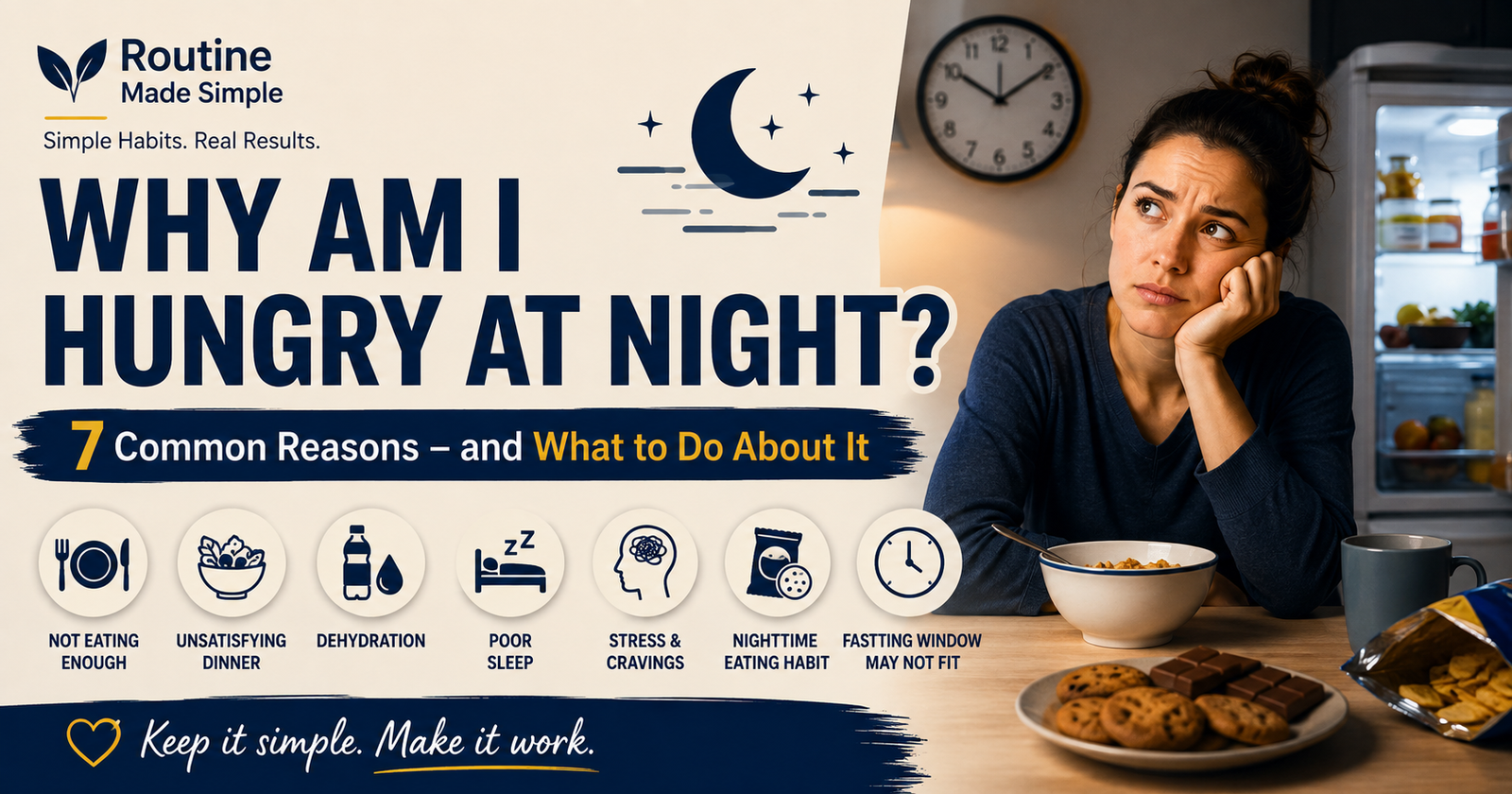
Why am I hungry at night? If you regularly finish dinner only to find yourself searching the kitchen for something to eat an hour or two later, you are not alone.
Evening hunger can be frustrating, especially when you are trying to lose weight, follow intermittent fasting, or simply build healthier eating habits.
But nighttime hunger does not automatically mean you lack willpower.
Sometimes you genuinely need more food. Other times, the problem may be an unsatisfying dinner, eating too little earlier in the day, poor sleep, stress, habit, or a fasting schedule that simply does not fit your life.
Understanding the reason can make the solution much simpler.
Here are seven common reasons you may feel hungry at night — and practical ways to deal with them.
Why Am I Hungry at Night? 7 Common Reasons
If you keep asking why am I hungry at night, it helps to look at your entire day rather than focusing only on the moment when hunger appears.
Your meal size, food choices, sleep, stress, hydration, habits, and eating schedule can all influence how easy or difficult your evening feels.
Let us start with one of the simplest explanations.
1. You Did Not Eat Enough During the Day
One possible reason for nighttime hunger is that you simply did not eat enough earlier.
This can happen when people become overly aggressive with dieting or intermittent fasting.
You might skip breakfast, eat a very small lunch, and then try to keep dinner light because you want to lose weight.
By evening, it should not be surprising if you are hungry.
This is particularly important if you use a restricted eating window.
Intermittent fasting can reduce the number of hours available for eating, but that does not mean every meal needs to be tiny.
Your meals still need to provide enough nutrition and energy for your needs.
If you regularly become extremely hungry at night, look at the entire day and ask yourself:
- Did I eat satisfying meals today?
- Did my meals contain useful sources of protein?
- Did I include fiber-rich foods?
- Did I eat enough at lunch and dinner?
- Am I trying to reduce calories too aggressively?
A slightly more substantial and balanced meal earlier in the day may make your routine easier to maintain.
2. Your Dinner Is Not Satisfying Enough
You can eat dinner and still feel hungry shortly afterward if the meal is not particularly satisfying.
Consider the difference between a meal built mostly around refined carbohydrates and a meal containing protein, vegetables, a fiber-rich carbohydrate, and some fat.
A simple dinner structure might include:
- Protein: chicken, fish, eggs, Greek yogurt, tofu, beans, or lentils
- Vegetables: salad, broccoli, peppers, tomatoes, carrots, or other vegetables you enjoy
- Carbohydrates: potatoes, rice, oats, whole grains, beans, or fruit
- Fat: olive oil, nuts, seeds, avocado, or fat naturally present in the meal
You do not need to calculate a perfect macronutrient ratio.
The goal is simply to build a meal that feels like a real meal rather than something you endure while waiting for your next snack.
If your evening meal consistently leaves you hungry, experimenting with more protein, vegetables, fiber, or an appropriate portion size may help.
3. You May Not Be Drinking Enough
Hydration is another part of the routine that is easy to overlook.
If you have barely had anything to drink during the afternoon, have some water before automatically reaching for food and take a moment to consider what you are feeling.
This does not mean that water should be used to suppress genuine hunger.
If you are hungry, drinking water is not a substitute for eating appropriate food.
The point is simply to avoid allowing poor hydration to complicate an already difficult evening.
If you follow intermittent fasting, water is also the simplest drink during your fasting window.
For more options, read our guide to what you can drink while intermittent fasting.
4. Poor Sleep Can Make Hunger Harder to Manage
Sleep is easy to overlook when discussing food and weight management because it does not seem directly connected to what is on your plate.
However, sleep restriction can affect appetite and eating behavior.
In a randomized crossover trial, participants experienced greater subjective hunger and consumed more energy from snacks during a period of restricted sleep compared with a control sleep condition.
You can review the study on PubMed.
This does not mean that one poor night of sleep automatically causes overeating.
It does mean that if you regularly sleep too little and notice that food becomes harder to manage the next day, sleep deserves attention as part of your overall routine.
Instead of responding by creating stricter food rules, consider whether improving your sleep schedule could make the rest of your routine easier.
5. Stress or Cravings Can Feel Different From Physical Hunger
Think about what happens at the end of a stressful day.
You finally sit down. Most responsibilities are finished. Food is nearby.
Suddenly something sweet, salty, or crunchy sounds extremely appealing.
Sometimes you are physically hungry. At other times you may be looking for comfort, distraction, relaxation, or a familiar reward.
You do not need to label every desire for food as either “good” or “bad.”
Instead, try identifying the pattern.
Before eating, you can ask yourself:
“Would I eat a normal meal right now, or do I only want one specific snack?”
If several normal foods sound appealing, physical hunger may be playing a larger role.
If you are only interested in one very specific treat, a craving or established habit may be involved.
This is not a perfect test. It is simply a useful pause that can help you understand what tends to happen in your evenings.
6. Nighttime Eating Has Become a Habit
Sometimes evening eating happens because evening eating always happens.
You turn on the television and grab a snack.
You sit at the computer and open a bag of something crunchy.
You finish dinner and automatically look for dessert.
After enough repetition, the activity itself can become associated with eating.
This is one reason an urge to eat can appear at almost exactly the same time every evening.
Try changing the sequence after dinner.
You might:
- Make unsweetened tea
- Brush your teeth
- Take a short walk
- Leave the kitchen
- Read
- Prepare something for the next morning
The goal is not to distract yourself from genuine hunger.
It is to break the automatic connection between a particular evening activity and eating when food is not actually what you need.
7. Your Fasting Window May Not Fit Your Life
This is especially important for people using intermittent fasting.
Suppose you decide that your eating window must end at 6 p.m., but you normally stay awake until midnight.
That gives you six waking hours after your final meal.
If you spend every evening fighting hunger, the problem may not be your discipline.
Your schedule may simply be poorly matched to your lifestyle.
Intermittent fasting does not require everyone to use identical hours.
A 16:8 schedule might look like:
- 10 a.m. to 6 p.m.
- 11 a.m. to 7 p.m.
- 12 p.m. to 8 p.m.
The best option depends on your work schedule, family meals, bedtime, social life, and personal preferences.
If you are new to fasting, our beginner’s guide to intermittent fasting explains how to choose a realistic eating window.
Why Am I Hungry at Night Even After Dinner?
If you are wondering why am I hungry at night even after dinner, start by looking at what dinner actually contains.
A small meal, a low-protein meal, or a dinner that does not provide enough food for your needs may leave you wanting more shortly afterward.
It can also help to look at what happened before dinner.
If you ate very little throughout the day, dinner may not completely compensate for a long period of restriction.
Instead of automatically adding stricter fasting rules, experiment with improving meal quality and making your daily food intake more consistent.
Is It Bad to Eat at Night?
Eating after a particular hour does not automatically make food unhealthy or guarantee weight gain.
For weight management, your overall pattern and energy intake remain important.
The practical issue with nighttime eating is often what and how much is consumed.
A planned evening meal is very different from repeatedly snacking for several hours while watching television.
Common nighttime foods can also be easy to overeat, including:
- Chips
- Cookies
- Chocolate
- Ice cream
- Sweetened drinks
- Alcohol
If evening eating regularly increases your overall intake beyond what supports your goals, it can make weight management more difficult.
That is why it makes more sense to look at your entire eating pattern than to treat one particular hour as a universal cutoff.
Nighttime Hunger and Intermittent Fasting
If you recently started intermittent fasting, some hunger may occur while your usual eating pattern changes.
But there is an important difference between mild hunger and spending every evening desperately waiting for your next eating window.
Your fasting schedule should eventually become reasonably manageable.
If it does not, consider:
- Moving your eating window later
- Making dinner more satisfying
- Using a shorter fasting window
- Eating more appropriately during your eating window
For example, moving from 16:8 to 14:10 may be more sustainable for some people.
There is no prize for completing the longest fast.
A routine you can comfortably repeat is generally more useful than an extreme schedule you constantly want to break.
This is also one of the issues covered in our guide to common intermittent fasting mistakes.
Does Nighttime Hunger Mean You Are Burning Fat?
Not necessarily.
Hunger by itself is not a reliable measurement of how much body fat you are losing.
You can feel hungry under many different circumstances, so it is not useful to treat hunger as proof that a fasting routine is working.
This is an important distinction because people sometimes assume:
“If I am hungry, my fast must be working better.”
That mindset can encourage unnecessarily aggressive fasting.
If weight loss is your goal, the overall pattern matters much more.
Read Intermittent Fasting and Weight Loss: What Actually Works? for a more complete explanation.
What About Autophagy?
Autophagy is another reason some people try to ignore strong hunger and extend their fasting window.
Autophagy refers to cellular processes involved in breaking down and recycling cellular components.
Fasting and nutrient availability can influence biological pathways associated with these processes, but claims that autophagy suddenly begins at one exact fasting hour oversimplify a much more complicated process.
For that reason, be cautious about extending an uncomfortable fast simply because an online chart claims that you must reach a particular hour to “activate autophagy.”
For people focused on practical weight management and healthier habits, building a sustainable routine is usually a more useful target than chasing an exact fasting number.
What Should You Do When You Are Actually Hungry?
Sometimes the answer is simple:
Eat.
Intermittent fasting should not turn every normal hunger signal into something you need to defeat.
If you are genuinely hungry and still within your eating window, choose something satisfying rather than ignoring hunger until it becomes overwhelming.
Depending on your needs and preferences, that might include:
- Greek yogurt with berries
- Fruit with a small handful of nuts
- Eggs
- Cottage cheese
- A small balanced meal
- Leftovers from dinner
If you are repeatedly hungry after your eating window closes, adjust the routine rather than fighting the same battle every night.
How to Reduce Nighttime Hunger
If you regularly ask yourself why am I hungry at night, start with a few practical changes rather than adding more restrictions.
- Eat enough during the day.
- Include useful sources of protein and fiber in your meals.
- Make dinner satisfying.
- Drink enough water.
- Pay attention to your sleep routine.
- Recognize habitual evening eating cues.
- Choose a fasting window that fits your actual schedule.
Try one or two changes first.
You may discover that nighttime hunger becomes much easier to manage without adding another complicated diet rule.
When Nighttime Hunger Deserves More Attention
Occasional evening hunger is one thing. A persistent change in appetite or eating behavior is another.
Frequent episodes of uncontrollable eating, regularly waking during the night specifically to eat, significant unexplained changes in appetite, or distress about your relationship with food deserve more attention.
If hunger or eating behavior is causing significant distress, or if you have a medical condition or medication that affects appetite, blood glucose, or meal timing, discuss the situation with a qualified healthcare professional.
Final Thoughts: Why Am I Hungry at Night?
If you keep wondering why am I hungry at night, do not immediately assume that you need more willpower.
Look at your entire routine.
You may be eating too little during the day, building meals that are not satisfying enough, sleeping poorly, responding to stress, following an established snacking habit, or using a fasting window that simply does not fit your life.
Fixing the likely cause is usually more practical than creating another restriction.
The goal is not to become better at ignoring hunger. The goal is to build a routine that makes healthy choices easier to repeat.
This article is for general educational purposes and is not a substitute for individualized medical or nutritional advice.