If intermittent fasting feels harder than you expected, you may not need more discipline. You may simply be making a few common intermittent fasting mistakes that make the routine unnecessarily difficult.
Fasting itself is fairly simple: you create periods when you eat and periods when you do not. But once people start adding complicated rules, aggressive fasting windows, poor meal choices, and unrealistic expectations, that simple routine can quickly become frustrating.
The good news is that most of these problems are easy to fix.
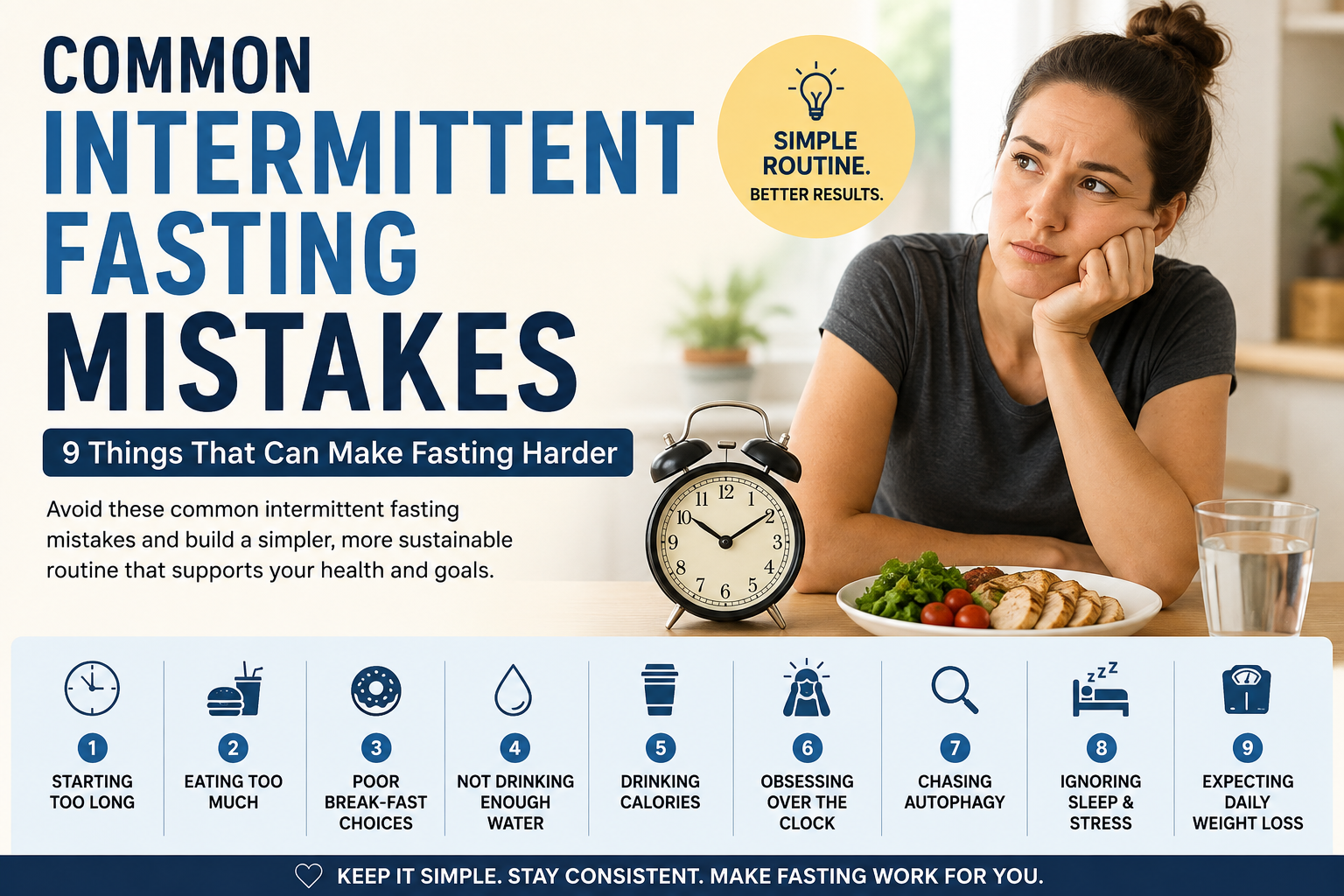
Here are nine common intermittent fasting mistakes — and simple ways to avoid them.
1. Starting With a Fasting Window That Is Too Long
One of the most common mistakes is assuming that longer fasting automatically means better results.
A beginner may hear about 16:8 fasting and immediately decide that 18:6 or 20:4 must be even better.
That can backfire.
If you are accustomed to eating from early morning until late evening, suddenly reducing your eating window to four or six hours can create excessive hunger, irritability, low energy, and a strong urge to overeat when the fast ends.
A more practical approach is to start with a schedule that feels manageable.
- 12:12 — a gentle introduction to structured eating
- 14:10 — a moderate fasting window
- 16:8 — a popular option once shorter fasts feel comfortable
You can always adjust later.
If you are just getting started, read our beginner’s guide to intermittent fasting.
2. Treating the Eating Window as Unlimited
Completing a 16-hour fast does not make the next eight hours calorie-free.
This is one of the most important intermittent fasting mistakes to understand if weight loss is your goal.
It is possible to fast every day and still consume more energy than your body needs.
For example, imagine breaking a fast with a very large meal, followed by snacks, sweetened drinks, another large meal, and dessert.
The fasting window does not erase those calories.
Intermittent fasting often helps with weight management because a shorter eating window may naturally reduce opportunities to eat. But the overall amount of food you consume still matters.
We explain this in detail in Intermittent Fasting and Weight Loss: What Actually Works?
3. Breaking Your Fast With a Meal That Leaves You Hungry Again
After fasting for several hours, it can be tempting to grab whatever food is easiest.
But a meal based mainly on highly refined carbohydrates or sugary foods may not keep you satisfied for very long.
A more balanced first meal usually includes:
- A useful source of protein
- Vegetables or fruit
- Fiber-rich carbohydrates
- Some healthy fat
For example:
- Eggs with vegetables and whole-grain toast
- Greek yogurt with berries, oats, and nuts
- Chicken with vegetables and rice
- Fish with potatoes and salad
- Beans with vegetables and whole grains
You do not need a special “fast-breaking” food.
You simply want a meal that helps you feel satisfied and supports the rest of your day.
See our complete guide to what to eat after a fast for more ideas.
4. Forgetting About Hydration
Some people accidentally drink less when they begin intermittent fasting because they associate drinking with meals.
But fasting does not mean avoiding water.
Water should generally remain your primary drink during the fasting period.
Depending on how strictly you define your fast, many people also use plain black coffee or unsweetened tea.
Problems such as headaches, fatigue, dry mouth, or difficulty concentrating can sometimes be made worse by inadequate fluid intake.
Do not wait until your eating window opens to start drinking.
For a more detailed explanation, see What Can You Drink While Intermittent Fasting?
5. Accidentally Drinking Calories During the Fast
Drinks are an easy place for calories to slip into a fasting routine.
A plain coffee is very different from a coffee containing sugar, flavored syrup, cream, or milk.
The same applies to:
- Juice
- Regular soft drinks
- Sweetened tea
- Energy drinks containing calories
- Sweetened coffee drinks
If your goal is a calorie-free fasting period, keep the drinks simple.
Water is the easiest option.
We have separate guides covering two of the most common questions:
6. Becoming Obsessed With the Exact Minute Your Fast Starts and Ends
Intermittent fasting is supposed to create structure, not another source of stress.
If your normal eating window begins at noon and one day you eat at 11:45 a.m., you have not ruined your routine.
Likewise, finishing dinner 20 minutes later than planned does not erase your progress.
Consistency matters much more than perfection.
Think about your routine over weeks and months rather than individual minutes.
A schedule that works 90% of the time is usually more useful than a “perfect” schedule you abandon after two weeks.
7. Chasing Autophagy Instead of Building a Sustainable Routine
Autophagy is frequently mentioned alongside intermittent fasting.
It refers to cellular processes involved in breaking down and recycling components inside cells.
Fasting and nutrient availability can influence pathways associated with autophagy, but online discussions often make the process sound much more precise than current human evidence allows.
You may see claims such as:
“Autophagy starts exactly at 16 hours.”
or:
“You need to fast for 18 or 24 hours to get the real benefits.”
Human metabolism does not operate according to one universal fasting stopwatch.
There is no single fasting duration that can be confidently identified as the exact moment when autophagy suddenly switches on for every person.
More importantly, chasing a longer fast simply to reach an imagined autophagy threshold can make your routine unnecessarily difficult.
If your primary goals are weight management and healthier eating habits, focus first on the fundamentals you can actually control:
- A sustainable eating window
- Balanced meals
- Appropriate overall energy intake
- Regular physical activity
- Adequate sleep
- Consistency
8. Ignoring Sleep and Stress
Your fasting schedule does not exist in isolation.
A poor night’s sleep can affect hunger, appetite, food choices, energy, and motivation the following day.
Stress can do something similar.
If you sleep poorly and then try to force yourself through an aggressive fasting window while extremely hungry, the problem may not be that you are “bad at fasting.”
Your routine may simply need more flexibility.
Good habits tend to support one another.
Instead of trying to perfect only your fasting window, look at the entire day:
- When do you sleep?
- When do you eat?
- Are your meals satisfying?
- Are you physically active?
- Are you constantly stressed?
A simple routine works better when the pieces fit together.
9. Expecting the Scale to Drop Every Day
Daily body weight fluctuates.
Your scale reflects much more than body fat.
Changes can come from:
- Water retention
- Salt intake
- Stored carbohydrate
- Food in your digestive system
- Hydration
- Actual changes in body fat
This means you can follow your fasting routine perfectly and still weigh more tomorrow morning than you did today.
That does not automatically mean the routine stopped working.
Look at the longer-term trend rather than allowing one measurement to determine whether you had a “good” or “bad” day.
Bonus Mistake: Thinking Hunger Means You Must Fast Longer
Hunger is not a competition.
Feeling hungry during part of a fasting period can be normal, especially while adapting to a new eating schedule.
But extreme or persistent hunger is not proof that the fast is working better.
If you regularly finish your fasting period feeling desperate for food and then overeat, consider whether your fasting window is too aggressive or your meals are not satisfying enough.
Sometimes moving from 16:8 back to 14:10 creates a routine that is much easier to maintain.
That is not failure.
It is adjustment.
How to Make Intermittent Fasting Easier
A good fasting routine should eventually feel relatively ordinary.
You should not need to spend the entire day thinking about your next meal.
Try keeping the rules simple:
- Choose a realistic eating window.
- Drink enough water.
- Eat satisfying meals with protein and fiber.
- Do not treat the eating window as unlimited.
- Keep calorie-containing drinks in mind.
- Allow some flexibility for real life.
- Pay attention to sleep and activity.
- Judge progress over time.
If you are constantly fighting your fasting routine, change the routine rather than assuming you need more willpower.
Is a Longer Fast Better?
Not automatically.
A longer fasting period may reduce the number of opportunities you have to eat, but it can also make some people significantly hungrier.
If that hunger leads to overeating later, the longer fasting window may provide no practical advantage.
The goal should not be to collect as many fasting hours as possible.
The goal is to find an eating pattern that supports your health goals and fits your life.
Should You Fast Every Day?
You do not necessarily need exactly the same fasting schedule seven days a week.
Some people enjoy consistency and use the same eating window almost every day.
Others prefer a little flexibility on weekends, social occasions, holidays, or travel days.
What matters is whether your overall pattern remains useful and sustainable.
If occasional flexibility helps you maintain the routine for months instead of abandoning it after a few weeks, that flexibility may actually make the plan stronger.
When Intermittent Fasting May Not Be Appropriate
Intermittent fasting is not suitable for everyone.
Extra caution is appropriate for people who:
- Have diabetes or use glucose-lowering medications
- Are pregnant or breastfeeding
- Have a current or previous eating disorder
- Are underweight
- Take medication that needs to be taken with food
- Have a medical condition affected by meal timing or food intake
Changing meal timing can affect medications and blood glucose management. The National Institute of Diabetes and Digestive and Kidney Diseases provides additional information about intermittent fasting and diabetes management.
If you have a medical condition or are unsure whether fasting is appropriate for you, speak with a qualified healthcare professional.
The Biggest Intermittent Fasting Mistake
Perhaps the biggest mistake is turning a simple eating pattern into something complicated.
You do not need the perfect fasting app.
You do not need to extend every fast.
You do not need to worry about whether you reached a precise metabolic milestone at hour 15, 16, or 17.
And you do not need every day to look exactly the same.
Intermittent fasting is simply one tool for creating structure around eating.
If that structure helps you eat more intentionally and maintain habits that support your goals, it may be useful.
If the structure becomes so restrictive that you constantly fight against it, simplify it.
Final Thoughts
Most intermittent fasting mistakes come from trying to make fasting more extreme or more complicated than it needs to be.
Start with a manageable schedule. Drink water. Build satisfying meals. Remember that calories still matter. Do not chase arbitrary fasting milestones, and give yourself enough flexibility to live normally.
Most importantly, judge your routine by whether you can maintain it — not by how impressive the fasting window looks.
A simple routine you can repeat is usually more useful than an extreme routine you cannot sustain.
This article is for general educational purposes and is not a substitute for individualized medical or nutritional advice.