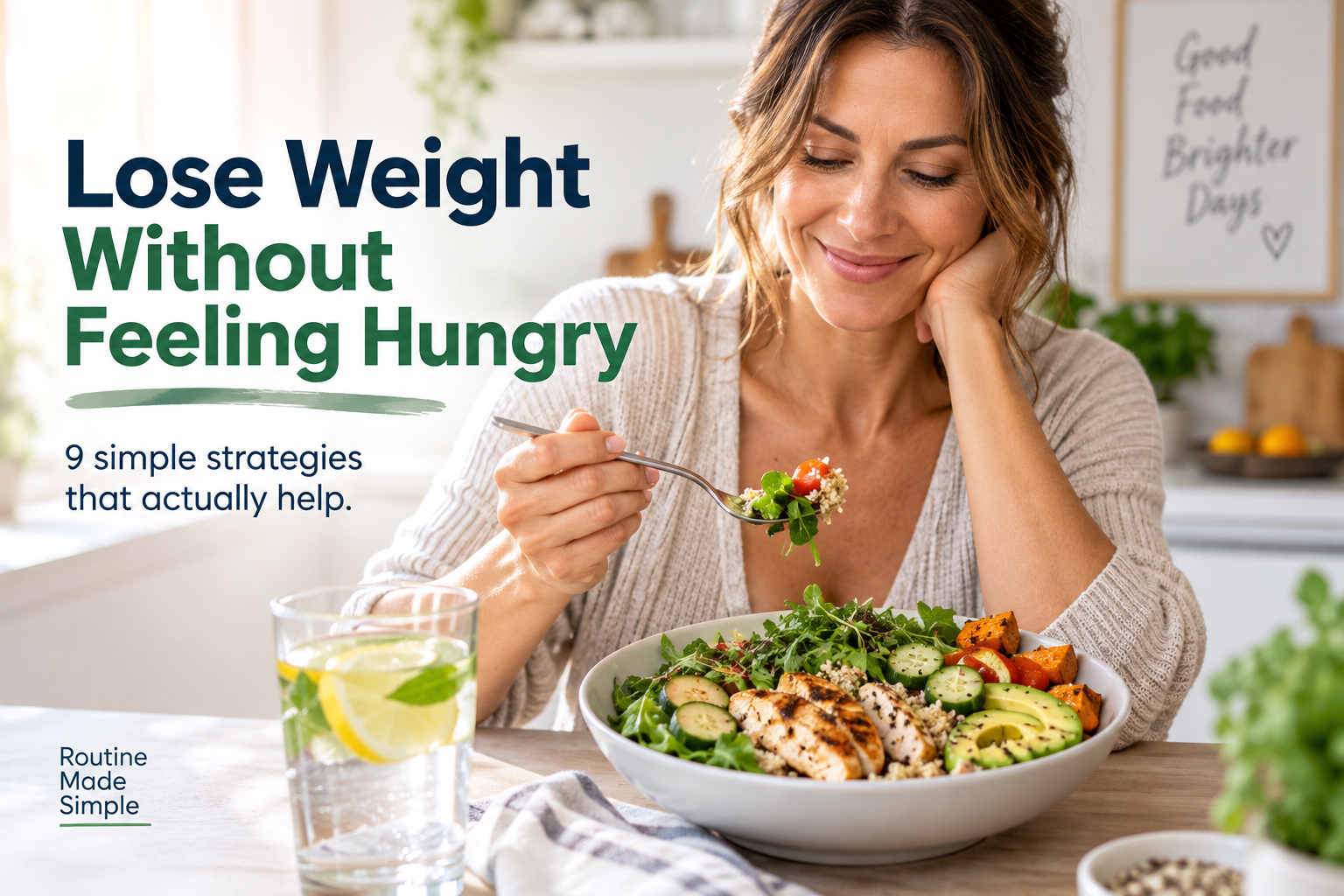
Losing weight does not have to mean walking around hungry all day.
In fact, if your weight-loss plan constantly leaves you thinking about food, fighting cravings, and waiting for your next meal, there is a good chance the plan is simply too difficult to maintain.
The goal is not to see how little you can eat. The goal is to create a modest calorie deficit while choosing foods and habits that help you stay satisfied.
If you are wondering how to lose weight without feeling hungry, the answer usually comes down to a few surprisingly simple changes: more protein, more fiber, better food choices, a reasonable calorie deficit, and a routine you can repeat consistently.
Here are nine practical strategies that can make weight loss feel much easier.
Why Are You So Hungry When Trying to Lose Weight?
Some increase in appetite can happen when you eat fewer calories than your body uses. That does not mean you need to be constantly hungry.
The problem often starts when people try to lose weight too aggressively.
- They dramatically reduce calories.
- They skip meals even when they are genuinely hungry.
- They remove entire food groups unnecessarily.
- They eat tiny portions of foods that are not very filling.
- They try to survive on willpower.
That approach may work for a few days, but it can be difficult to sustain for weeks or months. The CDC recommends a gradual, realistic approach to weight loss built around healthy eating, physical activity, sleep, and sustainable goals. You can read its guidance on healthy weight loss here.
A better approach is to make your meals more satisfying while keeping your overall calorie intake appropriate for your goal. That is the foundation of learning how to lose weight without feeling hungry all the time.
1. Build Your Meals Around Protein
If you want meals that keep you satisfied, protein is a good place to start.
Instead of building a meal around bread, pasta, rice, or snack foods and then adding a small amount of protein, try reversing the process. Choose your protein source first.
- Eggs
- Greek yogurt
- Cottage cheese
- Chicken or turkey
- Fish
- Lean meat
- Beans and lentils
- Tofu or tempeh
Then build the rest of the meal around it.
Protein can be particularly useful when you are trying to manage hunger. Harvard’s Nutrition Source notes that higher-protein foods may move more slowly from the stomach to the intestine, helping people feel full for longer. You can read more about protein, satiety and weight loss at Harvard’s Nutrition Source.
This does not mean you need to follow an extreme high-protein diet. It simply means making protein a consistent part of your meals instead of treating it as an afterthought.
If this is something you struggle with, read our guide on how to eat more protein without overcomplicating your diet.
2. Get Enough Fiber
Protein is only part of the picture. Fiber can also help make meals more satisfying.
High-fiber foods generally take longer to eat and can add volume to your meals. Many also contain plenty of water, which means you can eat a satisfying amount of food without necessarily consuming a huge number of calories.
Good options include:
- Vegetables
- Berries
- Apples and pears
- Beans and lentils
- Oats
- Whole grains
- Chia and flax seeds
- Nuts and seeds
Combining protein with fiber-rich foods is one of the simplest practical strategies when figuring out how to lose weight without feeling hungry.
We covered this in detail in our guide to getting enough fiber every day.
3. Choose Foods That Give You More Volume
One of the easiest ways to understand hunger during weight loss is to compare two meals with similar calories but very different amounts of food.
A small pastry can contain several hundred calories and disappear in a few bites. Those same calories could potentially give you a much larger meal containing lean protein, whole grains or another satisfying carbohydrate, vegetables, and fruit.
This concept is often described as energy density.
Foods with a lower energy density allow you to eat a larger physical volume of food for fewer calories.
Examples include vegetables, fruit, broth-based soups, lean proteins, beans, and many minimally processed foods.
This does not make higher-calorie foods “bad.” It simply means that when calories are limited, choosing more filling foods can make staying within your target much easier.
4. Create a Routine Instead of Fighting Hunger With Willpower
One of the biggest mistakes in weight loss is assuming that success depends on being disciplined every minute of the day.
A predictable routine can reduce the number of food decisions you need to make.
You might eat at roughly similar times each day, have a few reliable breakfasts or lunches, keep filling foods available, and decide in advance what you will do when cravings appear.
Some people also find that a defined eating window gives their day more structure. Intermittent fasting is not required for weight loss, but a schedule such as 14:10 or 16:8 can be useful if it naturally helps you reduce unnecessary snacking without leaving you miserable.
This idea of making the routine easier to follow is also why I use Unimate + Balance as part of my own Feel Great routine. For me, the value is the structure: a morning routine, Balance before meals, and a defined eating window. It does not replace sensible food choices or create weight loss by itself — it simply fits into a routine that I find easier to follow consistently.
Individual experiences vary. Supplements should complement, not replace, a balanced diet and healthy lifestyle.
5. Don’t Make Your Calorie Deficit Too Aggressive
If you are constantly hungry while dieting, your food choices may not be the only problem. You may simply be trying to eat too little.
Weight loss requires an energy deficit, but a larger deficit is not automatically better.
An aggressive approach may produce faster changes on the scale initially, but if it makes the diet impossible to maintain, it is not particularly useful.
If your goal is to learn how to lose weight without feeling hungry, think in terms of creating a manageable deficit that you can maintain consistently rather than eating as little as possible.
You also do not necessarily have to track every calorie. Our guide to creating a calorie deficit without counting calories explains several practical alternatives.
6. Be Careful With Liquid Calories
Calories you drink can be surprisingly easy to overlook.
Sugary drinks, specialty coffees, juices, alcohol, and other calorie-containing beverages can add hundreds of calories without providing the same satisfaction you might get from eating those calories as part of a meal.
You do not need to eliminate every calorie-containing drink. Just be aware of them.
For everyday hydration, water, sparkling water, unsweetened tea, and coffee without large amounts of added sugar or cream are usually simpler choices.
7. Plan for Cravings Instead of Trying to Be Perfect
A sustainable diet should leave room for foods you enjoy.
Trying to completely ban chocolate, dessert, pizza, or every other food you consider “unhealthy” can turn a normal craving into a much bigger psychological battle.
Instead, think about portions and frequency.
You can have nutritious meals most of the time while occasionally eating foods simply because you enjoy them.
That flexibility can make the difference between following a plan for two weeks and maintaining better habits for years.
8. Don’t Ignore Sleep
Food is not the only factor that can influence how hungry you feel.
Poor sleep can make weight management more difficult by affecting appetite, energy, food choices, and your willingness to be physically active.
After a bad night’s sleep, highly palatable foods can suddenly become much harder to resist.
That is one reason why improving sleep can be surprisingly useful when you are trying to lose weight.
Read more in our guide to sleep and weight loss.
9. Make Your Weight-Loss Routine Easy Enough to Repeat
This may be the most important strategy on the list.
You do not need the theoretically perfect diet. You need a routine that works on Monday morning, Wednesday afternoon, Friday night, and during a busy week when everything does not go according to plan.
That might mean eating similar breakfasts most days. Keeping easy protein options in the refrigerator. Buying frozen vegetables. Walking instead of doing complicated workouts. Or using a consistent eating window because it simplifies your day.
The easier your system is to repeat, the less you need to rely on motivation.
What Should a Filling Weight-Loss Meal Look Like?
You do not need a complicated formula. A simple meal might include:
- A protein source: chicken, fish, eggs, Greek yogurt, tofu, beans, or another protein you enjoy.
- Vegetables or fruit: for fiber, volume, and variety.
- A satisfying carbohydrate: potatoes, rice, oats, whole grains, beans, or fruit.
- Some dietary fat: olive oil, avocado, nuts, seeds, cheese, or another source in an appropriate portion.
You can adjust the proportions according to your preferences and calorie needs.
The important part is that the meal should actually feel like a meal — not a tiny “diet plate” that leaves you searching the kitchen an hour later.
How to Lose Weight Without Feeling Hungry: Is It Really Possible?
Learning how to lose weight without feeling hungry does not mean guaranteeing that you will never experience hunger. Hunger is a normal biological signal.
But there is a major difference between occasionally feeling ready for your next meal and spending the entire day battling intense hunger.
If you are hungry all the time, do not automatically assume you need more discipline. Look at your system.
- Are you eating enough protein?
- Are you getting enough fiber?
- Are your meals large enough to feel satisfying?
- Is your calorie deficit reasonable?
- Are you sleeping enough?
- Does your eating schedule actually fit your life?
Improving those basics can make a substantial difference.
The Bottom Line
Understanding how to lose weight without feeling hungry is not about finding a trick that switches off your appetite.
It is about creating an environment in which eating fewer calories becomes easier.
Prioritize protein and fiber. Eat foods that give you enough volume. Keep your calorie deficit reasonable. Pay attention to sleep. Build a simple eating structure. And leave enough flexibility that you can still enjoy your life.
You do not need to do all nine strategies perfectly tomorrow.
Pick one or two and start there.
Small improvements that you can repeat are usually more useful than a perfect plan you cannot maintain.