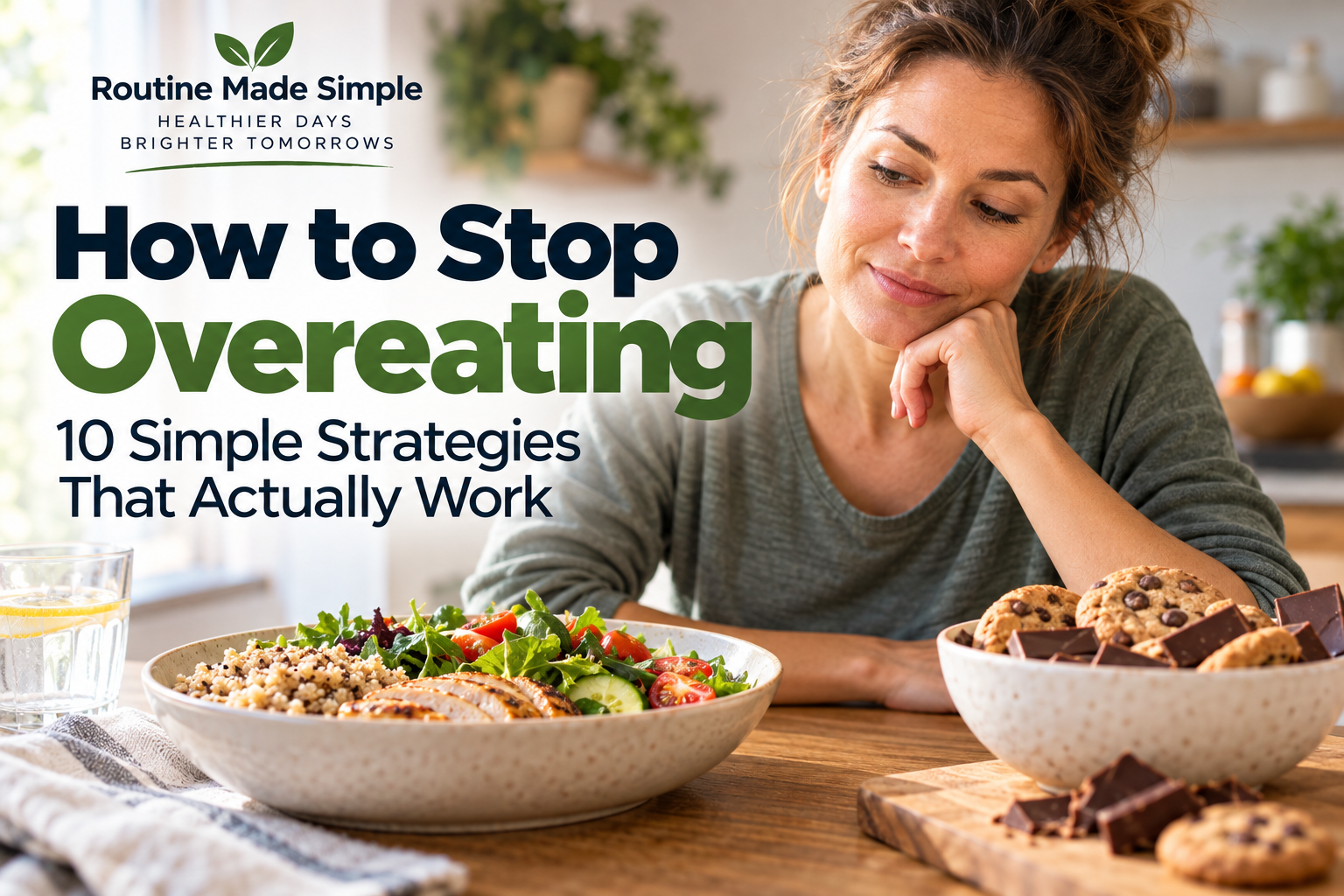
You planned to eat a normal dinner.
Then you went back for seconds.
And maybe thirds.
Or perhaps the problem is not one large meal. You simply keep eating throughout the day — a handful of something here, a snack there, and a few bites while preparing dinner.
By the end of the day, you have eaten considerably more than you intended.
If this sounds familiar, learning how to stop overeating does not begin with finding more willpower.
It begins with understanding why you are overeating.
Sometimes the reason is genuine hunger. Sometimes your meals are not satisfying enough. Sometimes portions have gradually become larger. And sometimes eating has become connected to stress, boredom, television or another everyday habit.
Here are 10 practical strategies that can help you build a more manageable eating routine without turning every meal into another diet rule.
Why Do We Overeat?
Overeating does not have one single cause.
You may eat more than you intended because:
- you waited too long between meals,
- your previous meal was too small,
- you are eating very quickly,
- the food is highly palatable and easy to keep eating,
- you are distracted while eating,
- you regularly eat directly from large packages,
- you are stressed or bored,
- you are following an overly restrictive diet,
- or eating has simply become attached to another habit.
This distinction matters.
If you are overeating because lunch consists of a tiny salad and you are starving by 6 p.m., the solution may be very different from someone who automatically eats chips every evening while watching television.
Instead of starting with:
“How do I force myself to eat less?”
start with:
“What is making me want to keep eating?”
How to Stop Overeating: 10 Practical Strategies
1. Don’t Arrive at Every Meal Starving
Extreme hunger makes portion control considerably harder.
If you regularly skip meals, eat very little during the day or deliberately try to “save calories” for dinner, you may arrive at your evening meal ready to eat everything available.
That is not necessarily a failure of discipline.
Your body is responding to hunger.
A more sustainable approach is to build meals that keep you reasonably satisfied throughout the day.
This does not mean you must eat on a rigid schedule.
It simply means that repeatedly pushing yourself into extreme hunger may make overeating more likely later.
If hunger is making weight management difficult, read our guide on how to lose weight without feeling hungry.
2. Put Protein on the Plate First
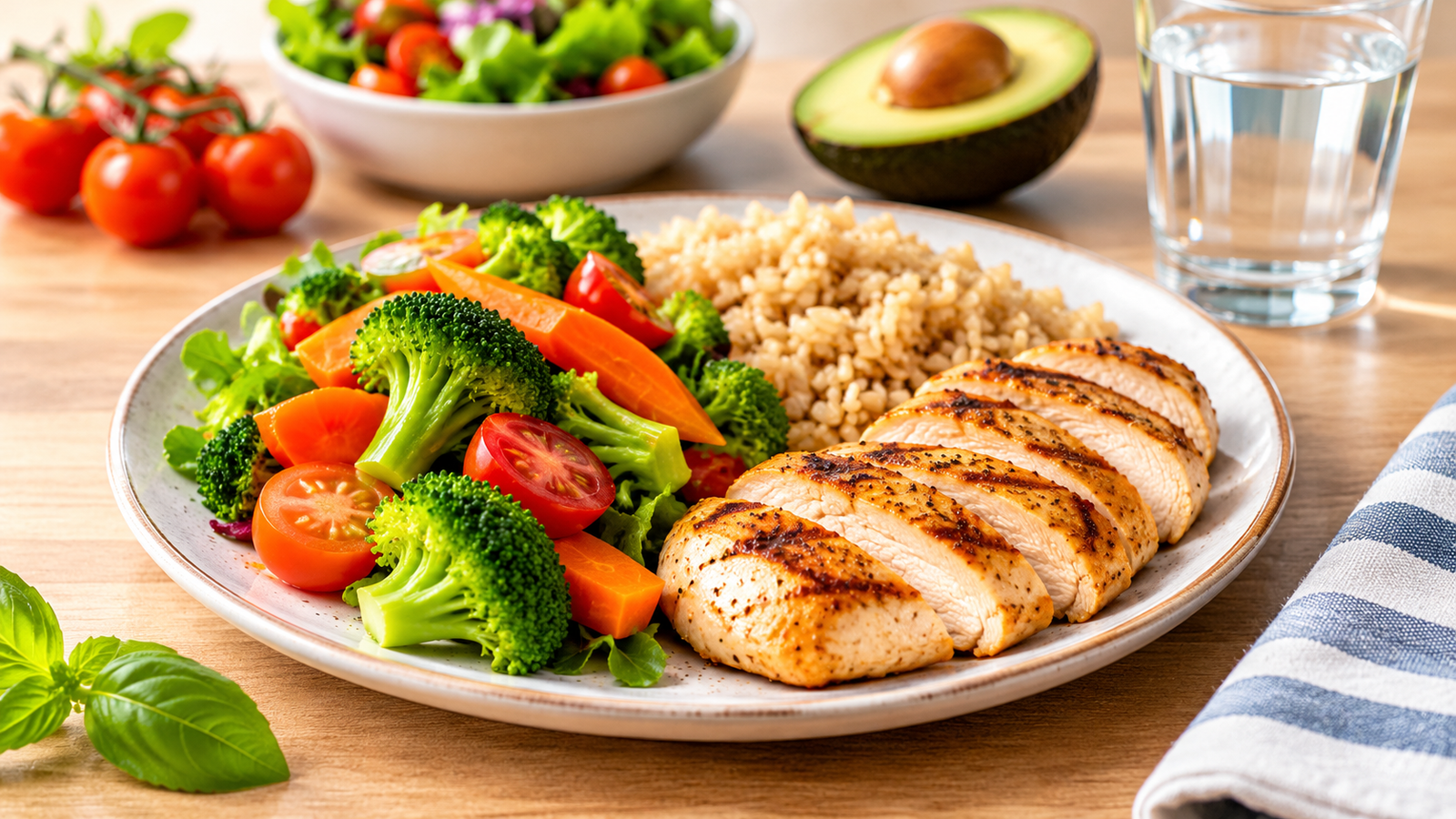
Protein can make meals more satisfying.
Instead of building a meal around whatever carbohydrate happens to be easiest, first ask:
What is my protein source?
That might be:
- eggs,
- Greek yogurt,
- chicken or turkey,
- fish,
- lean meat,
- cottage cheese,
- beans or lentils,
- tofu or another soy food.
Then build the rest of the meal around it.
You do not need enormous amounts of protein or complicated calculations.
The goal is simply to avoid meals that leave you searching for more food shortly afterward.
For practical examples, see our guide on how to eat more protein.
3. Add Volume With Fiber-Rich Foods
One reason some meals are easy to overeat is that they provide a lot of energy in a relatively small amount of food.
Adding vegetables, fruit, beans, whole grains and other fiber-rich foods can help create meals that feel more substantial.
For example, compare:
A small serving of pasta with sauce
with:
Pasta + chicken + a large portion of vegetables + salad.
The second plate contains more food volume and a broader combination of nutrients.
You do not need vegetables to replace everything else on your plate.
Use them to build a more satisfying meal.
Our article on how to get enough fiber can help if your current diet is low in fiber.
Make Your Eating Routine Simpler
A consistent structure can make food decisions easier, particularly if constant snacking and unplanned eating are making your routine difficult to manage.
The Unicity Feel Great system combines Unimate and Balance within a structured daily routine. Unimate is generally used earlier in the day, while Balance is typically used around meals according to current product directions.
Neither product prevents overeating or replaces the fundamentals of nutrition. Appropriate portions, nutritious meals, movement, sleep and your overall energy intake still matter.
If you want to understand how the two products differ, see our Unimate vs Balance guide.
Affiliate disclosure: Routine Made Simple may earn a commission or receive sales credit from qualifying purchases made through this link, at no additional cost to you.
4. Stop Eating Directly From the Package
This is one of the simplest changes you can make.
If you sit down with a large bag of chips, box of crackers or container of ice cream, you have very little visual information about how much you have eaten.
Your hand simply keeps returning to the package.
Instead:
Put the amount you want to eat on a plate or in a bowl.
Then put the package away.
You are still allowed to have more.
But getting a second portion now requires another conscious decision.
That small amount of friction can interrupt automatic eating.
This principle is part of our broader guide on how to control portion sizes without counting calories.
5. Slow Down the First 10 Minutes of Your Meal
You do not need to chew every bite 30 times or turn dinner into a mindfulness exercise.
Just slow the beginning of the meal down slightly.
Put your fork down occasionally.
Take a drink.
Talk to the person eating with you.
Notice what the food tastes like.
If you normally finish dinner in seven minutes, try making it last 12 or 15.
Eating more slowly gives you more opportunity to notice how your hunger is changing before automatically reaching for another serving.
6. Remove the Screen Sometimes
Television, phones and computers make it remarkably easy to eat without paying much attention to the food.
You look down and suddenly the plate is empty.
This does not mean every meal needs to happen in complete silence.
But if overeating frequently happens while watching television or scrolling through your phone, experiment with eating one meal each day without a screen.
See whether you notice your food — and your fullness — differently.
Environmental cues matter, especially when eating has become automatic.
7. Wait Before Getting Seconds
You finish your plate and immediately want more.
Before getting another full serving, wait for a few minutes.
You could:
- drink some water,
- clear part of the table,
- talk for another five minutes,
- or simply sit for a moment.
Then ask yourself:
Am I still physically hungry?
If the answer is yes, have more food.
The goal is not to forbid seconds.
The goal is to turn an automatic second serving into a conscious decision.
8. Stop Making Your Diet So Restrictive
If you spend Monday through Friday trying to eat perfectly, the weekend can easily become the opposite.
Restriction can create a familiar cycle:
strict diet → hunger and cravings → overeating → guilt → stricter diet.
Then the cycle repeats.
If this sounds familiar, the solution may not be another stricter plan.
You may need more flexibility.
A sustainable eating pattern can include foods you enjoy.
One dessert does not ruin a week.
One restaurant meal does not erase your progress.
And chocolate does not need to disappear from your home simply because you want to lose weight.
If sweet foods are your biggest trigger, our guide on how to reduce sugar cravings is a useful next read.
9. Identify Your Automatic Eating Trigger
If you want to learn how to stop overeating, pay attention to what happens immediately before it.
Maybe it is:
- coming home from work,
- sitting on the couch,
- feeling stressed,
- watching television,
- opening a bottle of wine,
- being alone in the evening,
- or staying awake too late.
Once you recognize the trigger, you can experiment with changing the routine around it.
For example, if the problem consistently happens at night, read our guide on how to stop snacking at night.
10. Stop Treating One Large Meal as a Disaster
You ate too much at dinner.
That does not require punishment.
You do not need to skip breakfast tomorrow.
You do not need an exhausting workout.
And you do not need to declare the entire week ruined.
Simply return to your normal routine at the next appropriate meal.
This is one of the most useful habits you can develop.
People rarely struggle because of one large meal.
The bigger problem is often what happens after it:
“I already messed up, so it doesn’t matter anymore.”
It still matters.
Your next decision is simply your next decision.
How to Stop Overeating Without Counting Calories
Calorie tracking can be useful for some people, but it is not the only way to become more aware of how much you eat.
You can also use simple visual and behavioral strategies.
Try:
- serving food on a plate instead of eating from packages,
- including a clear protein source,
- adding vegetables or another fiber-rich food,
- slowing down your meal,
- waiting before automatically getting seconds,
- and reducing distracted eating.
These strategies will not perfectly control your calorie intake.
That is not the point.
They simply make portions and eating decisions more visible.
Can Intermittent Fasting Help With Overeating?
For some people, yes.
A defined eating window can reduce opportunities for constant grazing and simplify the day.
Instead of eating from early morning until late at night, you have a clearer structure.
But intermittent fasting can also backfire if the fasting period leaves you extremely hungry.
If you regularly reach your eating window and immediately consume a very large amount of food, consider whether your fasting schedule is too aggressive.
A 12:12 or 14:10 schedule may work better for you than forcing yourself into 16:8.
If you are new to fasting, start with our beginner’s guide to intermittent fasting.
What If You Overeat Mostly at Night?
Nighttime overeating deserves its own attention because it is often strongly connected to routine.
You may eat dinner normally and then spend the next three hours grazing.
In that case, look at what happens after dinner.
Do you:
- sit in the same place?
- watch television?
- keep snack foods beside you?
- stay awake long after you become tired?
- use food as your main way to relax?
Changing the evening environment can sometimes be more effective than trying to resist food repeatedly.
Try a short walk, tea, brushing your teeth, cleaning the kitchen or another activity that clearly marks the end of your eating period.
Does Drinking Water Stop Overeating?
Water is important, but it is not a replacement for food when you are genuinely hungry.
Staying hydrated can support your normal routine, and having water available during meals is perfectly reasonable.
But you do not need to drink enormous amounts of water in an attempt to suppress hunger.
If you are unsure how much fluid you actually need, see our guide on how much water you should drink a day.
A Simple 7-Day Experiment
If overeating feels automatic, spend one week observing it instead of trying to create a perfect diet.
For the next seven days:
- Include a clear protein source in your main meals.
- Add a fiber-rich food to each main meal.
- Put snacks into a bowl instead of eating from the package.
- Slow down the first 10 minutes of dinner.
- Wait a few minutes before getting seconds.
- Notice what happens immediately before unplanned eating.
- If you overeat, simply return to your normal routine afterward.
Do not judge the results.
Look for patterns.
You might discover that overeating happens only when lunch is too small.
Maybe it happens when you eat while watching television.
Maybe weekends are difficult because your weekday diet is unnecessarily restrictive.
Once you know the pattern, you have something specific to change.
Frequently Asked Questions
Why do I keep overeating even when I’m not hungry?
Eating can be triggered by habit, boredom, stress, environmental cues or highly palatable food even when physical hunger is relatively low. Identifying the situations in which overeating occurs can help distinguish habitual eating from genuine hunger.
How can I stop overeating at dinner?
Try arriving at dinner reasonably hungry rather than starving, include protein and fiber-rich foods, slow the beginning of the meal and wait briefly before automatically taking another serving.
Should I skip the next meal after overeating?
Usually, there is no need to compensate for one large meal by dramatically restricting food afterward. Returning to your normal eating routine is generally a more sustainable approach.
Can portion control help prevent overeating?
Portion awareness can help, particularly when you regularly eat from large packages or automatically serve very large amounts. However, portions are only part of the issue. Hunger, food quality, habits and your overall eating pattern also matter.
Can lack of sleep contribute to overeating?
Sleep can influence appetite, food choices and how easy it feels to maintain healthy routines. If you regularly sleep too little, improving your sleep habits deserves attention alongside nutrition.
How to Stop Overeating: The Bottom Line
If you are learning how to stop overeating, do not begin with another list of foods you are forbidden to eat.
Start with the reason you are eating more than you intended.
Are you extremely hungry?
Are your meals satisfying?
Are your portions happening automatically?
Are you distracted?
Are you eating because you are stressed or bored?
Are you following a diet that is too restrictive to maintain?
Then change the part of the routine that is actually causing the problem.
Better meals, better portions and better habits usually work together.
You do not need perfection.
You need a routine that makes the better decision easier to repeat.
Build a Simpler Eating Routine
If intermittent fasting is part of your routine, our free 7-day guide can help you create a simple 16:8 structure without turning every meal into another complicated diet rule.
Affiliate disclosure: Routine Made Simple may earn a commission or receive sales credit from qualifying purchases made through affiliate links, at no additional cost to you.
Important: This article provides general educational information and is not individualized medical or nutritional advice. Frequent episodes of loss-of-control eating, binge eating, severe restriction or significant distress around food should be discussed with an appropriate qualified healthcare professional.