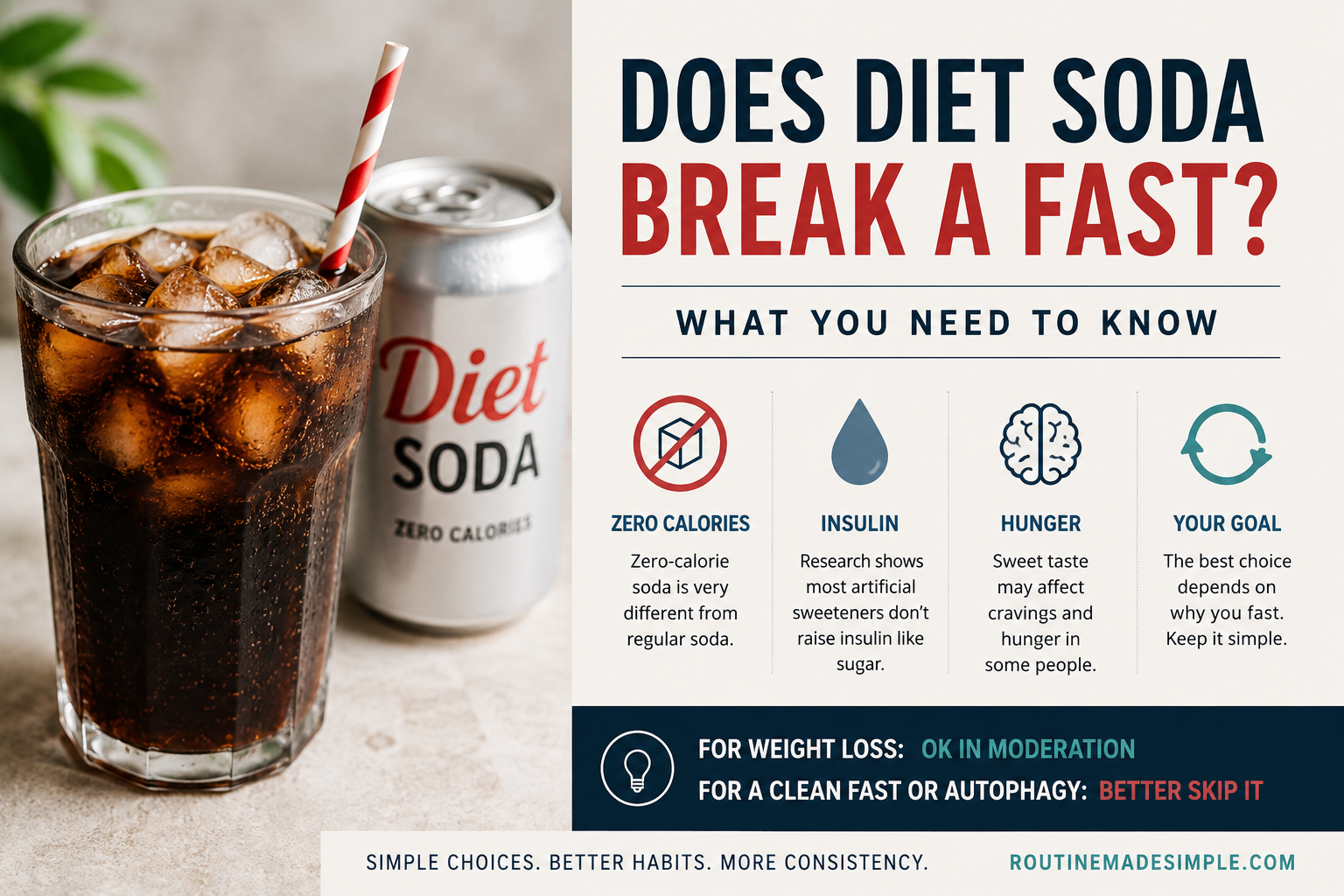
Does diet soda break a fast? If you are drinking a zero-calorie soda during intermittent fasting, the answer depends partly on what you mean by “breaking a fast.”
For a practical fast focused on calorie control or weight management, a truly zero-calorie diet soda is very different from a regular sugar-sweetened soda. But if your goal is a strict “clean fast,” avoiding sweet-tasting drinks entirely may be the simpler choice.
And if you are fasting specifically because you are interested in processes such as autophagy, the evidence in humans is not strong enough to say that diet soda definitely preserves or definitely stops those processes.
So the useful answer is not simply yes or no. It depends on your fasting goal.
Does Diet Soda Break a Fast? The Short Answer
If you are asking does diet soda break a fast because your main goal is reducing calorie intake or supporting weight management, a zero-calorie diet soda is unlikely to affect your fast in the same way as a sugar-sweetened drink.
Most diet sodas contain very few or no calories and use non-nutritive or low-energy sweeteners such as:
- Aspartame
- Sucralose
- Acesulfame potassium
- Saccharin
- Stevia-derived sweeteners
A systematic review and meta-analysis of randomized controlled trials found no significant acute effect of low-energy sweeteners on average post-meal glucose or insulin responses compared with control interventions.
A later systematic review and network meta-analysis similarly found that beverages containing non-nutritive sweeteners produced acute glucose and endocrine responses broadly similar to water controls.
That makes diet soda very different from regular soda containing sugar and calories.
But fasting can have different goals, which is why the answer becomes more nuanced.
Your Fasting Goal Changes the Answer
People use intermittent fasting for different reasons.
You may be fasting to:
- Reduce overall calorie intake
- Support weight loss
- Simplify your eating schedule
- Reduce unnecessary snacking
- Follow a strict calorie-free fasting period
- Explore metabolic effects associated with fasting
- Explore possible cellular processes such as autophagy
A drink that fits one version of fasting may not fit another.
That is why it helps to decide what you are actually trying to accomplish before worrying about whether one particular drink “breaks” your fast.
Diet Soda and Weight-Loss Fasting
If your primary goal is weight management, overall energy intake remains important.
Replacing a sugar-sweetened soda with a zero-calorie version can substantially reduce the calories coming from that drink.
That does not make diet soda necessary for weight loss, and water remains the simplest option.
But if a zero-calorie soda helps you avoid a calorie-containing drink and makes your eating routine easier to maintain, it may fit a practical calorie-focused fasting approach.
Remember that intermittent fasting is not magic by itself. What and how much you eat during your eating window still matters.
For a broader explanation, read Calorie Deficit vs Intermittent Fasting: What Actually Drives Weight Loss?
Does Diet Soda Raise Insulin?
This is one of the most common concerns about drinking diet soda while fasting.
You may have seen claims that the sweet taste of diet soda automatically causes a large insulin response and therefore immediately breaks the fast.
The evidence does not support such a simple universal rule.
Controlled studies of low-energy and non-nutritive sweeteners generally do not show the same acute glucose and insulin response as consuming sugar.
In the 2020 systematic review and meta-analysis, researchers found no statistically significant differences in post-meal glucose or insulin responses after low-energy sweetener exposure compared with control interventions.
Another systematic review of human studies found that physiological responses to non-nutritive sweeteners can occur inconsistently, illustrating why the subject is more complicated than saying that every sweet taste causes a large insulin spike.
That does not mean every person, sweetener, dose or situation produces an identical response.
It simply means that the statement “diet soda always spikes insulin and instantly breaks your fast” is too absolute.
Regular Soda Is Different
Regular soda is much easier to classify.
If it contains sugar and calories, it provides energy during your fasting period.
For a calorie-free fast, that means the fast has been broken.
The same basic principle applies to drinks such as:
- Regular soda
- Fruit juice
- Sweetened tea
- Coffee with sugar or caloric creamers
- Sports drinks containing sugar
- Energy drinks containing calories
If you are unsure about other foods and drinks, see What Breaks a Fast? A Simple Guide for Beginners.
What About Zero Sugar Soda?
“Zero sugar” and “diet” are product labels, not one universal formula.
Always check the nutrition label of the actual drink.
If a beverage contains:
- Zero or negligible calories
- No meaningful amount of carbohydrate
- No added sugar
then it is very different from a regular sugar-sweetened soda from a calorie perspective.
However, formulas can differ between brands and countries, so do not assume every drink labeled “diet,” “light” or “zero” is identical.
Can Sweet Taste Make Fasting Harder?
This is where your individual experience becomes important.
Even if a zero-calorie drink does not produce the same metabolic response as a sugary drink, its sweet taste may affect your behavior.
Some people can drink diet soda and move on with their day without thinking about food.
Others notice that sweet-tasting drinks make them think about food more often or increase their desire for something sweet.
If diet soda makes your fasting window easier, that is useful information.
If it makes you hungrier or triggers cravings, that is useful information too.
You do not necessarily need one universal rule. Pay attention to how the habit affects your own routine.
Diet Soda, Hunger and Sugar Cravings
The practical issue with diet soda may sometimes be less about technically “breaking” the fast and more about what happens afterward.
Suppose you drink one and then spend the next hour thinking about snacks or sweets.
In that situation, technically avoiding calories may not be helping your fasting routine very much.
On the other hand, if a diet soda helps you comfortably replace a regular soda while you build healthier habits, you may find it useful.
If cravings are a bigger issue for you, read How to Stop Sugar Cravings: 9 Simple Strategies That Actually Help.
Does Diet Soda Break a Clean Fast?
Some people use the term clean fasting to describe a fasting period in which they consume only simple calorie-free drinks such as:
- Water
- Plain sparkling water
- Black coffee
- Unsweetened tea
Under that stricter personal definition, diet soda usually does not fit.
It may contain no meaningful calories, but it still provides sweetness, flavorings and other ingredients.
If your personal fasting rule is “water, black coffee and plain tea only,” then diet soda is outside that rule.
That is different from claiming that a zero-calorie diet soda necessarily produces the same metabolic response as a sugar-sweetened drink.
Does Diet Soda Break Autophagy?
This question is much harder to answer confidently.
Autophagy is a cellular process involved in breaking down and recycling cellular components.
Fasting and calorie restriction are associated with pathways involved in autophagy, but translating this research into precise rules for everyday intermittent fasting is difficult.
A review of fasting, calorie restriction and autophagy found substantial evidence that food deprivation can influence autophagy across tissues, but much of the underlying evidence comes from experimental and animal research.
Human research is more difficult because measuring autophagic activity directly is complicated. A review of physiological responses to acute fasting concluded that whether a single acute fast produces significant increases in autophagy remains uncertain.
We therefore do not have good evidence showing that one can of diet soda definitely stops autophagy in humans.
We also do not have strong evidence proving that it has absolutely no effect.
If maximizing a strict fasting state for possible cellular effects is your main goal, the simplest approach is to choose water, black coffee or unsweetened tea instead.
That avoids the need to speculate.
What About Aspartame?
Aspartame is one of the sweeteners commonly found in diet beverages.
It is easy to find dramatic claims online suggesting that consuming aspartame automatically creates the same response as consuming sugar.
Human research on non-nutritive sweeteners does not support treating all sweeteners, doses and situations as metabolically identical to sugar.
That does not mean you need to consume aspartame.
It simply means that fasting decisions should be based on the best available evidence rather than assuming that sweet taste and sugar are physiologically identical.
What About Sucralose?
Sucralose is another common non-nutritive sweetener.
Research involving different sweeteners has produced varying findings depending on dose, timing, whether nutrients are consumed at the same time and characteristics of the participants.
That is another reason we should avoid turning every artificially sweetened drink into one identical metabolic category.
For practical calorie-focused fasting, however, the distinction between a zero-calorie beverage and a sugar-sweetened soda remains important.
Does Caffeine Change the Answer?
Many diet sodas also contain caffeine.
Caffeine itself does not add meaningful calories, so its presence does not automatically turn a zero-calorie drink into a calorie-containing one.
However, caffeine late in the day can interfere with sleep for some people.
That matters because a routine that harms your sleep may make hunger, cravings and food choices harder to manage the following day.
If you drink several caffeinated diet sodas in the afternoon or evening, caffeine may therefore be more relevant to your routine than whether the drink technically breaks your fast.
What Can You Drink Instead of Diet Soda?
If you want the simplest possible fasting drinks, choose:
- Water
- Plain sparkling water
- Black coffee
- Unsweetened tea
These options make fasting rules easier because there is less ambiguity.
Our complete guide is here: What Can You Drink While Intermittent Fasting?
You may also find these guides useful:
Is Sparkling Water Better Than Diet Soda During a Fast?
If you enjoy carbonation but want to avoid sweetness, plain sparkling water is probably the simplest alternative.
Look for a version with no sugar and no meaningful calories.
Some flavored sparkling waters may also fit a calorie-focused fast if they contain no sugar or calories, although people who prefer a strict clean fast may choose plain versions.
The main advantage is simplicity.
You still get carbonation without making your fasting routine more complicated.
Can Diet Soda Help With Weight Loss?
Diet soda is not a weight-loss product.
But replacing a calorie-containing drink with a zero-calorie version can reduce energy intake if those calories are not simply replaced elsewhere.
The important word is replacing.
If someone moves from several regular sodas per day to zero-calorie alternatives, that can remove a meaningful amount of energy from the diet.
If the person then compensates by consuming more calories elsewhere, the overall effect may be much smaller.
The complete eating pattern matters more than one individual beverage.
Should You Drink Diet Soda Every Day?
Whether you choose to drink diet soda regularly is a separate question from whether it technically fits your fasting routine.
You do not need diet soda to fast successfully.
Water should still do most of the work for hydration.
If you enjoy an occasional diet soda and it does not increase your cravings or interfere with your sleep, you may decide that it fits your routine.
If you find yourself relying on several cans every day simply to tolerate your fasting window, it may be worth looking at the fasting schedule itself.
A routine should be sustainable without feeling like a daily endurance test.
Does Diet Soda Break a Fast for Beginners?
If you are new to intermittent fasting, I would keep things simple.
Start with:
- Water
- Plain unsweetened tea
- Black coffee if you already enjoy drinking it
Once you understand how your fasting routine feels, you can decide whether an occasional zero-calorie diet soda helps or makes things harder.
If you are still learning the basics, see How to Start Intermittent Fasting: A Beginner’s Guide to Eating Windows.
A Simple Rule for Diet Soda While Fasting
If you do not want to overthink it, remember these three points:
- For a practical calorie-focused fast: an occasional truly zero-calorie soda is unlikely to affect the fast in the same way as a sugary drink.
- For a strict clean fast: choose water, black coffee, plain sparkling water or unsweetened tea.
- For autophagy-focused fasting: we do not have enough human evidence to confidently guarantee what diet soda does or does not do.
That covers most situations without creating unnecessary rules.
Common Diet Soda Fasting Mistakes
1. Assuming Zero Calories Means Unlimited
Something can contain almost no calories and still become an unhelpful habit if you rely on it constantly.
2. Assuming Sweet Taste Automatically Means the Fast Is Ruined
The human response to non-nutritive sweeteners is more complicated than that.
3. Ignoring Your Own Hunger Response
If diet soda consistently makes you crave food, that matters even if the label says zero calories.
4. Forgetting About Caffeine
Several caffeinated sodas late in the day may interfere with sleep and make tomorrow’s routine harder.
5. Turning Fasting Into a Chemistry Experiment
You do not need to analyze every ingredient in every drink to build a useful fasting routine.
Simple rules are usually easier to maintain.
Frequently Asked Questions
Does Coke Zero break a fast?
If the version you are drinking contains essentially no calories or sugar, it is unlikely to affect a calorie-focused fast in the same way as regular Coca-Cola. If you follow a strict clean fast, you may prefer water, black coffee or unsweetened tea instead.
Does Diet Coke break intermittent fasting?
For a practical fasting routine focused mainly on calorie intake, an occasional zero-calorie Diet Coke is different from consuming a sugar-sweetened drink. Whether you include it depends on how strictly you define your fasting window and how it affects your hunger and cravings.
Does zero-calorie soda break a fast?
Not necessarily in the same way as a calorie-containing beverage. However, “zero calorie” does not automatically mean that the drink fits every possible fasting goal.
Can I drink diet soda during a 16:8 fast?
If your 16:8 routine is primarily a tool for controlling your eating window and calorie intake, you may decide that an occasional zero-calorie soda fits your approach. Water remains the simplest everyday choice.
What is the safest simple drink during fasting?
If you want to avoid almost all debate about sweeteners and calories, choose water. Plain sparkling water, black coffee and unsweetened tea are also common fasting choices.
Final Thoughts: Does Diet Soda Break a Fast?
So, does diet soda break a fast?
For most people using intermittent fasting primarily as a way to manage their eating window or calorie intake, a truly zero-calorie diet soda is unlikely to affect the fast in the same way as a sugar-containing drink.
Controlled human studies generally find that non-nutritive sweetened beverages do not produce the same acute glucose and insulin response as sugar-sweetened beverages.
But that does not mean diet soda is necessary, ideal for everyone or guaranteed to fit every definition of fasting.
If it makes you hungrier, increases cravings, disrupts your sleep or simply makes your routine more complicated, skip it.
If you want the simplest and least controversial fasting choice, drink water.
Your fasting routine should make your life simpler — not give you another hundred rules to worry about.
This article is for general educational purposes only and is not a substitute for individualized medical or nutritional advice. If you have diabetes, take glucose-lowering medication, are pregnant or breastfeeding, have a history of an eating disorder, or have another medical condition affected by fasting, discuss fasting with an appropriate healthcare professional.