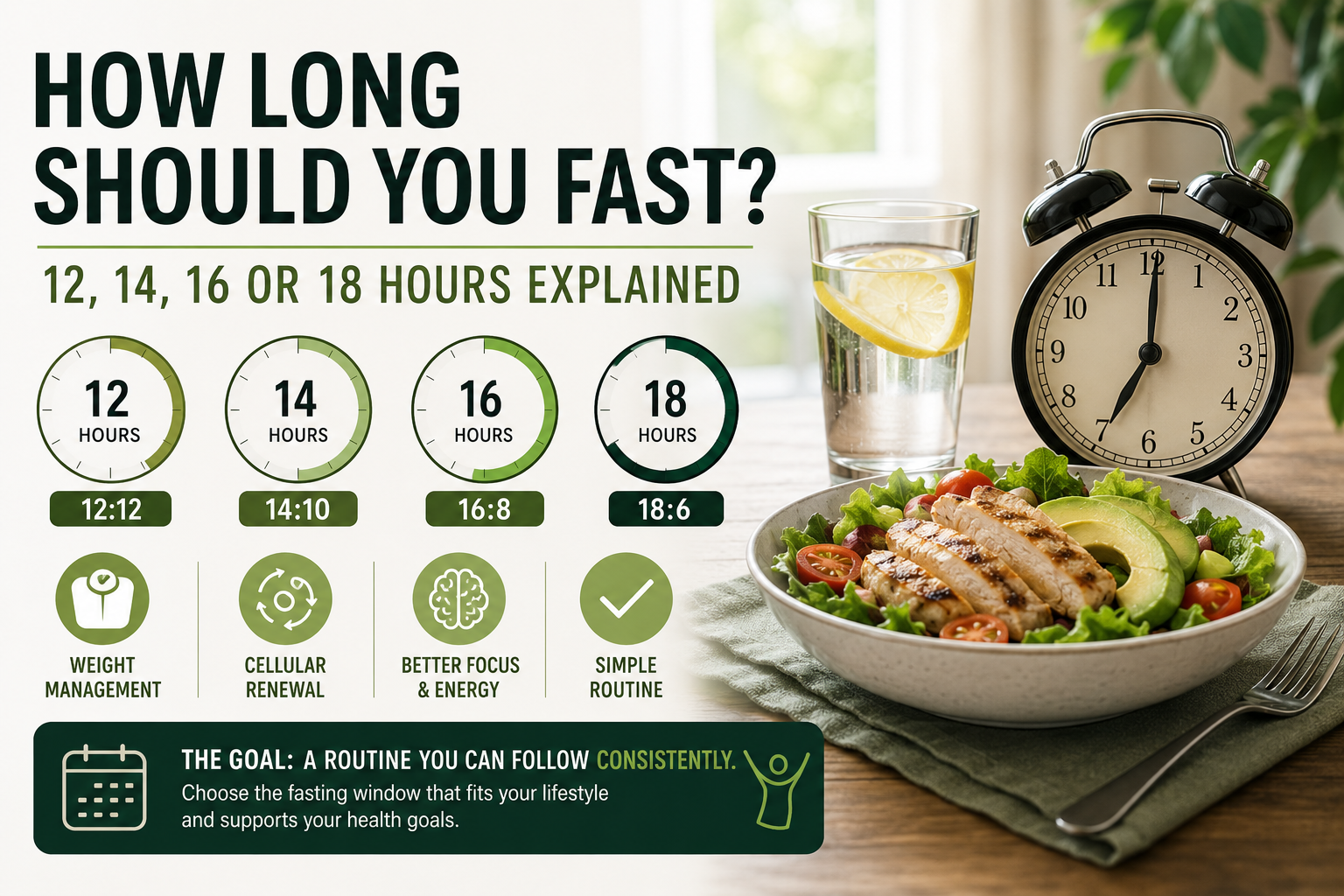
If you’re new to intermittent fasting, one of the first questions you’re likely to ask is how long should you fast?
Is 12 hours enough? Should you aim for 14 or 16 hours? And if a 16-hour fast works, would fasting for 18 hours produce even better results?
The simple answer is that there isn’t one fasting schedule that works best for everyone. A good fasting window is one you can follow consistently while still eating enough nutritious food during your eating window.
For many people, that means starting with 12 or 14 hours and gradually moving toward a 16-hour fast if it fits their lifestyle.
In this guide, we’ll compare 12-, 14-, 16- and 18-hour fasting schedules, explain how they may relate to weight loss and autophagy, and look at practical ways to make intermittent fasting easier to maintain.
How long should you fast?
Most intermittent fasting schedules involve fasting somewhere between 12 and 18 hours per day.
A simple way to think about them is:
- 12:12 – 12 hours fasting, 12 hours eating
- 14:10 – 14 hours fasting, 10 hours eating
- 16:8 – 16 hours fasting, 8 hours eating
- 18:6 – 18 hours fasting, 6 hours eating
The longer fasting window isn’t automatically the better one.
If an 18-hour fast leaves you extremely hungry and leads to overeating later, a comfortable 14- or 16-hour schedule may be much more useful.
Consistency usually matters more than choosing the longest possible fast.
12-hour fasting: the easiest place to start
A 12-hour fast is one of the simplest ways to introduce structure into your eating schedule.
For example, you could finish dinner at 7 p.m. and eat breakfast at 7 a.m.
That may not sound particularly dramatic, but it creates a clear overnight period without food and can help eliminate habitual late-night snacking.
Who might prefer 12:12?
- people completely new to intermittent fasting
- people who enjoy breakfast
- those who find longer fasting windows difficult
- anyone who simply wants more structure around eating
Think of 12:12 as a starting point rather than a competition. Once it feels easy, you can decide whether extending the fasting period makes sense for you.
14-hour fasting: a practical next step
A 14:10 fasting schedule gives you a slightly longer fasting period without dramatically shortening your eating window.
For example:
Finish eating at 7 p.m. → first meal at 9 a.m.
This can be a useful middle ground for people who want more structure but don’t enjoy skipping breakfast until late morning or lunchtime.
It is also an important reminder that intermittent fasting doesn’t have to mean jumping immediately into 16:8.
16-hour fasting: why 16:8 is so popular
The 16:8 intermittent fasting schedule is probably the best-known version of time-restricted eating.
You fast for 16 hours and eat during an eight-hour window.
For example:
7 p.m. → 11 a.m. fasting
11 a.m. → 7 p.m. eating window
For many people, this schedule is practical because much of the fasting period happens while sleeping.
Instead of planning numerous meals and snacks throughout the entire day, you have a clearly defined eating window.
That simplicity is also one reason intermittent fasting can be useful when weight loss is the goal.
How can a 16-hour fast help with weight loss?
Intermittent fasting is not magic, and fasting for 16 hours doesn’t automatically cause weight loss.
Body weight still depends heavily on overall energy intake over time.
However, a shorter eating window can make it easier for some people to eat less without constantly counting calories.
You may naturally remove:
- late-night snacks
- an unnecessary early breakfast
- constant grazing between meals
- extra calories from habitual eating
That can make maintaining a calorie deficit simpler.
This is why it is useful to think of intermittent fasting as a structure for eating, rather than a special fat-burning trick.
For a deeper explanation, read Intermittent Fasting and Weight Loss: What Actually Works?
You may also find our comparison useful: Calorie Deficit vs Intermittent Fasting: What Actually Drives Weight Loss?
MAKING FASTING EASIER TO LIVE WITH
Where Feel Great Fits Into a 16:8 Routine
Knowing when to eat is the easy part. Following the routine consistently is often harder.
This is where keeping things simple can help.
The Feel Great routine combines Unimate and Balance with a straightforward eating schedule rather than adding another complicated diet plan.
A simple day can look like this:
- Morning: Unimate as part of your morning routine
- Fasting window: water and a consistent schedule
- First main meal: a normal, balanced meal
- Balance: used with meals according to the product directions
- Second main meal: real food that fits your goals
- Evening: finish eating and begin the next fasting window
For people who use intermittent fasting for weight management, the practical benefit is not that Feel Great somehow replaces a calorie deficit. It doesn’t.
The potential advantage is that a structured routine can make it easier to stick to a fasting schedule, reduce unplanned eating opportunities and keep the day more predictable.
That can support a weight-management plan when it helps you maintain sensible eating habits and an appropriate overall calorie intake.
Feel Great should be viewed as part of the routine, not as a substitute for the fundamentals of weight loss.
What about an 18-hour fast?
An 18:6 fasting schedule extends the fasting period to 18 hours and leaves a six-hour eating window.
For example:
6 p.m. → 12 p.m. fasting
12 p.m. → 6 p.m. eating window
Some experienced fasters enjoy this approach, but longer isn’t automatically better.
A shorter eating window can make it more difficult to consume enough protein, fiber and other nutrients. It can also make some people so hungry that they overeat once the fasting period ends.
If 16:8 feels sustainable and works well with your lifestyle, there is no requirement to progress to 18:6.
Does fasting longer mean more weight loss?
Not necessarily.
This is one of the most important things to understand when asking how long should you fast for weight loss.
Imagine two people:
Person A follows 16:8 comfortably, eats two satisfying meals and maintains a modest calorie deficit.
Person B forces an 18-hour fast, becomes extremely hungry and consumes more calories during the six-hour eating window.
The longer fasting period doesn’t automatically give Person B an advantage.
For weight management, the better fasting schedule is generally the one that helps you maintain sensible eating habits over weeks and months.
Research on time-restricted eating suggests it may provide modest weight and metabolic benefits for some people, although longer-term research is still needed. Read the NIH overview on time-restricted eating →
How long should you fast for autophagy?
Autophagy is another reason people become interested in longer fasting periods.
Autophagy is a normal cellular recycling process in which cells break down and reuse damaged or unnecessary components.
Fasting and nutrient availability are among the factors involved in pathways associated with autophagy. However, it is misleading to claim that autophagy suddenly “switches on” at an exact fasting hour in humans.
Much of what we know about fasting and autophagy comes from laboratory and animal research, and the timing in humans is more complicated.
So you shouldn’t assume that:
16 hours = no autophagy
18 hours = autophagy activated
The biology isn’t that simple.
We explain this topic in more detail in Intermittent Fasting and Autophagy: What We Actually Know.
What can you drink during the fasting window?
Hydration becomes particularly important when you extend your fasting period.
Water is the simplest choice.
Depending on how strictly you define your fast, other very low- or zero-calorie drinks may also fit into your fasting routine.
We’ve covered these questions separately:
- What Can You Drink While Intermittent Fasting?
- Does Black Coffee Break a Fast?
- Does Tea Break a Fast?
If you’re unsure about a particular food or drink, our broader guide What Breaks a Fast? A Simple Guide for Beginners is a good place to start.
How to choose between 12, 14, 16 and 18 hours
Instead of asking which fasting schedule is the most powerful, ask which one you can realistically repeat.
| Schedule | Fasting | Eating | Good starting point for |
|---|---|---|---|
| 12:12 | 12 hours | 12 hours | Complete beginners |
| 14:10 | 14 hours | 10 hours | A gentle progression |
| 16:8 | 16 hours | 8 hours | A structured daily routine |
| 18:6 | 18 hours | 6 hours | More experienced fasters |
A simple way to start
If you’ve never practiced intermittent fasting before, you don’t need to begin with 16 or 18 hours.
Try this progression:
- Start with a 12-hour overnight fast.
- Once that feels normal, try 14 hours.
- If 14 hours feels comfortable, experiment with 16:8.
- Stay there if it works. There is no requirement to progress further.
Give yourself time to learn the difference between genuine hunger and eating simply because you’re accustomed to eating at a particular time.
Our Beginner’s Guide to Intermittent Fasting explains the process in more detail.
Common signs your fasting window may be too aggressive
A fasting schedule shouldn’t become a daily battle.
Consider shortening your fasting window if you regularly experience excessive hunger that leads to overeating, persistent low energy, difficulty concentrating or an inability to eat enough nutritious food during your eating window.
The goal isn’t to prove that you can tolerate the longest fast.
The goal is to find a routine you can actually maintain.
So, how long should you fast?
For beginners, 12 to 14 hours is a reasonable way to become comfortable with an overnight fasting routine.
For people who prefer a more defined eating window, 16:8 is a popular option because it can fit naturally into everyday life.
An 18-hour fast is another option, but it isn’t automatically better for weight loss and isn’t necessary simply because you’ve become comfortable with 16:8.
When weight loss is the goal, remember the bigger picture: a fasting schedule can help create structure, but your overall calorie intake, food quality and consistency still matter.
Choose the fasting window that makes your routine simpler — not the one that makes your life revolve around fasting.
Important
Intermittent fasting isn’t appropriate for everyone. Children and adolescents, people who are pregnant or breastfeeding, people with a history of eating disorders, and people with certain medical conditions or taking medications that affect blood sugar should seek advice from an appropriate healthcare professional before starting a fasting routine.