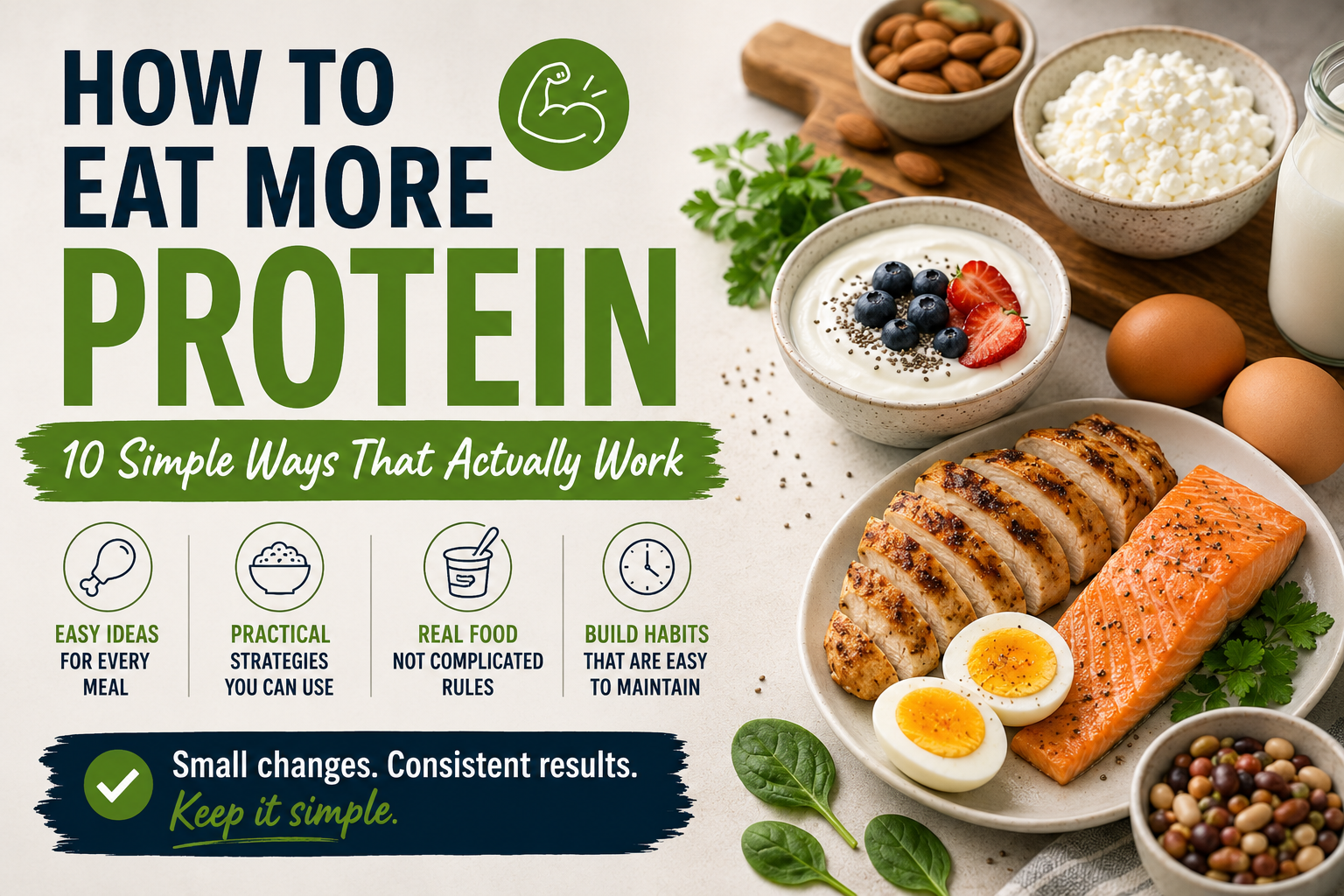
You have probably heard the advice before:
“Eat more protein.”
But what does that actually look like in everyday life?
You do not necessarily need protein shakes, complicated meal plans or chicken breast at every meal.
If you are wondering how to eat more protein, the easiest approach is usually to make a few small changes to meals you already eat.
Instead of completely rebuilding your diet, you can gradually make protein a more consistent part of breakfast, lunch, dinner and snacks.
Here are 10 simple ways to do it.
Why Is Protein Important?
Protein is an essential nutrient your body uses to build and maintain muscles, bones, skin and other tissues.
Protein can also help make meals feel more satisfying, which can be useful when you are trying to build a more structured eating routine.
However, eating more protein does not mean carbohydrates or fats suddenly become “bad.”
A balanced eating pattern can include all three macronutrients.
The practical goal is simply to make sure protein is not consistently missing from your meals.
1. Start With the Protein Source
One of the easiest ways to learn how to eat more protein is to change the way you build a meal.
Instead of asking:
“What should I have for dinner?”
start with:
“What is my protein source?”
For example:
- chicken or turkey,
- fish,
- eggs,
- Greek yogurt,
- cottage cheese,
- beans or lentils,
- tofu, tempeh or other soy foods.
Once you choose the protein, building the rest of the meal becomes easier.
Add vegetables, a carbohydrate source and other foods you enjoy.
This is the same simple formula we use in our meal planning for weight loss system.
2. Add Protein to Breakfast
Breakfast can easily become a meal dominated by carbohydrates.
Toast, cereal, pastries and fruit can all fit into a normal diet, but depending on the combination, the meal may contain relatively little protein.
You can increase it without completely changing breakfast.
For example:
- add eggs to toast,
- choose Greek yogurt instead of a lower-protein yogurt,
- add cottage cheese alongside fruit,
- combine oats with Greek yogurt or milk,
- include eggs in a breakfast wrap.
The point is not to create a perfect “fitness breakfast.”
Just add a meaningful protein source.
3. Use Greek Yogurt Strategically
Greek yogurt is one of the simplest foods to use when you want more protein without much preparation.
It can work as:
- breakfast,
- a snack,
- a dessert alternative,
- a base for sauces or dips.
Add fruit and oats for breakfast.
Add berries and a small amount of nuts for a snack.
Or use plain Greek yogurt in savory meals.
Check the nutrition label because protein content can vary between products.
FREE INTERMITTENT FASTING CHEAT SHEET
Keep the Most Important Fasting Rules on Your Phone
Get the free quick-start guide with schedules, fasting drinks, what breaks a fast and common mistakes.
4. Upgrade Your Snacks
Snacks are another easy opportunity to increase protein.
Instead of thinking of snacks only as something crunchy or sweet, try combining foods.
Examples include:
- Greek yogurt and fruit,
- cottage cheese and berries,
- eggs and vegetables,
- hummus with vegetables,
- fruit with a small portion of nuts,
- tuna on whole-grain crackers.
You do not need to snack simply because you are trying to eat more protein.
If you are not hungry, you do not need to create another eating occasion just to reach a protein target.
That distinction is especially useful if you are working on how to stop eating when you are not hungry.
5. Increase the Protein in Meals You Already Eat
Sometimes the simplest solution is already on your plate.
If your normal dinner includes a very small amount of chicken, fish, beans or another protein source, you may not need a new recipe.
You may simply need to adjust the proportions.
For example, instead of automatically adding another large serving of a side dish, you could increase the protein portion and include plenty of vegetables.
This can also fit well with a strategy for creating a calorie deficit without counting calories.
Remember that protein-rich foods still contain calories.
More is not automatically better.
6. Keep Easy Protein Foods at Home
Your environment matters.
If every protein-rich meal requires 45 minutes of cooking, it becomes much harder to maintain when you are busy.
Keep a few low-effort options available.
Depending on your preferences, these might include:
- eggs,
- Greek yogurt,
- cottage cheese,
- canned tuna or salmon,
- canned beans or lentils,
- pre-cooked chicken,
- frozen fish,
- tofu.
The best protein source is not necessarily the theoretically perfect one.
It is one you will actually use consistently.
7. Include Plant-Based Protein Sources
You do not need to rely exclusively on meat, dairy or eggs.
Plant foods can contribute protein too.
Useful options include:
- beans,
- lentils,
- chickpeas,
- tofu,
- tempeh,
- edamame,
- nuts and seeds,
- whole grains.
Plant-based meals can combine several protein-containing foods.
For example:
Lentils + rice + vegetables
or:
Tofu + vegetables + whole grains.
You do not need to obsess over creating a perfect protein combination at every individual meal.
A varied diet across the day can provide different amino acids from different foods.
8. Build an Emergency High-Protein Meal
Busy days are where good intentions often disappear.
Create one or two meals you can make in approximately five minutes.
For example:
- eggs + toast + vegetables,
- tuna + ready-made salad + bread,
- Greek yogurt + oats + fruit,
- cottage cheese + fruit + whole-grain toast,
- beans + microwave rice + vegetables.
These meals do not need to look impressive.
They simply need to be available when your alternative is ordering something because you have no idea what to eat.
9. Do Not Forget Fiber, Fruit and Vegetables
One potential mistake when learning how to eat more protein is focusing so heavily on protein that everything else disappears from the plate.
Protein is important, but so are vegetables, fruit, whole grains, legumes and other fiber-rich foods.
A practical meal might include:
Protein + vegetables + carbohydrate source + optional healthy fat.
For example:
- chicken + broccoli + potatoes + olive oil,
- fish + salad + rice,
- eggs + vegetables + whole-grain toast,
- lentils + vegetables + rice.
You are building balanced meals, not simply chasing a protein number.
10. Repeat the Meals That Work
You do not need a new recipe every day.
If you find three breakfasts, three lunches and five dinners that are easy, satisfying and fit your goals, use them repeatedly.
Repetition reduces decision fatigue.
It also makes grocery shopping and meal planning easier.
This is where healthy eating becomes a routine rather than a temporary project.
Our guide on how to build a habit without relying on motivation explains why repeatable systems are often more useful than waiting until you feel motivated.
How Much Protein Do You Actually Need?
There is no single protein target that is ideal for every person.
Protein needs can vary according to body size, age, activity level, health status and individual goals.
For generally healthy adults, the U.S. Recommended Dietary Allowance for protein is based on approximately 0.8 grams of protein per kilogram of body weight per day.
The RDA is designed to meet the needs of nearly all healthy people in a population group. It should not automatically be interpreted as the ideal target for every athlete, older adult or person pursuing a particular body-composition goal.
See the Dietary Reference Intake tables for protein
.
For example, a person weighing 70 kg would reach the basic adult RDA at approximately 56 grams of protein per day.
That calculation is simply:
70 kg × 0.8 g = 56 g protein per day.
It is an example of the RDA calculation, not a personalized nutrition recommendation.
If you want a protein target tailored to your health, training or body-composition goals, a qualified healthcare professional or registered dietitian can help determine what is appropriate for you.
Can Protein Help With Weight Loss?
Protein itself does not magically cause weight loss.
Your overall energy intake still matters.
However, protein-rich meals may help some people create meals that feel more satisfying, which can make an appropriate eating pattern easier to maintain.
This is why protein is better viewed as one part of a broader weight-management strategy rather than as a standalone solution.
Food quality, portions, daily movement, sleep and consistency still matter.
If you want a simple way to increase daily activity, see our guide to walking for weight loss.
What If You Use Intermittent Fasting?
If you use intermittent fasting, eating within a shorter window does not automatically guarantee that you are getting enough protein or other nutrients.
Your meals still matter.
For example, someone using a 16:8 schedule might distribute protein across:
- the first meal,
- an optional snack if genuinely needed,
- dinner.
You do not need intermittent fasting in order to eat well or manage your weight.
But if you choose to use it, planning your meals can help make the eating window more structured.
Our beginner’s guide to intermittent fasting explains the basic approach.
Where Feel Great Can Fit Into Your Routine
If you use the Feel Great system, it is useful to think of it as one part of a broader daily routine rather than a replacement for nutritious food.
Unimate and Balance can be incorporated into a structured schedule, while your meals still need to provide protein, vegetables, fruit and other nutrients.
No supplement or product replaces the fundamentals of nutrition, appropriate portions, movement, sleep and sustainable habits.
Curious About the Feel Great Routine?
See the products and learn how the routine can fit into a simple daily structure.
Affiliate disclosure: Routine Made Simple may earn a commission if you purchase through this link, at no additional cost to you.
How to Eat More Protein: A Simple Day
You do not need to completely redesign your diet.
A simple day might look something like this:
Breakfast:
Greek yogurt + oats + berries.
Lunch:
Chicken + salad + potatoes.
Optional snack:
Cottage cheese + fruit.
Dinner:
Fish + vegetables + rice.
Another person might use eggs, tofu, lentils, beans or other protein-rich foods instead.
The exact foods matter less than creating a pattern that works for your preferences and lifestyle.
Common Mistakes When Trying to Eat More Protein
Increasing protein does not need to become another complicated diet rule.
Watch for these common mistakes:
- trying to change every meal immediately,
- depending entirely on protein shakes or bars,
- ignoring vegetables, fruit and fiber,
- assuming high-protein foods have no calories,
- forcing yourself to eat when you are not hungry simply to reach a target,
- buying foods you do not actually enjoy,
- following someone else’s protein target without considering your own needs.
A good eating routine should be practical enough to maintain.
How to Eat More Protein: The Bottom Line
If you are learning how to eat more protein, do not make it unnecessarily complicated.
Start with the meals you already eat.
Add a clear protein source to breakfast.
Build lunch and dinner around a useful protein source.
Keep easy protein foods available.
Upgrade snacks when you actually need them.
Create an emergency meal.
Then repeat the combinations that work.
You do not need a perfect high-protein diet.
You need a simple eating structure that you can consistently maintain.
Build a Simpler Eating Routine
If intermittent fasting is part of your routine, our free 7-day guide can help you build a simple 16:8 schedule without making the process unnecessarily complicated.
Affiliate disclosure: Routine Made Simple may earn a commission from qualifying purchases made through affiliate links, at no additional cost to you.
Disclaimer: This article is for general informational and educational purposes only and is not medical or nutritional advice. Protein needs vary between individuals. If you have kidney disease or another medical condition, take medication, are pregnant or breastfeeding, or have specific dietary requirements, consult an appropriate qualified healthcare professional or registered dietitian.