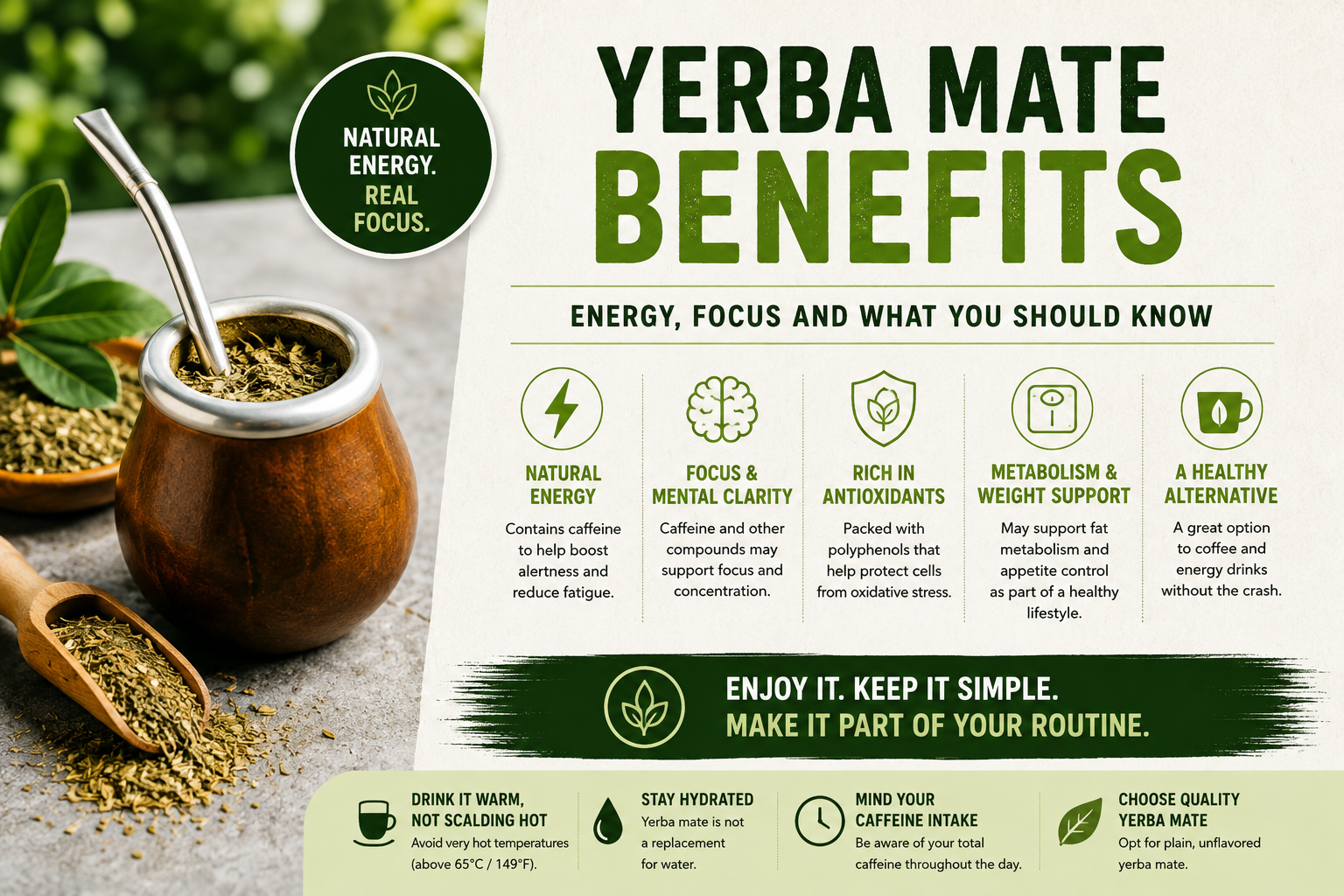
Yerba mate benefits are getting more attention as people look for simple alternatives to coffee and sugary energy drinks. This traditional South American drink naturally contains caffeine and plant compounds called polyphenols, which is why it has become popular for energy, alertness and everyday morning routines.
But is yerba mate actually better than coffee? Can it help with weight management? Does it fit into intermittent fasting? And how much of what you read about yerba mate is actually supported by research?
Here is a simple look at what yerba mate is, what the research suggests, and what you should know before making it part of your routine.
What Is Yerba Mate?
Yerba mate is a drink made from the dried leaves of Ilex paraguariensis, a plant native to South America. It has traditionally been consumed in countries including Argentina, Paraguay, Uruguay and Brazil.
The traditional preparation is distinctive. Dried yerba mate leaves are placed inside a container called a mate or gourd, hot water is added, and the drink is sipped through a filtered metal straw known as a bombilla.
Today, yerba mate is available in many forms, including loose leaves, tea bags, bottled drinks and extracts used in other beverages and products.
What makes it particularly interesting is its natural combination of caffeine and plant compounds such as polyphenols.
🌿 Curious how yerba mate connects with my own morning routine?
My routine is built around keeping things simple: a consistent 16:8 schedule, two main meals, plenty of water, Unimate in the morning and Balance before my main meals.
I’ve put the complete routine — including the Feel Great products I personally use — on one page so you can see exactly how it fits together.
Yerba Mate Benefits: What Does the Research Suggest?
Research into yerba mate has examined several possible benefits, including effects related to alertness, antioxidant activity, metabolism and markers of metabolic health.
However, it is important to separate promising research from proven results. Many studies are relatively small, and some research has used concentrated yerba mate extracts rather than the traditional drink people normally consume.
That means yerba mate can be an interesting addition to a healthy routine, but it should not be treated as a miracle drink.
1. Yerba Mate Can Provide Energy
Probably the most noticeable effect of yerba mate comes from something very familiar: caffeine.
Yerba mate naturally contains methylxanthines, particularly caffeine and theobromine. These compounds contribute to its characteristic stimulating effect.
The exact amount of caffeine varies significantly depending on the leaves, serving size and preparation method.
Scientific reviews report caffeine in yerba mate preparations, but the amount a person actually consumes can vary considerably — particularly with traditional preparation, where water may be added repeatedly to the same leaves.
That makes yerba mate potentially useful when you want a morning or early-afternoon source of caffeine without automatically reaching for a sugary energy drink.
2. Yerba Mate May Support Alertness and Focus
Because yerba mate contains caffeine, another practical benefit is increased alertness.
Caffeine stimulates the central nervous system, which is why caffeinated beverages are commonly used when people want to feel more awake and attentive.
For that reason, yerba mate can fit naturally into a morning routine, particularly for people who enjoy caffeine but want something different from coffee.
That does not necessarily mean yerba mate provides a completely different type of stimulation from coffee. Claims that yerba mate always provides “clean energy” or never causes jitters are largely subjective.
Your individual response to caffeine still matters.
3. Yerba Mate Contains Polyphenols
One of the more interesting yerba mate benefits comes from its plant compounds.
Yerba mate contains several types of phenolic compounds, including caffeoylquinic acids. These compounds have antioxidant properties and have attracted considerable scientific interest.
Antioxidants are involved in protecting cells from oxidative damage, but that does not mean drinking an antioxidant-rich beverage automatically prevents disease.
Scientific reviews of yerba mate research describe a range of potentially interesting biological effects while also highlighting limitations in the available evidence.
In other words: yerba mate contains interesting plant compounds, but we should avoid turning that fact into exaggerated health promises.
4. What About Yerba Mate and Weight Loss?
This is where claims surrounding yerba mate become particularly interesting — and where we need to be careful.
Some studies have investigated whether yerba mate or yerba mate extracts could influence body weight, appetite, fat metabolism or other metabolic markers.
There are interesting findings, but the current evidence does not justify thinking of yerba mate as a weight-loss solution.
For most people, the bigger factors remain much more basic:
- overall calorie intake,
- food quality,
- physical activity,
- sleep,
- and consistency over time.
A caffeinated drink may fit into that routine, but it cannot replace the routine itself.
If weight loss is your main goal, you may also want to read our guide to calorie deficit vs intermittent fasting.
How Much Caffeine Is in Yerba Mate?
There is no single caffeine number that applies to every cup of yerba mate.
Caffeine content depends on factors including the amount of leaves used, processing method, water temperature, steeping time and how many times water is added to the same leaves.
Traditional consumption is especially difficult to compare with a standard cup of coffee because people may continue adding water and drinking from the same serving of leaves over an extended period.
This is worth remembering if you already consume coffee, tea, energy drinks or caffeine-containing products during the day.
More caffeine is not automatically better.
Yerba Mate vs Coffee
People often ask whether yerba mate is healthier than coffee.
The simplest answer is: you don’t necessarily need to choose a winner.
Both are naturally caffeinated beverages. Both contain plant compounds. And both can fit into a healthy routine.
The experience, however, can be different.
| Yerba Mate | Coffee |
|---|---|
| Contains caffeine | Contains caffeine |
| Contains polyphenols | Contains polyphenols |
| Herbal, slightly bitter flavor | Roasted coffee flavor |
| Traditionally consumed gradually | Often consumed as a cup or serving |
| Caffeine varies with preparation | Caffeine varies with preparation |
Which one works better may simply depend on taste, caffeine tolerance and what fits your routine.
We’ll explore this comparison in more detail in a separate guide.
Can You Drink Yerba Mate While Intermittent Fasting?
Plain brewed yerba mate without added sugar, milk, honey or other caloric ingredients may fit into many practical intermittent fasting routines in much the same way people use unsweetened tea or black coffee.
The important word here is plain.
Adding sugar, honey, milk, cream or caloric syrups changes what you are consuming and may no longer fit the goal of your fasting window.
If your goal is a simple fasting routine built primarily around controlling when you eat and reducing calorie intake, unsweetened yerba mate may be a reasonable beverage choice.
If you follow a particularly strict fasting protocol or are interested specifically in fasting-related processes such as autophagy, the answer becomes more nuanced. Human research cannot currently tell us precisely how every beverage and individual plant compound affects autophagy during a fasting period.
We’ll cover that question properly in our upcoming guide: Does Yerba Mate Break a Fast?
For now, you can also read what you can drink while intermittent fasting and our guide explaining what breaks a fast.
Is Yerba Mate Better Than Energy Drinks?
If the comparison is between plain yerba mate and a traditional sugar-sweetened energy drink, one obvious difference is that plain yerba mate can provide caffeine without automatically adding a large amount of sugar.
However, bottled yerba mate drinks are different.
Some contain added sugar, sweeteners or other ingredients, so always check the label rather than assuming that every product containing yerba mate is nutritionally equivalent to plain brewed mate.
The same principle applies to coffee and tea.
The beverage itself can be simple. What we add to it can completely change its nutritional profile.
Does Yerba Mate Reduce Hunger?
You may see claims that yerba mate suppresses appetite.
Some research has explored potential effects of yerba mate on satiety, metabolism and body weight, but the evidence is not strong enough to rely on yerba mate as an appetite-control strategy.
Caffeine can also affect people differently.
One person may find that a caffeinated beverage makes a fasting window easier. Another may feel jittery, uncomfortable or more focused on food.
If hunger and cravings are a bigger problem for you, start with the fundamentals rather than looking for a single drink to eliminate hunger.
Our guide on how to stop sugar cravings covers several simple strategies that may help.
Are There Downsides to Yerba Mate?
Yes. Natural does not automatically mean unlimited.
The first consideration is caffeine.
Too much caffeine can contribute to problems such as:
- difficulty sleeping,
- restlessness,
- jitters,
- rapid heartbeat or palpitations in some people,
- and digestive discomfort in sensitive people.
If you are sensitive to caffeine, start with a smaller amount and pay attention to how you feel.
It is also worth considering when you drink it. Caffeine later in the day can interfere with sleep in some people.
A Particularly Important Yerba Mate Safety Point
There is one issue that deserves special attention because discussions about yerba mate and cancer can easily become confusing.
The International Agency for Research on Cancer (IARC) has evaluated mate and very hot beverages. The concern identified by IARC relates particularly to drinking beverages at very high temperatures. In its evaluation, “very hot” refers to beverages consumed above approximately 65°C (149°F).
Importantly, this is not the same as saying that yerba mate itself has been proven to cause cancer when consumed at normal temperatures.
The practical lesson is much simpler:
You don’t need to drink yerba mate — or any other beverage — extremely hot.
Where Yerba Mate Fits Into a Simple Routine
This is the part I find most useful.
A sustainable routine doesn’t need dozens of rules.
For many people, a morning routine can be as simple as:
- wake up,
- drink some water,
- have a preferred caffeinated drink if desired,
- follow a consistent eating schedule,
- and repeat the same basic structure tomorrow.
Yerba mate can simply be one option within that routine.
There is no need to turn it into another complicated health hack.
Yerba Mate and My Morning Routine
Yerba mate is also interesting to me for another reason.
My own morning routine includes Unimate, while Balance is something I use before my two main meals as part of the broader Feel Great routine.
That doesn’t mean you need Unimate to enjoy yerba mate, and the purpose of this article isn’t to turn an educational discussion about yerba mate into a product pitch.
I prefer to understand the ingredients and ideas behind the products I choose to include in my own routine.
My Simple Routine
Want to see exactly what I personally do?
I follow a simple 16:8 eating schedule with two main meals, Unimate as part of my morning routine, Balance before my main meals and plenty of water throughout the day.
I put the complete routine on one page, along with the Feel Great products I use and why I chose to keep the routine simple.
You can also read our guide explaining the different roles of Unimate and Balance in a practical Feel Great routine.
How to Try Yerba Mate Without Making It Complicated
If you want to try traditional yerba mate, you don’t need to overhaul your entire morning.
Start simply.
- Choose plain yerba mate without added sugar.
- Start with a moderate serving.
- Let very hot water cool before drinking.
- Pay attention to your total caffeine intake.
- See how your body responds.
If you enjoy it and it fits naturally into your day, keep it.
If you don’t like it, there is no reason to force yourself to drink it simply because it is popular.
Consistency matters more than chasing every new “super drink.”
Frequently Asked Questions About Yerba Mate Benefits
What are the main yerba mate benefits?
Yerba mate naturally contains caffeine and a variety of plant compounds, including polyphenols. Its most immediately noticeable effect for many people is increased alertness associated with caffeine. Researchers have also investigated possible metabolic and cardiovascular effects, but stronger human evidence is still needed for many health claims.
Does yerba mate give you energy?
Yerba mate contains caffeine, which stimulates the central nervous system and can increase alertness. The amount of caffeine varies considerably depending on how the drink is prepared and consumed.
Is yerba mate healthier than coffee?
There is no simple reason to declare one universally healthier than the other. Both contain caffeine and plant compounds. Your choice can depend on taste, preparation, caffeine tolerance and how each beverage fits into your routine.
Can yerba mate help with weight loss?
Some studies have investigated yerba mate and weight-related outcomes, but it should not be considered a weight-loss solution. Overall calorie intake, diet quality, activity, sleep and long-term consistency remain much more important.
Can I drink yerba mate while fasting?
Plain unsweetened yerba mate may fit into many practical intermittent fasting routines. Adding sugar, milk, honey or other caloric ingredients changes the situation. If your fasting goal is particularly strict or related specifically to autophagy, the answer is less certain and deserves more nuance.
Is it safe to drink yerba mate every day?
Yerba mate contains caffeine, so the amount consumed, total daily caffeine intake and individual sensitivity all matter. It is also sensible to avoid consuming yerba mate or other beverages at extremely high temperatures.
The Bottom Line
The most realistic yerba mate benefits start with something simple: it is a naturally caffeinated beverage that also provides a variety of plant compounds, including polyphenols.
That can make it an interesting alternative to coffee or sugary energy drinks.
Research into potential effects on metabolism, body weight and other health markers is interesting, but we shouldn’t turn early or limited evidence into promises.
Yerba mate doesn’t need to be a miracle drink to be useful.
If you enjoy it, tolerate caffeine well and drink it at a sensible temperature, it can simply become another option in a healthy morning routine.
Keep it simple. Make it work.
Ready to make your routine simpler?
See the simple 16:8 routine I personally follow and explore the Feel Great products that are part of it.
This is my personal experience, not a promise or guarantee of results. Individual results vary.
Sources and further reading:
- National Library of Medicine — Critical review of phenolic compounds in yerba mate and potential health effects
- National Library of Medicine — Yerba Mate: A Long but Current History
- IARC / NCBI — Drinking Coffee, Mate, and Very Hot Beverages
This article is for general informational purposes only and is not medical advice. Individual responses to caffeine and dietary products vary. If you are pregnant, breastfeeding, taking medication, have a medical condition or have concerns about caffeine intake, discuss appropriate use with a qualified healthcare professional.
This page contains referral links. If you purchase through a referral link, I may earn a commission at no additional cost to you.