Have you ever opened the refrigerator, grabbed a snack, or reached for something sweet even though you knew you were not physically hungry?
You are not alone.
Eating is not always driven by hunger. We also eat because of habit, boredom, stress, tiredness, emotions, social situations, or simply because food is available.
If you are trying to understand how to stop eating when not hungry, the solution is usually not more willpower.
It is learning to recognize what is triggering the urge to eat — and creating a simple routine that makes the better choice easier.
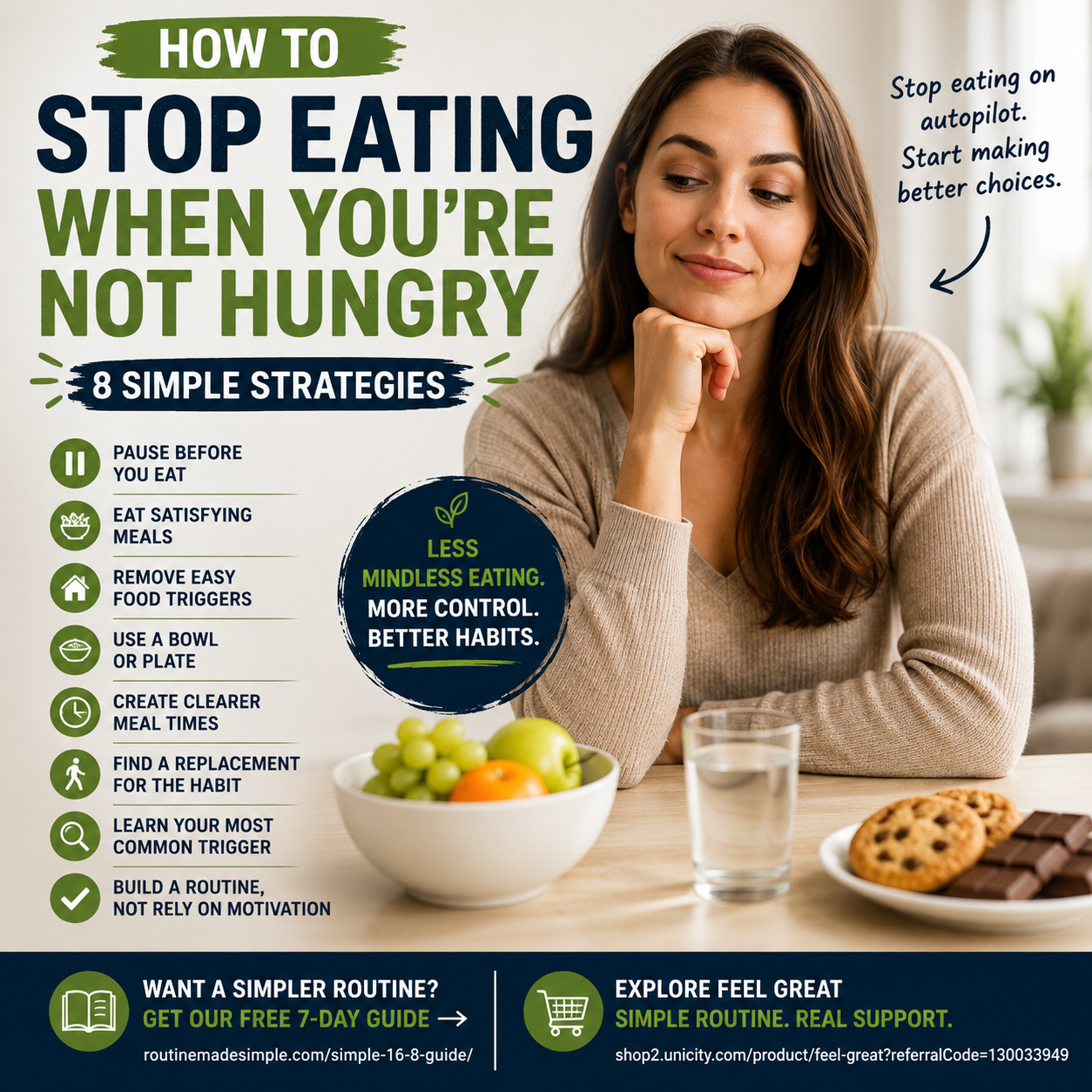
Here are eight practical strategies that can help.
Why Do We Eat When We Are Not Hungry?
Physical hunger is only one reason we eat.
Your environment and daily habits can trigger eating automatically. Walking into the kitchen, sitting in front of the television, finishing work, feeling stressed, or seeing food on the counter can all become signals to eat.
Over time, the behavior can become so automatic that you barely notice the decision.
This is why learning how to stop eating when not hungry starts with awareness rather than restriction.
Physical Hunger vs. Habit Hunger
Before changing your eating habits, it helps to recognize the difference between physical hunger and an urge to eat.
Physical hunger usually develops gradually. You may notice an empty feeling in your stomach, lower energy, difficulty concentrating, or a general willingness to eat a normal meal.
Habit or emotional hunger can appear suddenly and may be connected to a specific food.
For example, you may not want chicken, vegetables, or a normal meal — but suddenly a cookie sounds very appealing.
That does not mean you can never eat the cookie. The goal is simply to notice whether you are making a conscious choice or reacting automatically.
1. Pause Before You Eat
One of the simplest strategies is to create a short pause between the urge to eat and actually eating.
Before grabbing an unplanned snack, ask yourself:
“Am I physically hungry right now?”
Another useful question is:
“Would I eat a proper meal right now?”
If the answer is yes, you may genuinely be hungry.
If the answer is no but you still strongly want a particular snack, something else may be triggering the urge.
You do not have to wait an hour or fight the craving.
Even a pause of 30 seconds can interrupt an automatic behavior.
That brief pause creates space between the trigger and the action.
2. Make Meals More Satisfying
If your meals are too small or poorly structured, frequent snacking may actually be a sign that your meals are not satisfying enough.
Try building meals around protein, vegetables, fiber-rich foods, and foods that you genuinely enjoy.
A meal that leaves you reasonably satisfied makes it easier to distinguish real hunger from the desire to snack.
This is especially important if you are also trying to create a calorie deficit without counting calories.
The goal is not to eat as little as possible.
The goal is to create a structure you can actually maintain.
FREE INTERMITTENT FASTING CHEAT SHEET
Keep the Most Important Fasting Rules on Your Phone
Get the free quick-start guide with schedules, fasting drinks, what breaks a fast and common mistakes.
3. Remove Easy Food Triggers
Your environment influences your behavior more than you may realize.
If highly tempting foods are always visible and easy to reach, you will think about them more often.
You do not need to ban every snack from your home.
But you can make the foods you want to eat less automatically slightly less convenient.
Put them in a cupboard instead of on the counter. Buy smaller packages. Avoid keeping large quantities within immediate reach.
At the same time, make your preferred foods easier to access.
Keep fruit visible. Prepare simple meals. Keep water nearby.
Good environments reduce the amount of willpower you need.
One of the best ways to learn how to stop eating when not hungry is to make unplanned eating slightly less automatic.
4. Stop Eating Directly From the Package
Eating directly from a large bag, box, or container makes it difficult to notice how much you have eaten.
If you decide to have a snack, put a reasonable portion on a plate or in a bowl.
Then put the package away.
This creates a clear beginning and end to the eating occasion.
It also gives you another opportunity to decide whether you actually want more rather than simply continuing because the food is still in front of you.
5. Create Clearer Meal Times
Eating randomly throughout the entire day can make hunger cues harder to recognize.
You do not need a rigid schedule, but having reasonably consistent meal times can create useful structure.
Instead of constantly asking yourself whether you should eat, you begin to establish predictable times when meals normally happen.
Some people naturally use this principle with intermittent fasting, while others simply prefer three structured meals.
Neither approach is mandatory.
The useful part is reducing constant food decisions.
If evenings are particularly difficult for you, read our guide on why you may feel hungry at night.
6. Find a Replacement for the Habit
Sometimes removing a habit leaves an empty space.
If your normal routine is:
TV → snack
simply telling yourself not to snack may be difficult.
Instead, create an alternative response.
You might:
- make tea,
- drink sparkling water,
- take a short walk,
- brush your teeth,
- call someone,
- read for ten minutes, or
- move to another room.
The replacement does not have to be perfect.
Its purpose is to interrupt the automatic sequence.
7. Learn Your Most Common Trigger
Do not try to fix every eating habit at once.
Instead, identify the situation where unnecessary eating happens most often.
For example:
- after dinner,
- while watching television,
- during stressful work,
- when you arrive home,
- late at night, or
- when sweets are visible.
Once you know your strongest trigger, you can design a specific response for it.
Over time, understanding how to stop eating when not hungry becomes less about willpower and more about recognizing your personal triggers.
If sweets are your biggest challenge, our guide on how to stop sugar cravings may also help.
8. Build a Routine Instead of Relying on Motivation
Motivation changes from day to day.
A simple routine reduces the number of decisions you need to make.
For example, your routine might be:
- eat two or three satisfying meals,
- keep a water bottle nearby,
- avoid eating directly from packages,
- pause before unplanned snacks, and
- have a planned evening routine after dinner.
None of these actions is dramatic.
But repeated consistently, they can change your eating environment significantly.
This is the same principle we discuss in our guide to building habits without relying on motivation.
Where Feel Great Can Fit Into a Structured Routine
Some people find that having a consistent daily framework makes healthy habits easier to follow.
The Feel Great system combines Unimate and Balance as part of a structured daily approach.
It should not be viewed as a replacement for sensible food choices, appropriate portions, movement, sleep, or sustainable habits.
Instead, if you choose to use it, it can become one component of an established routine.
The important part is still the overall structure of your day.
Want to learn more about Feel Great?
See the products and learn how the routine works.
Affiliate disclosure: Routine Made Simple may earn a commission if you purchase through this link, at no additional cost to you.
What If You Still Want to Eat?
Then you can choose to eat.
The purpose of these strategies is not to create fear around food or to eliminate every snack.
Sometimes you simply want something because you enjoy it.
That is different from eating automatically without even realizing why you started.
A conscious decision to enjoy a piece of chocolate is not the same behavior as repeatedly reaching into a bag while distracted.
The goal is awareness, not perfection.
What About Emotional Eating?
Food can provide comfort, and occasional emotional eating does not automatically mean something is wrong.
However, if eating becomes your primary way of dealing with stress, anxiety, sadness, loneliness, or other difficult emotions, it may help to develop additional coping strategies.
These might include movement, talking with someone, journaling, relaxation techniques, or professional support when appropriate.
If eating feels out of control, causes significant distress, or involves repeated binge-eating episodes, consider speaking with a qualified healthcare or mental-health professional.
Try the Simple 10-Minute Rule
If you are unsure whether you are hungry, try waiting ten minutes before eating an unplanned snack.
Do something else during that time.
Drink some water. Walk around. Finish a small task.
After ten minutes, ask yourself again whether you still want the food.
If you do, you can choose to eat it.
The point is not to force yourself to wait indefinitely.
The ten-minute pause simply gives an automatic urge enough time to become a conscious decision.
How to Stop Eating When Not Hungry: A Simple Daily Plan
If you want to put everything together, keep the routine simple.
At meals: Eat satisfying meals built around foods that help you feel comfortably full.
Between meals: Before an unplanned snack, pause and ask whether you are physically hungry.
At home: Keep tempting foods less visible and healthier options easy to access.
When snacking: Put the food on a plate or in a bowl instead of eating from the package.
In the evening: Create a simple routine that signals the end of eating for the day.
When cravings appear: Identify the trigger before deciding what to do.
This approach will not eliminate every unnecessary snack overnight.
It does something more useful: it helps you gradually become more aware of why you are eating.
How to Stop Eating When Not Hungry: The Bottom Line
Learning how to stop eating when not hungry is not about developing perfect self-control.
It is about making unconscious eating more conscious.
Start with one small change.
Pause before an unplanned snack.
Move tempting foods out of sight.
Stop eating directly from the package.
Or create a clearer end to your evening eating routine.
Small changes repeated consistently are usually more useful than trying to follow an extremely restrictive plan for a few days.
Ready to Make Your Routine Simpler?
If you are experimenting with intermittent fasting, our free 7-day guide can help you build a simple routine without making the process unnecessarily complicated.
Affiliate disclosure: We may earn a commission from qualifying purchases made through affiliate links, at no additional cost to you.
Disclaimer: This article is for general informational and educational purposes only and is not medical, nutritional, or mental-health advice. Individual needs vary. If you have concerns about your eating behavior, health, or relationship with food, consult an appropriate qualified healthcare professional.