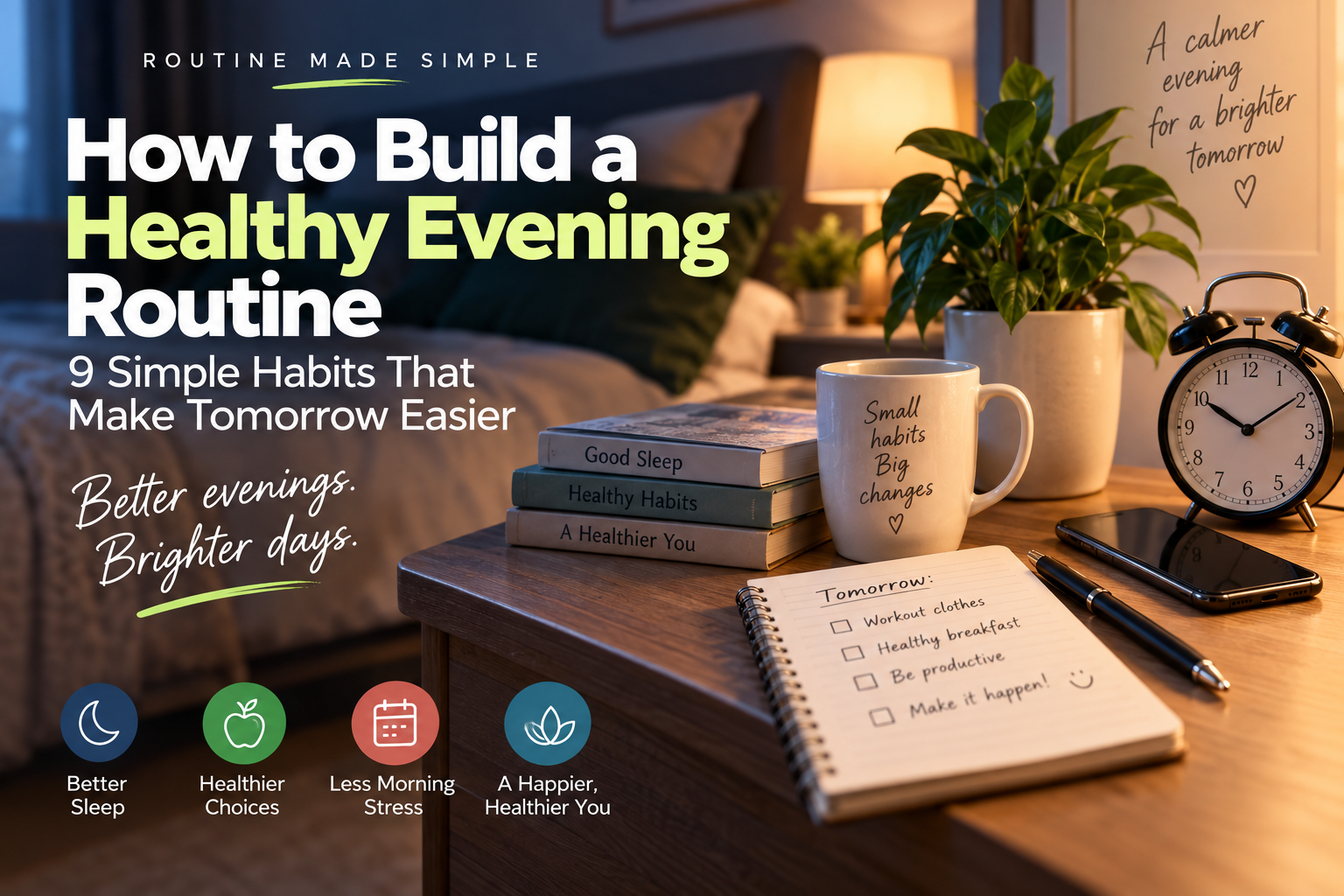
Most people think a healthier lifestyle starts in the morning.
But a surprising amount of what happens tomorrow is decided the night before.
Going to bed too late, leaving everything until morning, scrolling on your phone for another hour or realizing at 10 p.m. that you have nothing ready for tomorrow can make even simple healthy habits harder than they need to be.
A healthy evening routine doesn’t need to involve meditation, journaling, stretching, herbal tea and ten other habits.
It can be much simpler.
The goal is to create a few repeatable actions that help you slow down, prepare for tomorrow and make going to bed at a reasonable time easier.
A good evening routine shouldn’t give you more things to do. It should make tomorrow easier.
Want to make your whole routine simpler?
You don’t need to change everything at once. Our free 7-day guide gives you a simple structure for building better everyday habits one step at a time.
What makes a healthy evening routine?
There isn’t one perfect evening routine that everyone should follow.
Your work schedule, family responsibilities, bedtime and personal preferences all matter.
But useful evening routines usually accomplish three things:
- they reduce unnecessary decisions the next morning
- they help you transition from a busy day toward sleep
- they make important habits easier to repeat
You don’t need to implement everything below.
Start with one or two ideas that solve an actual problem in your evenings.
1. Decide roughly when your day ends
One reason evenings disappear so quickly is that they often have no clear ending.
You finish dinner, check your phone, watch something, answer a message, open your laptop again — and suddenly it’s much later than you intended.
Try choosing a rough time when the active part of your day ends.
It doesn’t need to be exact.
It might simply mean that after 9:30 p.m. you stop working, doing household jobs or starting anything that can easily consume another hour.
Think of it as a boundary rather than a strict schedule.
2. Prepare one thing for tomorrow
You don’t need an elaborate nighttime preparation ritual.
Just remove one obstacle from tomorrow morning.
For example:
- put your workout clothes somewhere visible
- prepare what you’ll wear to work
- pack your bag
- put a water bottle on your desk
- decide what you’ll have for your first meal
These tasks take only a few minutes, but they reduce the number of decisions you have to make when you’re tired or in a hurry.
That matters because healthy habits are usually easier to maintain when the healthier option is also the easier option.
3. Give your kitchen a closing time
This doesn’t mean you’re forbidden from eating after a particular hour.
It’s simply a useful behavioral boundary.
After dinner, clean up the kitchen, put food away and mentally treat eating as finished for the evening unless you’re genuinely hungry.
This can be particularly useful if most of your evening eating happens while watching television, scrolling or simply because food is available.
If nighttime eating is something you struggle with regularly, this guide may help:
How to Stop Eating When You’re Not Hungry: 8 Simple Strategies →
4. Make tomorrow’s food decisions easier
You don’t have to spend Sunday afternoon preparing 20 containers of food to eat better during the week.
A few small decisions the evening before can be enough.
Check what food you already have.
Know roughly what you’ll eat tomorrow.
If you’re taking lunch to work, prepare it or at least make sure the ingredients are ready.
If breakfast tends to be rushed, decide what you’re going to have before you go to bed.
This is especially helpful if you’re trying to lose weight because unplanned meals can easily turn into whatever happens to be quickest or most convenient.
For a more practical approach to this, see:
How to Plan Your Meals for Weight Loss Without Meal Prepping for Hours →
5. Reduce bright light and stimulation before bed
Your body uses light as one of the signals that helps regulate your sleep-wake cycle.
Bright light in the evening — including light from phones, tablets and other screens — can interfere with the normal rise of melatonin that occurs before sleep.
You don’t necessarily have to ban screens completely.
A more realistic approach might be to dim the lights, reduce screen brightness and avoid spending the final part of your evening jumping between emails, news, social media and work.
The goal is simply to give your brain fewer reasons to stay in “daytime mode.”
Learn more about healthy sleep from the CDC →
6. Stop chasing the perfect bedtime
Going to bed at exactly the same minute every night isn’t realistic for many people.
Consistency still helps.
Instead of aiming for a perfect bedtime, try creating a reasonable range.
For example, you might aim to be in bed between 10:30 and 11:00 most nights.
That gives you some flexibility without letting bedtime drift later and later.
For most adults, the CDC recommends at least seven hours of sleep per night, although individual sleep needs vary.
If sleep is affecting your weight-management efforts, we’ve covered that relationship in more detail here:
Sleep and Weight Loss: Why Poor Sleep Makes It Harder →
7. Put your phone somewhere inconvenient
If your phone is next to your pillow, using it requires almost no effort.
That’s exactly the problem.
Try charging it on the other side of the bedroom, on a dresser or somewhere that requires you to physically get out of bed to pick it up.
You can still hear an alarm.
But you’ve added a tiny amount of friction between you and another 30 minutes of scrolling.
Sometimes making an unwanted habit slightly less convenient works better than relying on willpower.
8. Write down tomorrow’s most important task
You don’t need a complicated productivity system.
Before finishing the day, write down the one thing you most want to get done tomorrow.
Not ten things.
One.
If you want, add two smaller tasks underneath it.
This gives tomorrow a starting point and reduces the temptation to begin the morning by reacting to emails, notifications and other people’s priorities.
The same principle works for healthy habits.
If tomorrow’s priority is a walk, put it on the schedule.
If it’s preparing a proper lunch, decide when you’ll do it.
A vague intention is easier to ignore than a specific plan.
9. Make the routine small enough to repeat
This might be the most important point.
Don’t create a 45-minute evening routine that only works when everything goes perfectly.
Build a routine that still works when you’re tired.
For example:
10 minutes before winding down
✓ Put the kitchen in order
✓ Prepare one thing for tomorrow
✓ Write down tomorrow’s main task
✓ Put the phone on charge away from the bed
✓ Dim the lights and slow things down
That’s enough.
If you enjoy reading, stretching, journaling or meditation, you can add them.
But they’re optional.
The basic routine should work without them.
Why simple routines are easier to maintain
Motivation changes from day to day.
A routine reduces how often you need motivation in the first place.
When an action happens in roughly the same context repeatedly, it can become increasingly automatic.
That’s one of the reasons small habits are so useful: they require less effort to repeat consistently.
If you’re trying to build better habits in general, read:
How to Build a Habit Without Relying on Motivation →
A healthy evening routine doesn’t need to look healthy
This is worth remembering.
You don’t need candles, supplements, expensive sleep gadgets or a perfectly organized bedroom.
You also don’t have to spend an hour “working on yourself” every night.
A useful evening routine might simply mean:
clean up → prepare for tomorrow → put the phone away → go to bed.
That may not look impressive on social media.
But if you can repeat it most nights, it’s probably more valuable than an elaborate routine you abandon after a week.
Frequently asked questions
How long should an evening routine be?
There is no required length. A useful routine can take just 10–20 minutes. What matters more is whether you can repeat it consistently without feeling that it has become another chore.
What time should I start my evening routine?
Work backward from your intended bedtime. If you need about 30 minutes to get ready and wind down, begin roughly 30 minutes before you want to be in bed. If your routine is shorter, you may need even less time.
Should I avoid my phone completely before bed?
Not necessarily. If completely avoiding your phone isn’t realistic, try reducing brightness and stimulation and avoid letting a few minutes of scrolling turn into an extra hour awake.
Is it bad to eat at night?
Eating at night isn’t automatically unhealthy. What matters includes what you eat, how much you eat and your overall dietary pattern. If evening snacking regularly adds food you weren’t actually hungry for, creating a kitchen “closing time” can be a useful behavioral strategy.
What is the most important evening habit?
There probably isn’t one habit that is best for everyone. If your sleep schedule is inconsistent, protecting bedtime may have the biggest impact. If your mornings are chaotic, preparing a few things the night before may be more useful.
Healthy evening routine: the bottom line
A healthy evening routine doesn’t need to be complicated.
Its job is to help you finish today and make tomorrow a little easier.
Start small.
Prepare one thing for tomorrow. Give the kitchen a closing time. Reduce stimulation before bed. Put your phone somewhere less convenient. Aim for a reasonably consistent sleep schedule.
Then repeat.
You can always add more later.
But if a simple 10-minute routine works, there’s no reason to turn it into a 45-minute project.
Want to build better habits without overcomplicating your life?
Start with small changes you can actually repeat. Explore more practical guides from Routine Made Simple.
Important: This article is for general educational purposes and is not medical advice. Individual sleep needs and health circumstances vary. If you have persistent problems sleeping or concerns about your health, speak with a qualified healthcare professional.