You start intermittent fasting on Monday.
By Friday, you are already wondering:
When am I supposed to see results?
It is one of the most common questions people have when starting a fasting routine.
And it is understandable.
If you are changing when you eat, dealing with a little extra hunger and trying to build a new routine, you want to know whether the effort is actually doing anything.
But intermittent fasting results rarely follow a perfect timeline.
Some people see the scale move quickly during the first week. Others notice almost nothing at first. Some find that fasting makes eating less much easier, while others simply eat the same amount of food inside a shorter window.
So instead of promising that you will lose a certain number of pounds by a certain date, let’s look at what you can realistically expect after one week, one month and three months — and what actually determines your progress.
In This Guide:
- What Counts as an Intermittent Fasting Result?
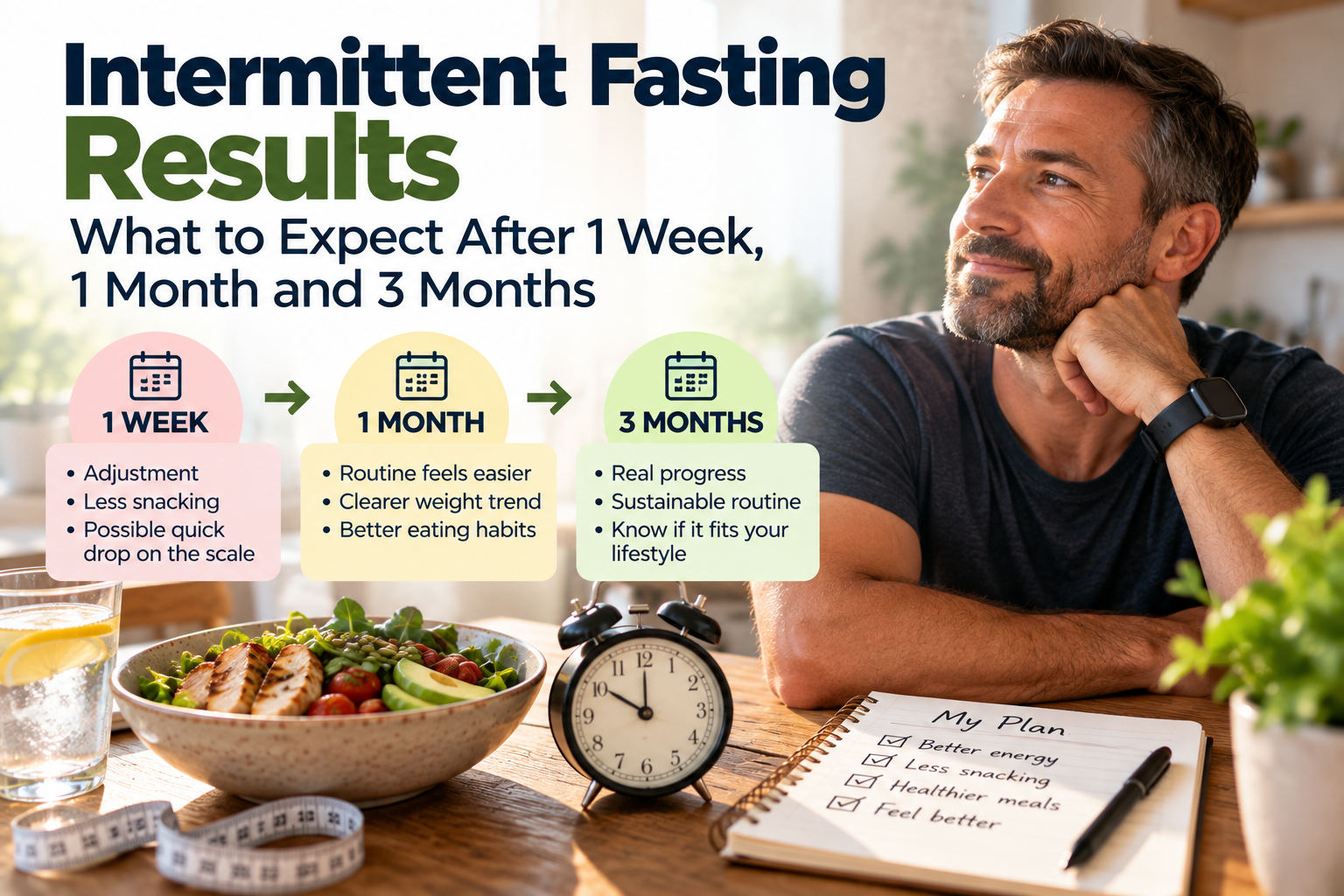
- Intermittent Fasting Results After 1 Week
- Intermittent Fasting Results After 1 Month
- What If Nothing Changes After One Month?
- Intermittent Fasting Results After 3 Months
- How Much Weight Can You Lose?
- How to Get Better Intermittent Fasting Results
- Frequently Asked Questions
First: What Counts as an Intermittent Fasting Result?
Most people immediately think about weight loss.
But that is only one way to evaluate whether a routine is working.
You might also notice:
- less random snacking,
- a more predictable eating schedule,
- better awareness of genuine hunger,
- fewer late-night eating occasions,
- simpler mornings,
- better portion awareness,
- or an eating routine that is simply easier to maintain.
Those changes may eventually support weight management, but they are useful even before the scale changes dramatically.
This is important because intermittent fasting is not a fat-loss switch.
It is primarily a way of organizing when you eat.
Your overall food intake still matters.
Intermittent Fasting Results After 1 Week
The first week is usually more about adjustment than transformation.
If you previously ate breakfast early and continued eating until late at night, suddenly limiting your eating window can feel very different.
Your first intermittent fasting results may therefore have more to do with changes in your routine than dramatic changes in body weight.
You may notice several things.
1. Hunger at Your Usual Eating Times
If you normally eat breakfast at 7:00 AM, your body and your habits expect food around that time.
When you suddenly decide that your first meal will be at 11:00 AM, hunger at 7:30 does not mean fasting is failing.
Your routine has simply changed.
For many people, those hunger patterns become easier to manage as the new schedule becomes familiar.
Our guide on intermittent fasting and hunger explains several practical ways to handle this adjustment.
2. A Quick Change on the Scale
Some people see a surprisingly large drop during their first several days.
Do not automatically assume that all of it represents body fat.
Short-term body weight can change because of water, glycogen, food volume, sodium intake and bowel contents.
That is why the first week’s number should not become your expectation for every following week.
A fast initial change can be motivating.
It is not a reliable prediction of your long-term rate of fat loss.
3. Less Time Spent Thinking About Food
This is one of the underrated benefits of a defined eating window.
If you decide that you are not eating until your planned first meal, you remove several decisions from your morning.
No breakfast decision.
No mid-morning snack decision.
No wondering whether you should eat something simply because food is available.
For some people, that simplicity is immediately useful.
Want a Simple Structure for Your Fasting Routine?
If you like the simplicity of intermittent fasting but want a more structured daily routine, you may also want to explore Unicity Feel Great.
Feel Great combines Unimate and Balance within a simple daily framework that many people pair with a defined eating schedule.
It is not a shortcut around nutrition or a guarantee of weight loss. Your meals, portions and overall energy intake still matter.
We explain the entire system here:
Intermittent Fasting Results After 1 Month
After a month, you have much more useful information.
You are no longer judging the routine based on three good days or one difficult weekend.
You can start looking for patterns.
Your Eating Window May Feel More Normal
At the beginning, an eating window can dominate your thoughts.
You watch the clock.
You calculate how many hours are left.
You wonder whether everything breaks your fast.
After several weeks, the schedule may start feeling much more ordinary.
You simply know approximately when you eat.
That is a useful transition because sustainable habits eventually need to feel normal rather than like a daily challenge.
You Can Evaluate Your Weight Trend
One month is far more useful than one week for evaluating your overall direction.
Do not focus only on the difference between two individual weigh-ins.
Body weight fluctuates.
Instead, look at the trend across several weeks.
If your average weight is gradually decreasing, something in your current routine is creating a consistent enough energy deficit for progress to occur.
If nothing is changing, fasting may not be reducing your overall intake.
At this point, your intermittent fasting results should be evaluated as a trend rather than by comparing two individual days on the scale.
That brings us to one of the most important points in this article.
Fasting Longer Does Not Automatically Mean Losing More Weight
You can fast for 16 hours and still consume more energy than your body uses.
You can also eat breakfast every day and lose weight.
Those statements are not contradictory.
Intermittent fasting determines when you eat.
A calorie deficit determines whether stored body energy needs to be used over time.
Fasting can help some people create that deficit because there are fewer hours available for eating.
But it does not guarantee one.
For a deeper explanation, read Calorie Deficit vs Intermittent Fasting.
Intermittent Fasting Results: What If Nothing Changes After One Month?
Do not immediately make your fasting window longer.
First examine what happens inside the eating window.
Ask yourself:
- Have my portions become larger?
- Am I eating because the window is about to close?
- Do I reward myself for fasting?
- Am I drinking a lot of calories?
- Am I grazing continuously throughout the eating window?
- Do weekends look completely different from weekdays?
A shorter eating window does not help much if it simply compresses the same — or greater — amount of food into fewer hours.
If portions are the problem, see our guide on how to control portion sizes.
If you regularly reach your eating window extremely hungry and then eat far more than intended, read how to stop overeating.
Intermittent Fasting Results After 3 Months
Three months is long enough to ask a different question.
Not:
“Can I survive this diet?”
But:
“Can this actually become part of my normal life?”
That is a much more useful question.
Your intermittent fasting results after three months can tell you much more than the first few days on the scale.
You Should Know Whether the Schedule Fits You
By this point, you have experienced workdays, weekends, restaurants, social events and probably a few days when your schedule did not go according to plan.
You should have a better idea whether 16:8 genuinely suits you.
Maybe it does.
Maybe 14:10 feels much better.
Maybe you prefer fasting only on certain days.
There is no prize for choosing the longest fasting window.
The schedule needs to work in real life.
You Can Judge Progress More Rationally
After three months, individual daily fluctuations matter much less than the overall trend.
You can compare:
- your weight trend,
- waist measurements,
- how your clothes fit,
- your eating habits,
- how often you snack,
- and how manageable the routine feels.
This gives you a much broader picture than one number on the scale.
You May Need to Adjust the Routine
A routine that worked perfectly during the first month may need adjustments later.
That is normal.
Your work schedule changes.
Your social life changes.
Your hunger changes.
Your body weight changes.
Good routines are not rigid.
They are adjustable.
How Much Weight Can You Lose With Intermittent Fasting?
There is no responsible answer that applies to everyone.
Your starting body size, energy intake, activity, food choices, adherence, sleep, medications and many other factors can affect your weight trend.
More importantly, intermittent fasting itself does not determine the exact amount of weight you lose.
If fasting helps you consistently consume less energy than you use, weight can decrease over time.
If it does not change your overall energy balance, simply extending the fasting window will not guarantee weight loss.
This is why dramatic online before-and-after stories should not become your personal deadline.
Research on time-restricted eating also shows why it is better to think in terms of long-term patterns rather than expecting identical results from everyone. You can explore an overview of the research on intermittent fasting from the National Institute on Aging.
How to Get Better Intermittent Fasting Results
You do not necessarily need a longer fast.
You may simply need a better eating window.
Remember that intermittent fasting results depend on the entire routine — not simply the number of hours you spend fasting.
1. Eat Enough Protein
Build your main meals around a useful protein source.
Protein can help make meals more satisfying and is particularly important when you are trying to manage body weight while maintaining lean tissue.
See our practical guide on how to eat more protein.
2. Get Enough Fiber
Vegetables, fruit, beans, whole grains and other fiber-rich foods can add volume and nutritional value to meals.
If your current diet is low in fiber, increase it gradually.
Our fiber guide gives you several easy ways to do that.
3. Don’t Turn the Eating Window Into a Free-for-All
Opening your eating window is not permission to eat everything available.
Eat normal meals.
You do not need to compensate for the hours you spent fasting.
4. Pay Attention to Liquid Calories
Drinks can add substantial energy without feeling like a meal.
Water remains the simplest default beverage.
If you are unsure about fasting beverages, our article on what breaks a fast is a useful reference.
5. Walk More
You do not need an extreme training program to improve your activity level.
Walking is accessible, easy to scale and easier for many people to maintain consistently.
Start with our guide to walking for weight loss.
6. Sleep
A perfect eating window cannot compensate for every other part of your lifestyle.
Poor sleep can make healthy routines harder to maintain and can influence appetite and food choices.
If your evenings are chaotic, our guide on building a healthy evening routine is a good place to start.
Should You Fast Every Day?
You do not have to.
Some people enjoy using approximately the same eating window every day because consistency makes the routine easier.
Others prefer more flexibility on weekends or social occasions.
The important question is whether your approach remains practical over time.
A routine that works most of the time is usually more useful than a perfect schedule that you abandon after two weeks.
What If You Break Your Fast Early?
Nothing dramatic happens.
You ate earlier than planned.
That is all.
You do not need to compensate by fasting excessively the next day.
Return to your normal routine.
This mindset matters because all-or-nothing thinking can turn one imperfect day into an entire week of abandoned habits.
A Simple Way to Track Your First 3 Months
You do not need a complicated spreadsheet.
Once a week, record:
- your average body weight if weight loss is your goal,
- your waist measurement if useful to you,
- your usual eating window,
- how manageable hunger felt,
- how often you ate outside your planned routine,
- and one thing you want to improve next week.
That is enough to identify patterns.
The goal is not to generate more data.
The goal is to make better decisions.
Frequently Asked Questions
When Should You Expect Intermittent Fasting Results?
You may notice changes in your eating routine within the first week, while meaningful weight trends generally require more time to evaluate. Short-term scale changes can reflect water and other factors, so several weeks of consistent data are more informative than a few days.
Why Am I Not Losing Weight on 16:8 Fasting?
A 16:8 schedule does not guarantee a calorie deficit. Large portions, frequent eating during the window, calorie-containing drinks and weekend habits can all result in an overall intake that maintains your current body weight.
Is 16:8 Better Than 14:10?
Not automatically. A 14:10 schedule you can comfortably maintain may be more useful than a 16:8 schedule that repeatedly leads to extreme hunger and overeating.
Can I Take Weekends Off From Intermittent Fasting?
You can use a more flexible schedule if that makes the routine sustainable. What matters is the overall pattern rather than achieving a perfect fasting streak.
Do I Need Supplements for Intermittent Fasting?
No. Supplements are not required to practice intermittent fasting. Some people choose products that fit their routine, but fasting itself simply refers to periods of eating and not eating.
Want to Make the Routine Easier?
The best intermittent fasting plan is not the most aggressive one. It is the one you can repeat consistently.
If you are just starting, use our free guide to build a simple 16:8 routine. If you already understand fasting and want to explore a more structured system, see how Unimate and Balance fit into the Feel Great approach.
Intermittent Fasting Results: The Bottom Line
Your first week of intermittent fasting is mostly an experiment.
Your first month starts revealing patterns.
And after three months, you should have a much clearer idea whether the routine genuinely fits your life.
Do not judge success only by how long you can avoid food.
Look at the bigger picture.
Are your meals better?
Are you snacking less?
Are your portions more manageable?
Is your weight moving in the direction you want?
And most importantly:
Can you imagine eating this way six months from now?
Because sustainable intermittent fasting results come from a routine you can repeat — not from winning a competition for the longest fasting window.
Important: This article provides general educational information and is not individualized medical or nutritional advice. Intermittent fasting is not appropriate for everyone. If you are pregnant or breastfeeding, have diabetes, take medications affected by food intake, have a history of an eating disorder, or have another medical condition, discuss fasting with an appropriate qualified healthcare professional before changing your eating schedule.