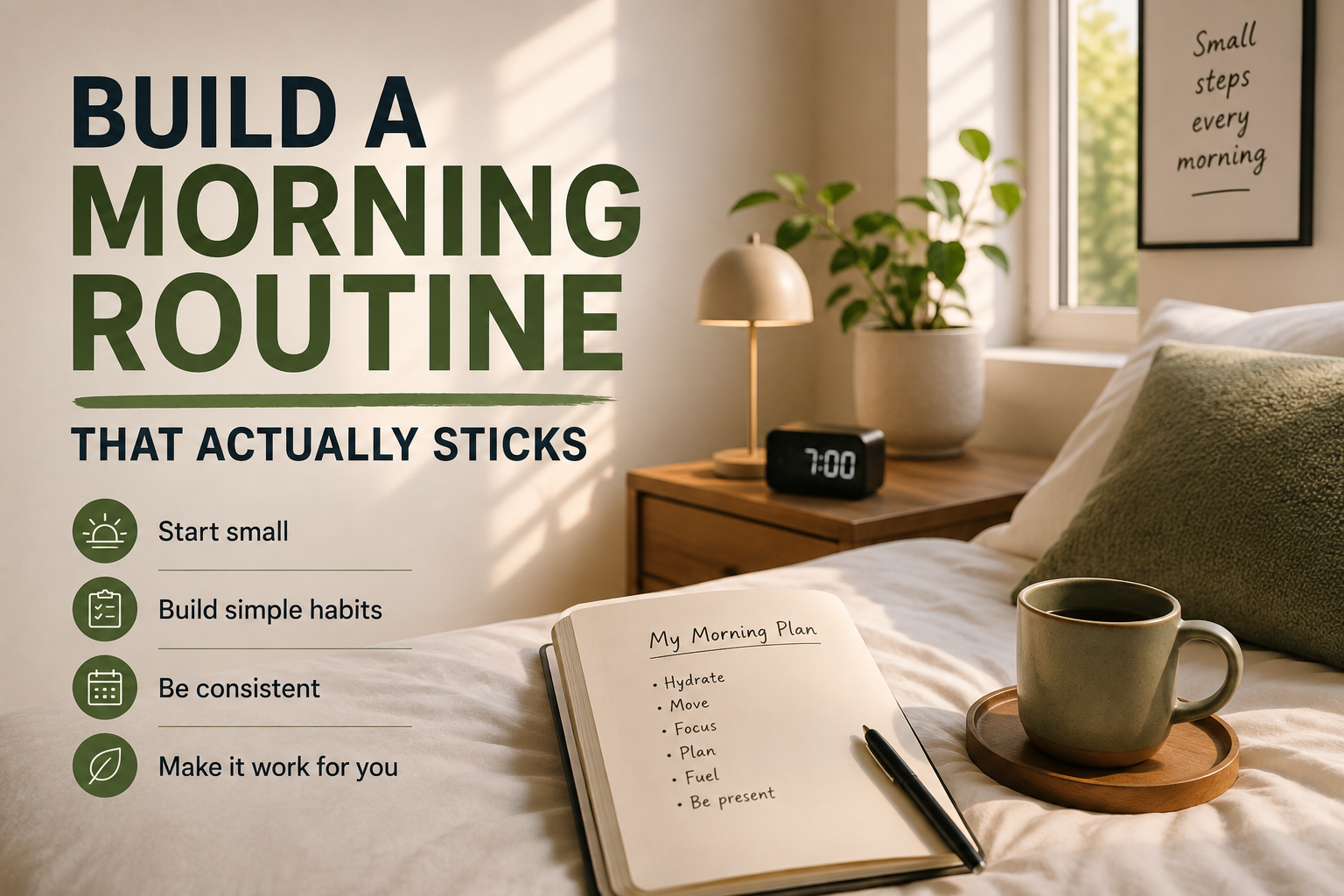
If you have ever tried to copy someone else’s “perfect” morning routine, you probably know how quickly it can become exhausting.
Wake up at 5 a.m. Exercise. Meditate. Journal. Read. Drink something healthy. Plan the entire day. Avoid your phone. Prepare breakfast. Somehow do all of it before work.
It sounds productive. But for many people, it is simply too much.
If you want to learn how to build a morning routine that actually lasts, the goal is not to fill your morning with more tasks. The goal is to create a small, predictable sequence that makes the beginning of your day easier.
A useful morning routine should fit your real life — including busy mornings, imperfect sleep and days when motivation is low.
How to Build a Morning Routine That Actually Works
The simplest way to think about a morning routine is this:
Choose a few useful actions, put them in an easy order and repeat them often enough that they require less thought.
You do not need ten habits.
You do not need an hour.
And you definitely do not need to wake up at 5 a.m. unless that schedule genuinely works for you.
For most people, a routine built around three or four repeatable actions is a much better starting point.
1. Start With the Morning You Already Have
Before changing anything, look at what currently happens after you wake up.
Ask yourself:
- What time do I normally get up?
- How much time do I actually have?
- What do I already do automatically?
- What usually makes my morning stressful?
- Which decisions do I keep making every morning?
This matters because your routine has to fit into your existing life.
If you normally get up at 6:45 and leave home at 7:30, designing a 75-minute morning routine is probably not realistic unless you are also willing to change your sleep schedule.
Instead of designing your ideal morning first, improve the morning you already have.
2. Choose One Habit You Already Do Every Morning
Building a routine becomes easier when you connect a new behavior to something that already happens automatically.
For example:
Wake up → drink water
Brush teeth → get dressed
Start the coffee maker → look at today’s schedule
The first behavior gives the next one a natural place in your day.
This is much easier than relying on yourself to remember five completely new habits every morning.
Research on habit formation supports this approach: repeating a behavior in a stable context can strengthen automaticity and make the behavior easier to repeat over time. You can read the habit-formation research published in Frontiers in Psychology for a deeper look at how stable contexts influence habit development.
3. Make Your First Morning Routine Small
One of the easiest ways to make a routine fail is to add too much too quickly.
A new morning plan often starts looking something like this:
- drink water,
- stretch,
- meditate,
- write in a journal,
- exercise,
- read for 20 minutes,
- prepare a healthy breakfast,
- plan the day,
- and avoid your phone.
None of those habits is necessarily a bad idea.
The problem is trying to create all of them at once.
Instead, begin with two or three actions.
For example:
Wake up → drink water → get ready → check today’s priorities.
That is already a morning routine.
Once it becomes easy, you can decide whether adding something else would genuinely improve your morning.
4. Reduce Friction Wherever You Can
A good routine should require as little negotiation with yourself as possible.
If you want to drink water after waking up, keep water where it is convenient.
If you want to walk in the morning, prepare your shoes and clothes the night before.
If you want to take lunch to work, prepare most of it before going to bed.
If you want to review your priorities, leave your notebook or calendar somewhere you will naturally see it.
Small environmental changes can make a habit much easier to repeat.
The question is not only:
“What habit should I build?”
Also ask:
“How can I make this habit easier to do?”
5. Make Hydration Easy, Not Complicated
Drinking some water in the morning is one of the simplest habits you can add to a routine.
There is no need to turn it into another complicated rule.
You do not need a special type of water or an exact amount immediately after waking up.
Simply having water available and drinking according to your needs can be enough.
If you are unsure how much fluid you need across the entire day, our guide to how much water you should drink a day explains why there is no single perfect amount for everyone.
6. Decide What Your Phone Is Allowed to Do
For many people, the first real morning routine is already established:
Wake up → pick up phone → start scrolling.
The problem is not that looking at a phone automatically ruins your morning.
The problem is that opening one notification can quickly become email, social media, news, messages and twenty minutes of scrolling.
You do not necessarily need a dramatic “no phone before noon” rule.
A smaller boundary may be much easier to maintain.
For example:
- No social media until I am dressed.
- Complete my first three morning habits before opening apps.
- Check messages, but not social media.
- Keep the phone away while preparing breakfast or a morning drink.
A specific rule is usually easier to follow than simply telling yourself to “use the phone less.”
7. Choose a Morning Drink That Fits Your Routine
Many people naturally build part of their morning around a drink.
That might be:
- water,
- coffee,
- tea,
- or yerba mate.
There is no need to search for a magical morning beverage.
What matters more is whether it fits comfortably into the rest of your routine.
If you use yerba mate, our guide to yerba mate benefits looks at caffeine, energy, focus and some of the practical things worth considering.
If you also practice intermittent fasting, your choice may depend on whether the drink contains calories or added ingredients. We have separate guides on black coffee and fasting, tea and fasting and what you can drink while intermittent fasting.
8. Build the Routine Around Your Energy, Not Someone Else’s
Morning routines are often presented as productivity competitions.
But waking up earlier does not automatically make a routine better.
Neither does doing more.
Ask a more useful question:
What helps me feel ready for my actual day?
For one person, that could be ten minutes of walking.
For another, it might be a quiet cup of coffee before the household wakes up.
Someone else may need to prepare food, organize children or simply avoid rushing out of the door.
The best routine is not the one that looks impressive online.
It is the one that makes your own morning easier to manage.
9. Prepare Part of Your Morning the Night Before
One of the most effective ways to simplify the morning is to move some decisions into the evening.
You could:
- prepare your clothes,
- fill a water bottle,
- prepare lunch,
- put your keys where you can find them,
- write down tomorrow’s most important tasks,
- or prepare anything you regularly need in the morning.
Each decision you remove gives you one less thing to think about after waking up.
This is particularly useful if you regularly feel rushed in the morning.
10. Create a Minimum Version of Your Morning Routine
When learning how to build a morning routine that lasts, it helps to have a backup plan for mornings when you have less time or energy.
This is one of the most useful strategies for making a routine sustainable.
Have two versions:
Your normal routine.
And:
Your minimum routine.
Your normal routine might be:
Water → 10-minute walk → shower → morning drink → review the day.
But on a difficult morning, your minimum version might simply be:
Water → get ready → check today’s schedule.
Maybe it takes three minutes.
That is completely fine.
The purpose is to avoid the all-or-nothing mindset where a routine only “counts” if you complete every step.
Real routines need to survive busy days.
11. Do Not Try to Make Every Morning Identical
Consistency does not mean your morning has to look exactly the same every day.
Your weekday routine may be different from your weekend routine.
A workday may require a shorter version.
A quiet Sunday may give you more time.
Travel, poor sleep, family responsibilities and unexpected events will occasionally change your plans.
That does not mean your routine failed.
A useful routine has enough structure to guide you and enough flexibility to survive normal life.
12. Don’t “Start Again on Monday”
Missing one morning is not the problem.
The problem is often what happens next.
One missed day becomes:
“I’ll start again Monday.”
Then Monday becomes next week.
Instead, simply return to your normal routine the next morning that makes sense.
You do not need a fresh start.
You just need the next repetition.
A Simple 10-Minute Morning Routine
If you have no routine at all and want somewhere simple to begin, try this:
Minutes 0–2: Get up and drink some water.
No complicated preparation. Just start the day.
Minutes 2–5: Wash, get dressed or do whatever signals that your morning has started.
This creates a clear transition between sleeping and starting the day.
Minutes 5–8: Prepare your usual morning drink.
That may be coffee, tea, yerba mate or simply more water.
Minutes 8–10: Look at your day.
Identify one or two things that genuinely matter.
That’s it.
You can add movement, breakfast, reading, journaling or something else later if it helps you.
But you do not need any of those things to have a useful morning routine.
What If You Practice Intermittent Fasting?
Your morning routine does not have to include breakfast.
If you use a time-restricted eating schedule such as 14:10 or 16:8, your morning may fall entirely inside your fasting window.
That can actually make the routine fairly simple:
Wake up → water → morning drink → get ready → start the day.
If you are new to fasting, our beginner’s guide to intermittent fasting explains how to start with a realistic eating window rather than immediately trying to make the fast as long as possible.
And if you are unsure how long your fasting window should be, see how long you should fast for a comparison of 12-, 14-, 16- and 18-hour schedules.
Where Feel Great Can Fit Into a Simple Morning Routine
A structured product routine can also be easier to maintain when it has a predictable place in the day.
For people who use the Feel Great system, Unimate is commonly placed earlier in the day, while Balance is used around meals according to the current product directions.
That means the practical benefit of planning is not adding more decisions to the morning. It is doing the opposite.
You know what belongs in the morning, what belongs around meals and what does not need to be reconsidered every day.
For a clearer explanation of the two products and their different roles, see Unimate and Balance: Two Different Roles in a Practical Feel Great Routine.
Supplements should remain part of the larger routine rather than replacing basic habits such as appropriate nutrition, hydration, sleep and regular movement.
What About Morning Hunger and Sugar Cravings?
Not every difficult morning is a motivation problem.
Sometimes the issue is hunger, poor sleep, an inconsistent eating schedule or simply having highly tempting foods nearby.
If sweet foods are particularly difficult to manage, our guide on how to stop sugar cravings covers practical ways to make them easier to handle without relying on strict bans.
The same principle applies here: make the environment work with you instead of expecting willpower to solve everything.
How Long Does It Take to Build a Morning Routine?
There is no universal number of days after which a morning routine suddenly becomes automatic.
Some simple behaviors become easier quickly. Others take much longer.
Instead of focusing on a specific number of days, look for a more practical sign:
Does the routine require less thought than it did when you started?
If you automatically drink your water, prepare your morning drink or check your schedule without debating whether to do it, the routine is becoming more established.
That is more useful than trying to reach an arbitrary deadline.
Common Morning Routine Mistakes
If your routine keeps disappearing after a few days, one of these problems may be responsible:
- Adding too many habits at once. Start with fewer actions.
- Copying someone else’s schedule. Build around your own responsibilities.
- Relying on motivation. Make useful behaviors easier to perform.
- Expecting perfection. Create a minimum version for difficult days.
- Changing everything after one bad morning. Simply return to the routine.
- Making the routine too long. A short routine can still be effective.
The Bottom Line
Learning how to build a morning routine is not about creating the most impressive start to the day.
It is about creating a morning that requires fewer unnecessary decisions.
Start with the schedule you already have.
Choose a few useful actions.
Make them easy to repeat.
Prepare what you can in advance.
Have a shorter version for difficult mornings.
Then keep going.
You can always improve your routine later.
First, build one simple enough that you can actually keep it.