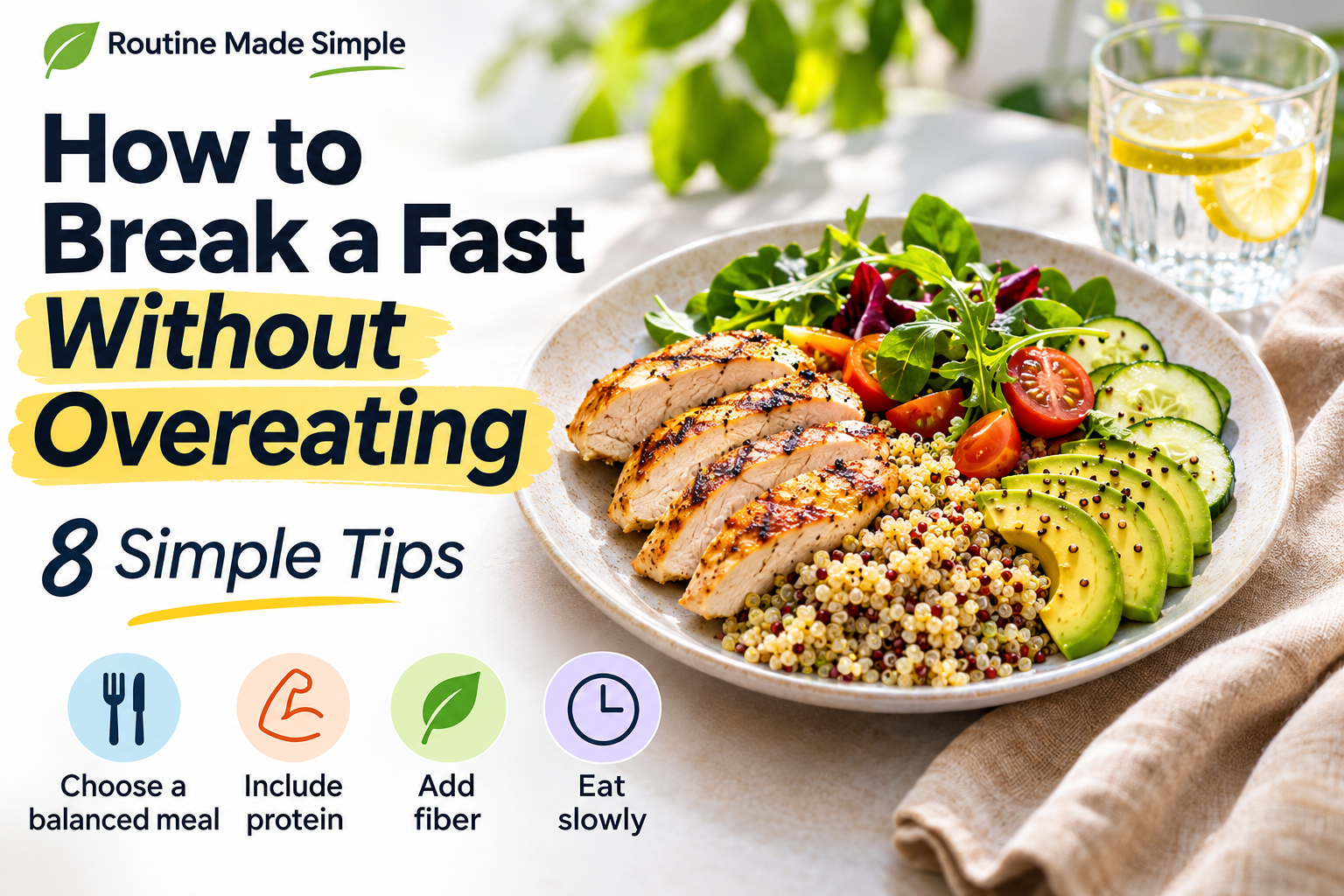
How to Break a Fast Without Overeating: 8 Simple Tips
You’ve been fasting for 16 hours. Lunch is finally here, and suddenly everything in the kitchen looks delicious.
You planned to have a normal meal. But before you know it, you’ve finished your plate, grabbed something sweet, and started looking for another snack.
Sound familiar?
One of the challenges of intermittent fasting isn’t necessarily going without food. Sometimes, it’s knowing what to do when it’s finally time to eat.
The good news? Learning how to break a fast without overeating doesn’t require complicated meal plans, expensive foods, or another set of strict rules.
A few practical changes can make your first meal more satisfying and your fasting routine easier to maintain.
How to Break a Fast Without Overeating: The Short Answer
The simplest way to break a fast without overeating is to eat a balanced, satisfying meal, include protein and fiber, slow down while eating, and avoid arriving at your first meal excessively hungry.
For most healthy adults following a typical 14:10 or 16:8 intermittent fasting schedule, there’s no need for a special food or complicated ritual to end the fasting window.
What matters is choosing an appropriate meal, eating enough to feel comfortably satisfied, and finding a routine you can repeat.
And here’s something worth remembering: being hungry after fasting is normal. Feeling that you must ignore your hunger isn’t a requirement for success.
Why Do People Sometimes Overeat After Fasting?
Imagine you’ve skipped breakfast, worked through a busy morning, and finally sit down for lunch at 1 p.m.
You’re distracted, hungry, and in a hurry. You eat quickly, barely notice the meal, and then wonder why you’re still looking for something else.
There are several possible explanations:
- Your fasting window may be longer than you’re comfortable with.
- You may not be eating enough throughout the day.
- Your first meal may contain too little protein or fiber.
- You may be eating too quickly to notice changing fullness signals.
- Poor sleep or stress may be affecting your appetite.
- Restrictive food rules may make certain foods feel unusually tempting.
None of this means you’re lacking willpower.
Hunger is influenced by physiology, food choices, daily routines, sleep, and individual circumstances. A fasting schedule that consistently leaves you ravenous may simply need adjusting.
8 Practical Tips to Break a Fast Without Overeating
1. Know What You’re Going to Eat Before Your Fast Ends
Making food decisions when you’re extremely hungry isn’t always easy.
That’s why a little planning can help.
You don’t need to prepare seven days of meals or fill your refrigerator with perfectly organized containers.
Simply decide what your first meal will be before your eating window opens.
For example:
- Scrambled eggs, whole-grain toast, and tomatoes.
- Chicken, rice, and roasted vegetables.
- Greek yogurt, oats, berries, and nuts.
- A lentil bowl with vegetables and olive oil.
These are ordinary meals made from familiar ingredients.
Having a plan reduces the chance of grabbing whatever happens to be closest when you’re hungry.
2. Make Protein Part of Your First Meal
Protein plays an important role in maintaining muscle and contributes to satiety.
Including a source of protein in your first meal can help make that meal more satisfying.
Good options include:
- Eggs
- Chicken or turkey
- Fish
- Greek yogurt
- Tofu or tempeh
- Beans and lentils
- Cottage cheese
You don’t need to calculate an exact amount of protein every time you sit down to eat.
Start with a simpler question: Does this meal contain a meaningful source of protein?
If not, consider adding one.
For more practical ideas, read our guide to how to eat more protein without overcomplicating your diet.
3. Include Fiber-Rich Foods
Fiber is another useful part of a satisfying meal.
Foods containing fiber can add volume, support digestive health, and contribute to fullness.
Some easy choices are:
- Vegetables
- Beans and lentils
- Oats
- Whole grains
- Berries and other fruit
- Nuts and seeds
For example, chicken and rice can be a perfectly reasonable lunch. Adding a generous portion of vegetables makes the meal more varied and provides additional fiber.
There’s no need to change everything overnight.
If your current diet is low in fiber, increase your intake gradually and drink adequate fluids.
Our article on how to get enough fiber offers more simple food ideas.
4. Start With a Reasonable Portion, Not the Smallest Possible One
Here’s a mistake that’s easy to make.
You’ve fasted for 16 hours, so you decide your first meal should be as small as possible to maximize your calorie deficit.
Twenty minutes later, you’re hungry again.
Now you’re searching for snacks, wondering why intermittent fasting feels so difficult.
The problem may not be your self-control. Your meal may simply have been too small.
A practical starting point is a balanced plate containing:
- A source of protein
- Vegetables or fruit
- A source of carbohydrates
- Some healthy fat
Adjust the amounts according to your appetite, activity level, nutritional needs, and goals.
You can learn more in our guide to controlling portion sizes without counting calories.
5. Slow Down and Actually Enjoy Your Meal
When you’re hungry, it’s tempting to eat quickly.
Especially if you’ve been thinking about lunch since 10 a.m.
But eating at a comfortable pace gives you more opportunity to notice how your hunger and fullness are changing.
Try a few simple habits:
- Sit down rather than eating while standing in the kitchen.
- Put your phone aside when possible.
- Take time to taste your food.
- Pause occasionally and notice how satisfied you feel.
You don’t need to count every bite or chew each mouthful a specific number of times.
And there’s no magic number of minutes that guarantees you won’t overeat.
The goal is simply to make eating a little less automatic.
6. Don’t Treat Food as a Reward for Fasting
This one is more about mindset than nutrition.
It’s easy to think:
“I’ve been good all morning. I deserve something special.”
But fasting isn’t a punishment, and eating isn’t a prize.
There’s nothing wrong with enjoying dessert or your favorite food. The problem starts when every fasting window becomes something you feel you need to compensate for with a large meal.
Try looking at your fasting and eating windows as two ordinary parts of your routine.
Neither needs to be perfect.
And one larger meal doesn’t mean you’ve failed.
7. Consider Whether Your Fasting Window Is Too Long
Sometimes the best solution to overeating after fasting is surprisingly simple:
Make the fasting window shorter.
If you’re following 18:6 and regularly arrive at your first meal feeling excessively hungry, a 16:8 or 14:10 schedule may be easier to maintain.
Longer fasting windows aren’t automatically better for weight loss.
For many people, the main advantage of intermittent fasting is that a consistent eating schedule makes overall food intake easier to manage.
If a longer fast leads to repeated overeating, fatigue, or difficulty eating enough nutritious food, it may not be serving that purpose.
Read our comparison of 12-, 14-, 16-, and 18-hour fasting schedules for a closer look at different eating windows.
8. Think Beyond Your First Meal
Learning how to break a fast without overeating also means looking at what happens during the rest of your eating window.
Let’s say your 16:8 schedule runs from noon until 8 p.m.
You don’t have to squeeze your entire day’s nutrition into one enormous lunch.
Depending on your needs and preferences, your day might include:
- 12:00 p.m. — A balanced lunch
- 3:30 p.m. — An optional snack if you’re hungry
- 6:30 p.m. — A satisfying dinner
- 8:00 p.m. — Your fasting window begins
That’s just an example, not a schedule everyone must follow.
The important part is getting appropriate nutrition throughout the day and choosing a routine that works with your life.
What Should You Eat After a 16-Hour Fast?
For most healthy adults practicing everyday 16:8 intermittent fasting, a normal, balanced meal is generally an appropriate way to end the fasting window.
There’s no need to start with a special drink, a particular fruit, or an elaborate sequence of foods.
Here are three practical examples.
Example 1: A Simple Lunch
- Grilled chicken or tofu
- Rice or potatoes
- A generous serving of vegetables
- Olive oil or another source of healthy fat
Example 2: A Quick Breakfast-Style Meal
- Two eggs or another suitable protein portion
- Whole-grain toast
- Tomatoes or other vegetables
- Fruit on the side
Example 3: Something You Can Prepare in Five Minutes
- Plain Greek yogurt
- Oats
- Berries
- A handful of nuts or seeds
The right portion depends on your individual needs. These examples aren’t fixed meal prescriptions.
For more ideas, see our existing article What to Eat After a Fast: A Simple Guide to Your First Meal.
Can Intermittent Fasting Help You Manage Your Appetite?
It can help some people, but the experience isn’t the same for everyone.
Some find that a consistent eating window reduces unplanned snacking and makes meals easier to organize.
Others experience more hunger, especially when the fasting period is too demanding or their meals don’t provide enough nutrition.
Research suggests intermittent fasting can be a useful approach to weight management for some adults, but it doesn’t consistently outperform conventional calorie restriction.
That distinction matters.
The goal isn’t to fast for as many hours as possible. It’s to find an eating pattern that supports your health and can be maintained over time.
Where Does Feel Great Fit Into This Routine?
Some people find that having a consistent daily structure helps them stick to their eating habits.
That’s also the idea behind the Unicity Feel Great program, which combines intermittent fasting with two products: Unimate and Balance.
Unimate is a yerba mate-based drink mix commonly used earlier in the day.
Balance is a fiber-based drink mix generally used before meals according to the product instructions.
Dietary fiber can contribute to fullness and has established roles in digestive and metabolic health. However, those general findings shouldn’t be treated as proof that Balance prevents overeating or that the complete Feel Great program produces a specific weight-loss result.
Neither product replaces balanced meals, adequate nutrition, or an appropriate overall energy intake.
Curious About the Feel Great Routine?
If you’re looking for a structured approach to intermittent fasting, you can explore how Unimate and Balance fit into the Feel Great program.
We’ve also included a free introductory guide to help you understand the routine before deciding whether it’s right for you.
Explore Feel Great + Free Guide
Affiliate disclosure: Routine Made Simple is operated by an independent Unicity distributor. We may receive compensation from qualifying purchases made through our referral links, at no additional cost to you. Individual experiences and results vary.
What If You’re Still Hungry After Breaking Your Fast?
First, don’t assume you’ve done something wrong.
Hunger after eating can happen for several reasons.
Your meal may have been too small. It may have lacked protein or fiber. You may have slept poorly, eaten quickly, or simply need more food that day.
If this happens regularly, look at the bigger picture rather than immediately trying to suppress your appetite.
Ask yourself:
- Am I eating enough throughout the day?
- Does my first meal contain protein and fiber?
- Am I getting adequate sleep?
- Is my fasting schedule comfortable and realistic?
- Am I eating because I’m hungry, or because I’m distracted or stressed?
Our article Why Am I Still Hungry After Eating? 7 Common Reasons explores this topic in more detail.
What Does the Research Say?
Research on intermittent fasting has examined its effects on body weight, metabolic health, and different eating schedules.
The overall picture is more nuanced than many social media posts suggest.
Intermittent fasting may help some people manage their weight, particularly when it makes their eating habits easier to organize or reduces overall energy intake.
However, studies don’t establish that everyone needs a 16-hour fast, that longer fasts always produce better results, or that a specific food must be eaten first.
For more background, these medical and public health resources are useful starting points:
- Johns Hopkins Medicine: Intermittent Fasting — What Is It, and How Does It Work?
- National Institute of Diabetes and Digestive and Kidney Diseases: Healthy Eating and Physical Activity for Life
These resources provide general background on fasting and healthy eating. They are not direct clinical proof that any particular one of the eight tips prevents overeating.
Frequently Asked Questions About Breaking a Fast
How do you break a fast without overeating?
To break a fast without overeating, plan a balanced first meal, include protein and fiber, eat at a comfortable pace, and choose a portion that satisfies your hunger. If you’re consistently excessively hungry, consider whether your fasting window or overall food intake needs adjusting.
Should I eat a small meal after a 16-hour fast?
Not necessarily. Most healthy adults don’t need a specially restricted first meal after a routine 16-hour fast. A normal, balanced meal is generally reasonable. Choose an amount that suits your appetite and nutritional needs.
Is it bad to eat a large meal after fasting?
One large meal doesn’t automatically undo your progress. However, regularly eating beyond comfortable fullness may cause digestive discomfort and make weight management more difficult. Your overall eating pattern matters more than one meal.
Can I break my fast with fruit?
Yes. Fruit can be part of your first meal. Combining it with foods such as yogurt, eggs, nuts, or another protein source can help create a more balanced and satisfying meal.
Should I eat protein or carbohydrates first?
For most healthy adults, there’s no requirement to eat foods in a particular order after a routine 16-hour fast. Meal composition and overall nutrition are generally more important than following a rigid sequence.
Does overeating after fasting cancel the benefits?
Not automatically. But intermittent fasting doesn’t override energy balance. If your goal is weight loss, regularly consuming more calories than your body uses can prevent progress, regardless of your fasting schedule.
What if I feel dizzy or shaky while fasting?
Don’t ignore dizziness, shakiness, faintness, or unusual weakness to complete a fasting target. Stop fasting and seek appropriate medical advice. People with diabetes or those taking glucose-lowering medication need particular caution because fasting can increase the risk of low blood sugar. Severe symptoms require urgent medical attention.
The Bottom Line: Keep Your First Meal Simple
Learning how to break a fast without overeating doesn’t mean following a perfect meal plan or avoiding every food you enjoy.
It’s about making your first meal satisfying, paying attention to hunger, and finding a fasting schedule that works with your daily life.
Start with protein and fiber-rich foods. Eat enough. Slow down when possible. And don’t make your fasting window more restrictive than it needs to be.
If you occasionally eat more than planned, there’s no need to compensate by fasting longer the next day.
Simply return to your normal routine.
Because the best routine isn’t the one you follow perfectly for three days. It’s the one you can comfortably maintain for months.
Important health information: This article is intended for general educational purposes and focuses on routine daily intermittent fasting, not prolonged fasting. Fasting may be unsuitable for some individuals, including minors, pregnant or breastfeeding people, those with a history of eating disorders, and people with certain medical conditions. Anyone with diabetes or taking medication that affects blood glucose should consult a qualified healthcare professional before fasting. Prolonged fasting can involve additional risks, including refeeding complications in susceptible individuals. This content is not a substitute for personalized medical advice.